Mark D. White

Writer, editor, teacher

  • Typepad, the former home of this site/blog (as well as Economics and Ethics and The Comics Professor) is shutting down at the end of September, so I will be moving whatever I can from these blogs to WordPress. (The uncertainty is due to the fact that most all of my content seems to have disappeared from Typepad already, and I am not hopeful about getting it back.)

    Regardless of how much content I can reclaim, I will be rebuilding my main site here over the coming months, at the very least restoring all the information about my books and other activities. (As with everyone else, there is a lot going on, and I did not plan for this.)

    UPDATE: The Typepad content did reappear and I have transferred it to this blog. Now the work of reformatting begins, starting with classifying the posts from the three blogs and restoring the old “pages” (which were transferred over as posts).

  • FF group shot
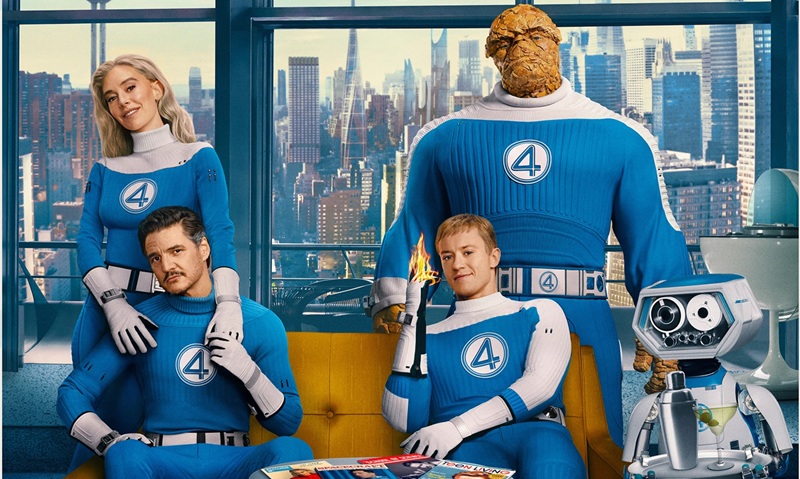
    I have to tell you, I wasn't sure what to expect from The Fantastic Four: First Steps. The history of Marvel's first family on film has been more than rocky, what with the Roger Corman boondoggle (financially if not creatively) in 1994, the two entertaining but lightweight attempts in the 2000s (which I liked more than many, it seems), and the atrocious 2015 version ('nuff said).

    Ten years on, we finally get Marvel Studios' first swing of the bat… and I'm happy and relieved to say it was a home run. I'll start with general, spoiler-free comments, and then get into plot details below the fold.

    As the trailers and preview footage made clear, the tone and palette of The Fantastic Four: First Steps is overall decidedly light. It takes place in a retro-futuristic 1960s-ish world—with very little Kirby aesthetic to it, though, which was a little disappointing—the first sign that this is not a typical MCU movie. (Literally: it takes place on Earth 828, as shown in the opening shot, and the meaning of which is revealed at the very end.) This movie had a refreshing earnestness about it, with no Whedonesque pop culture references or snarky sarcasm, but rather warm humor that makes you chuckle rather than gasp. (Think Cheers rather than Curb Your Enthusiasm.) This is not to say the story had no drama or stakes: indeed, the light tone established in the beginning contrasted very well with the impending arrival of Galactus (as well as other tragic events later in the film).

    My main interest was in the portrayal of the Fantastic Four members, and each of the four was spot on, referencing their classical character traits as established in the comics (and described in my book). Here are my spoiler-free thoughts on each (with more detail to come below):

    • Reed Richards (Pedro Pascal) balances optimism with an outsized sense of responsibility, not just for the accident that changed all their lives but also for the world he feels he has to protect. Pascal's quiet, reserved portrayal of Reed never lets you forget he feels the weight of the world on his shoulders, which helps excuse the occasional cluelessness that has earned him some scorn from comics readers over the years.
    • Sue Storm-Richards (Vanessa Kirby) proves herself to be the powerhouse of the team, both in terms of physical force as well as force of will. Her focus is on family, both in terms of the birth of their son Franklin as well as their community—as Reed said recently in the comics, her true superpower, contrasting nicely with her invisibility, is the ability to make people feel seen, and that is on full display here.
    • Johnny Storm (Joseph Quinn) thankfully avoids the caricature of the brash and egotistical hothead, instead being playful but not goofy, with the maturity to know when to joke and when to be serious. Thankfully, he shows both his intelligence and heroism here, and avoids being the hapless comic relief (or slobbering horndog).
    • Ben Grimm (Ebon Moss-Bachrach)… what can I say. I almost broke down the first time the Thing appeared on screen, even though I'd seen the shot numerous times in trailers, because the ever-lovin' blue-eyed Thing is finally on screen in all his glory. Through the CGI, Moss-Bachrach embodies Ben's simmering ennui over his situation, happy to be a part of the family when they're together but distinctly lonely and despondent while wandering on old stomping grounds on Yancy Street. (There wasn't as much emphasis on Ben's self-loathing as I had hoped, but there wasn't a lot of time for it; the movie was very tightly paced, and most of it saw the group dealing with Galactus.)

    Even H.E.R.B.I.E. was adorable—how's that for impressive?

    Let me say a word also about Shalla-Bal, the Silver Surfer played by Julia Garner. Anyone who's seen Garner in Ozark or The Assistant knows what she can do, and she brought her combination of steely intensity and breathtaking sensitivity to this role—and in silver "paint," no less. (I guess that's the modern version of "backwards and in heels," as Ginger Rogers was described while matching Fred Astaire step for step.) And for anyone in a tizzy over the "gender swap," there is a plot rationale for that (which I'll talk about below the fold).

    Before I get to spoilers, let me sum up by saying this is not only the best FF film to date (by far), it is one of the best superhero films ever. It simply hit all the right notes: inspiring heroism, devastating tragedy, and jokes that made you smile. There were no concessions to overriding cynicism or despair, just legitimate concern and pathos where appropriate. The cast embodied their roles completely, in the same way that Robert Downey Jr., Chris Evans, and Chadwick Boseman became Tony Stark, Steve Rogers, and T'Challa (respectively). 

    SPOILERS BELOW THE FOLD

    (more…)

  • Morning scene
    After our commencement exercises yesterday, my 27th year at the College of Staten Island is over; as of June 30, my 14th and final year as department chair will be over as well. (Although my able successor officially takes over on July 1, I will continue as summer department chair until the fall semester begins on August 25.) At that point, I will have three more years to go until I retire, but they will be three years of teaching and routine committee work, which I anticipate being a tremendous relief from the responsibilities of being chair (which grew much more onerous and frustrating over the last few years).

    My main publication activity this semester was my book Ethics of the Fantastic Four, which came out earlier this month (as reported in my last post). Now that the semester is over, I will return to my other book projects, which my very patient and understanding editors, to whom I remain eternally grateful, eagerly await.

    Online, I published a series of posts about Captain America (Sam Wilson) at Psychology Today based on material in the second edition of The Virtues of Captain America (published last summer), to coincide with the release of the film Captain America: Brave New World in February:

    I also published two new posts about the show Daredevil: Born Again in March, partially based on my book A Philosopher Reads… Marvel Comics' Daredevil:

    Work also continues on The Virtues of Captain America Blog, now up to the middle of 1999, and I plan to launch a similar blog for the Fantastic Four this summer (tentatively titled "Here's the Thing… A Lighthearted and Occasionally Enlightening Blog about the Fantastic Four").

    In other news, I was very proud to watch my daughter graduate from college last week, and I've continued to see many great concerts with my son (still in high school), most recently Arch Enemy, Emperor, and Revocation, as well as dropping loads of filthy lucre at the many splendid record stores of north/central New Jersey.

    Let's all have the summer we want and deserve, whatever that may mean to you…


  • FF cover 3-4 viewToday is the release day of my latest book, Ethics of the Fantastic Four, the fourth (natch) volume in my A Philosopher Reads… series at Ockham Publishing (even though the title does not reflect this). Unlike my recent Thor and Daredevil books, Ethics of the Fantastic Four is full-length, about 80K words, with the print version available here and the ebook available here.

    This has been a dream project of mine for as long as I can remember, and is the result of years of planning, re-reading, more planning, and drafting. I say "planning" twice because determining the structure of the book was definitely the most challenging part of writing it. I didn't have a single unifying idea around which to organize the book; the well-known conceptions of the Fantastic Four as being a family rather a team, and adventurers rather than traditional superheroes, are important but not sufficient to hang an entire book on. I toyed with the idea of doing a Blackwell-style collection of around twenty short essays (all written myself), collected into sections of three or four around the main characters and concepts. But when I gathered my list of proposed chapters and sorted them into sections, one or two chapters in each section stood out as most interesting, so the sections themselves turned into longer chapters focused on a central idea.

    In the end, I structured the book like so:

    • The first chapter introduces Reed, Sue, Johnny, and Ben, as well as the three main schools of ethics (virtue ethics, consequentialism, and deontology) that will be used throughout the book.
    • Having provided an overview of the four main characters in the first chapter, the next four chapters narrow in on a specific aspect of each: Reed's outsized sense of responsibility, Sue's demonstration of several versions of strength, Johnny's issues with the danger posed by his powers, and Ben's self-loathing (especially in relation to the love of his life, Alicia Masters).
    • The next chapter gets the band back together in the context of an event that draws out their various ethical perspectives: the superhero Civil War (about which I wrote before, albeit focusing on different heroes).
    • Then we have a chapter about Galactus and the Silver Surfer, in which I assess the Devourer's frequent claims to be "above morality" and consider his herald's complicity in their destruction of worlds and their populations.
    • Last but hardly least, there is a chapter on Doctor Doom, looking at his insecurity, vanity, and his self-description as a man of honor. (Just don't tell him his chapter didn't come first!)

    Ethics of the Fantastic Four ends with the customary reading guide to the eight volumes of the main title and full references to the hundreds of comics I cite and quote throughout the book, ranging from 1961's Fantastic Four #1 to 2025's One World Under Doom #1. (The complete table of contents can be found at the dedicated page for the book, which will also keep track of any podcasts, blog posts, or any media related to the book.)

    Soon, I hope to launch a new blog for the Fantastic Four, similar to The Virtues of Captain America Blog but with a broader focus. Even with a full-length book, I could not discuss or even mention all the things I find fascinating about Marvel Comics' first family and their adventures, many of which don't fit into moral philosophy, or philosophy at all. (I hesitate to even call it a philosophy blog; I envision it more as an appreciation blog by a fan who happens to be a philosopher.)

    UPDATE (7-21-2025): The blog, titled Here's the Thing…, is now live.

    Whether you love the Fantastic Four as much as I do or are new to their adventures, and whether you are philosophically knowledgeable or just hunger for a different perspective on superheroes, I think you'll find much in Ethics of the Fantastic Four to enjoy.

  • Winter picThis will be brief, as this was not a good year, especially in terms of new work…

    I had two books published this year, Rights versus Antitrust and the second edition of The Virtues of Captain America; you can see the various podcasts and blog posts for their dedicated pages (here and here, respectively). I also had two chapters published this year with one more coming in 2025: "Punishment and Resources" in Jesper Ryberg's The Oxford Handbook of the Philosophy of Punishment; a slightly revised version of "Paternalism, Moralism, and Markets" in the second edition of Gerald F. Gaus (RIP), Fred D'Agostino, and Ryan Muldoon's The Routledge Companion to Social and Political Philosophy; and "Introducing Rights and Justice to Students of Economics" forthcoming in Ricardo Crespo, John B. Davis, and Giancarlo Ianulardo's The Elgar Handbook of Teaching Philosophy to Economists. (Only the last piece was written this year; everything else was written if not finalized earlier.)

    I continued work on The Virtues of Captain America Blog, now well in 1998 and the "Heroes Return" period; blogged intermittently at Psychology Today; and visited my undergraduate alma mater, Ohio Northern University, in March for the first time in thirty years.

    The day job continues to deteriorate apace; happily I only have one more semester to serve as department chair and three years left afterwards (which should be much better, as teaching has been a welcome respite). Outside work, I continued my foray into vinyl collecting and seeing live music, which in 2025 now includes Arch Enemy and Emperor, both in May.

    I hope need to get things back on track in 2025; this land has lain fallow far too long.

  • Woods 2004-10-07I wanted to get this update out before the end of August, but it took until now to get some summer tasks done (in the midst of a challenging start to the fall semester), so here we are. At least it gives me an opportunity to post this picture, taken yesterday in the woods near where I live.

    The main event here has been the July release of the second edition of my Captain America book (and the August release of the audiobook). I did a round of podcasts for it (which can be found here), most recently the Captain America Comic Book Fans podcast, in which we dove deep into the new material, especially the sections on fascism and "Secret Empire" and the half-chapter on Sam Wilson's time so far as Cap. I also posted at Psychology Today on what "Secret Empire" can teach us about fascism (and I plan to post there about Sam closer to the release of his movie). On The Virtues of Captain America Blog, we finally made it through "Heroes Reborn" and have started in on the "Heroes Return" era with the third volumes of Captain America and Avengers.

    In terms of other writing, I have a number of book chapters in various stages of completion for edited volumes, including a chapter on the resource implications of punishment in Jesper Ryberg's The Oxford Handbook of the Philosophy of Punishment, which will be published soon, and a chapter about the importance of teaching economics students about rights and justice for The Elgar Handbook of Teaching Philosophy to Economists, edited by Ricardo Crespo, John B. Davis, and Giancarlo Ianulardo. I also posted twice more at Psychology Today on fascinating journal articles on moral obligations after hearing a slur and questions around manic episodes and autonomy.

    Other than that, work continues on several books as well as teaching and chairing. On the concert front, since my last post my son and I saw Deep Purple, Yes, Accept, and Metal Allegiance, and coming up this weekend is Testament, Kreator, and Possessed, followed by King Diamond and Overkill at the end of October and Iron Maiden in early November. (Big plans for 2025 as well, including Nile, Kerry King, Dream Theater, and Oasis.)

  • Cap 2nd ed coverWelcome back to your quarterly glimpse into my life…

    [UPDATED 7-11-2024] The biggest "news" I have to report is that the second edition of The Virtues of Captain America is now available in print and as an ebook and will be released as an audiobook (narrated by Kirby Heyborne) on August 27. I have a number of podcasts lined up, and will undoubtedly be blogging about it here and there, so watch my page for the new edition, the socials, and this blog for news on that. It has been a wild ride since I sent the "hey, what if" email just over two years ago, and I am very pleased with how it turned out.

    In related news, my blog of the same name recently passed 500 posts, and now covers the entire first volumes of the Captain America and Avengers titles. Of course, this means it will soon be starting in on the second (the controversial "Heroes Reborn" era, for those in the know), but I plan to go through that short run tout suite.

    I have continued to blog at Psychology Today, most recently these four posts:

    As you can see from the last two, I am a huge fan of The Bear, and am currently engrossed in season 3. (The posts above went up before the new season began, so there are no spoilers for it; the post on finding purpose does vaguely recap the events of "Forks" from season 2.)

    Other than that, work continues on several projects (including reading tons of Fantastic Four comics for some mysterious reason), while the day job continues to deteriorate. (1524 days to retirement as of June 30.) In the hope of finding alternative employment opportunities, I bit the bullet and joined LinkedIn although I have no idea what to do with it. (I almost made a joke based on an episode from season 3 of The Bear but I stopped myself before it was too late.)

    On the brighter side, I have taken the plunge into vinyl collecting, amassing quite a collection over the past few months as my son and I make our Satuday rounds to the amazing record stores of north and central New Jersey. If you're curious, our main haunts are Scotti's, SOMA Sounds, Factory Records, Sound Exchange, and, as of yesterday, Vinyl Addiction. (There may have been a few ebay purchases too, but I prefer to shop firsthand.)

    Also, we have been seeing a few hard rock and metal concerts, including Judas Priest; Saxon and Uriah Heep; Mr. Big; Cannibal Corpse, Obituary, and Frozen Soul (joined by my daughter, briefly home from college); Death to All and Cryptopsy; and most recently Overkill (at the same NJ venue where I saw them in 2010).

    Overkill

    Coming up in the late summer and fall: Deep Purple (second time seeing them at PNC Bank Arts Center, third time overall) with Yes; Accept with K.K.'s Priest; Amorphis; Testament, Kreator, and Possessed; and Iron Maiden (second time seeing them at the Prudential Center in Newark, fourth time overall).

    That's it for now… I hope to have more to report by summer's end, even if it is only promotion for Cap 2.0. Enjoy the rest of summer—or winter, if you tend toward the southern side of the planet!


  • Just wanted to provide a quick update about some things that have happened since the beginning of the year as I continue to work on long-term projects amidst an ever-worsening employment situation. (Only 1616 days to retirement as of March 30!)

    – — — —- —– —- — — –

    As I said before, my Daredevil book came out at the end of December, and in addition to the Seize the Moment podcast and Psychology Today posts I noted in my 2023 wrap-up post, I recently appeared on the Good Is In the Details podcast to discuss Daredevil, work/life balance, and relationships.


    – — — —- —– —- — — –

    My antitrust book came out in February, and I have a short piece on it at the LSE American Politics and Policy blog and a new appearance on Seize the Moment to discuss it.


    – — — —- —– —- — — –

    The second edition of my Captain America book will be published this summer, and the full cover was recently finalized (click for larger version with better resolution):


    Cap 2nd ed full cover

    – — — —- —– —- — — –

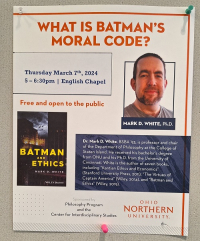
    ONU poster picI was honored to return to my undergraduate alma mater, Ohio Northern University (class of 1993), in early March to give two talks: a classroom lecture on Kant and economics and a public lecture on Batman and ethics, both of which were well-received with excellent questions from the audience (including a certain Caped Crusader in the latter). It had been nearly thirty years since I’d been back to ONU, and it was quite an experience, connecting with friends and faculty both old and new and seeing how much the campus had changed but still remaining very familiar.

    – — — —- —– —- — — –

    Finally, I blogged a few times at Psychology Today at the end of March:


  • Rights versus antitrust coverMy latest book, Rights versus Antitrust: Challenging the Ethics of Competition Law, will be published a week from today (and looks to be shipping sooner, at least from Amazon).

    You can read the preface below, which should give you a good idea what the book is about.

    – — — —- —– —- — — –

    The right to swing my fist ends where your nose begins.
    (Common aphorism)

    In liberal democracies, we are accustomed to a wide range and degree of freedom, limited only by the equally valid freedom of others. In other words, individuals are presumed to have the right to pursue their interests, whatever they may be, provided they do not wrongfully interfere with others doing the same.

    The word “wrongfully” is crucial here. The five people ahead of me in the line for coffee in the morning are definitely interfering with my interests, but they are not acting wrongfully if they simply arrived there before I did. However, if someone arrives after me and cuts in front of me, that person is acting wrongfully, violating an important social norm, even if not a legal one. If I manage to procure my treasured beverage and then, upon leaving the coffee shop, someone attacks me and steals my coffee, that person has violated a clear legal norm, and I can marshal the powers of the state to my side to pursue justice. (My sole recourse to the person who cut in line is to express scorn and hope my fellow patrons do the same.)

    Although we may resent those who have a negative impact on our lives, we should also recognize when they had every right to their actions. Each of us interacts with countless other people in myriad ways every day, inevitably leading to blameless conflict, due only to scarcity of time and space (and coffee shops). It is only when people violate social or legal norms, implying rights held by others, do those actions become wrongful—and it is only when actions are wrongful that we feel justified in addressing them in some way, whether by scorn (in the case of social norms) or state action (in the case of legal norms). This idea applies not only to individual actions, but to those of businesses as well. Firms take many actions that affect individuals (and other firms) in positive and negative ways, but even the latter is not of concern to the state unless they violate recognized rights. Businesses can increase prices, stop producing certain products, or close locations, all of them possibly setting back the interests of individuals who enjoyed or relied on them. And these are just their activities that affect consumers: firms also take many actions with respect to employees, creditors, and other businesses they work with, all of which have effects on those other parties, for better or for worse.

    Even though businesses can cause harm with all of these activities, we recognize that they have wide latitude to conduct their affairs as long as they do not violate the rights of their consumers, employees, creditors, or trading partners. We can complain when the price of coffee increases, or our local shop no longer carries our favorite roast, or shuts down completely, but we have no legal recourse to prevent these actions. The same goes for the shop’s employees, creditors, and suppliers, all of whom have the same rights to change their behavior (as do their customers), but not to interfere with those of the coffee shop. Only when the business violates rights, such as by deceptive or coercive practices, does it behave wrongfully, which can and should be addressed through the legal system.

    This is what I regard as the commercial ideal in a liberal democracy: businesses and consumers (and other related parties) freely acting and interacting within constraints provided by the rights of all, with violations of these rights punished under the law. For the most part, this is the picture of commerce those of living in liberal democracies see around us. Of course, there are limitations on business in the form of regulations that govern treatment of workers, product safety, and environmental practices, which can all be formulated in the language of rights protection. Each of these is controversial, as most laws are, but they can be justified in terms of the recognized rights and protected interests of those affected, and therefore are valid interferences with the free interaction of business with their consumers, employees, and other partners.

    And then we have antitrust.

    I shall argue in this book that, despite the wide consensus among academics, policymakers, and elected leaders across the political spectrum, the legal institution of antitrust is anathema to liberal democracy. Antitrust betrays our most basic understandings of property rights and economic liberty—not just those of libertarians or classic liberals, but those of the majority of people living in liberal democracies with market economies, ranging from Sweden to Singapore, with the United States somewhere in the middle. Antitrust sacrifices the rights of some for the well-being of others by neglecting what rights are actually meant to do. It punishes firms, not for doing wrong, but for not doing enough good. It implies that business exists, not to express the interests and agency of individuals, but as mere means to promoting economic welfare—or, in more political orientations of antitrust, democracy itself. In other words, antitrust holds businesses responsible for a role they have no obligation to fulfill, which represents a grave misunderstanding of the nature of commerce in a free society.

    If you’re not inclined to be sympathetic to the titans of industry, consider if the same obligations were imposed on you as a consumer or employee. Imagine that your choices regarding what goods and services to buy, where to shop, and what career you could pursue and for whom, were permitted only insofar as they served the interests of the state or society as a whole. If you happened to make choices that coincided with the greater good, you would never encounter any interference. But if you decided to buy beef when buying chicken would do more for the economy, or chose to be a writer (gasp) when working as an engineer is declared to be of more value, then your preferred choices would be foreclosed. You would be obligated to make choices that served the greater good, as opposed to the liberal tradition of a zone of autonomy in which you can make your choices regarding your own life, provided (once again) that your actions do not infringe on the same rights of others.

    But we are not accorded this same consideration when acting commercially as businesses. In countries with antitrust or competition law—which is to say most industrialized countries—business firms are prevented from taking actions that are seen as counterproductive to broader economic well-being. This goes against the understanding of business in liberal societies as the free expression of individuals’ interests. In a market economy, some persons sell their labor (by working), some their capital (by investing), and some exercise their entrepreneurial drive through starting or joining businesses. There is no obvious reason why, when people choose the third option, their options are limited by their potential to increase societal well-being, or why they should face more scrutiny than workers or investors (provided that they are doing nothing wrongful).

    In writing this book, I have tried to keep my argument as straightforward and lighthearted as I can, in hopes of inspiring readers from a variety of backgrounds to reconsider the wisdom of antitrust and competition law. To that end, I do not get into the fine details of antitrust statutes, judicial opinions, or legal cases, or the various interpretations or implementations of these laws around the globe. All I rely on are some concepts from economics, philosophy, and law, which I explain fully before applying them to the general idea of antitrust—and, most important, the basic and common belief that individuals should be free to pursue their own interests provided they do not wrongfully interfere with others doing the same.
  • Sunrise picI'm pleased to have more to report this year than the last several, not necessarily because I did more—although I suspect I did—but because what I've been doing has begun to appear in the world.

    First of all, as I've been banging on about for the last several weeks, A Philosopher Reads… Marvel Comics' Daredevil: From the Beginning to Born Again (the third in the series) was published on December 21 by Ockham Publishing. You can see more details about it here, and I posted a few times at Psychology Today (mostly drawn from the last two chapters focusing on his mental state, not the earlier ethics material):

    Also, my friends at the Seize the Moment Podcast had me on once again, and we covered a lot (with most of the good points made by the guys who weren't me, of course):

    Second, Rights versus Antitrust: Challenging the Ethics of Competition Law will be published by Agenda Publishing in February—a book I've been trying to write for years but it took the right approach together with the right publisher to make it happen. Expect to hear much more about this after the new year, but in the meantime you can see more details about it here.

    Third, I have all but finished work on the second edition of The Virtues of Captain America: I submitted the corrected proofs and revised index just before Christmas, and the book is scheduled to be published next summer (just a few months over ten years after the first edition). Not only did I revise the entire manuscript, adding new examples where useful, but I also added two new substantial sections on the recent "Secret Empire" episode—one of how Steve Rogers's moral character was affected by the Hydra brainwashing and the other on how "Hydra-Cap" illustrates various aspects of fascism—and a new half-chapter on Sam Wilson's time so far as Captain America, examining how his approach to the job compares to Steve's.

    On a related note, I also resumed work on The Virtues of Captain America Blog in late September, after putting it on hold a year ago to work on the book, posting weekly since. (This is a more manageable pace, I've found, allowing me to comfortably get ahead of schedule and not feel rushed.)

    In terms of shorter work, I was also happy to see a handbook chapter published—“A Kantian Perspective on Teaching Ethics to Economists,” in Ioana Negru, Craig Duckworth, and Imko Meyenburg (eds), Handbook of Teaching Ethics to Economists: A Plurality of Perspectives (Edward Elgar)—as well as my review of Samuel Hollander's Immanuel Kant and Utilitarian Ethics in The European Journal of the History of Economic Thought.

    In terms of the day job, the less said the better: I have three more semesters to go as department chair and then three more years as a full-time teacher until my retirement in 2028 (thirty years after I began).

    In cheerier academic news, I was honored to be invited back to my undergraduate alma mater, Ohio Northern University (class of '93), to give two lectures in March (thanks to my former professor and dean Rich Meininger who whispered about me in the organizers' ears after hearing they wanted someone interdisciplinary).

    As 2024 begins, I move on to other projects full-time. (If any of my very patient editors are reading this, I assure you that yours is my top priority!) Whatever your 2024 plans are, I wish you well in their pursuit, and I'll have more updates as more of my work sees the light of day.