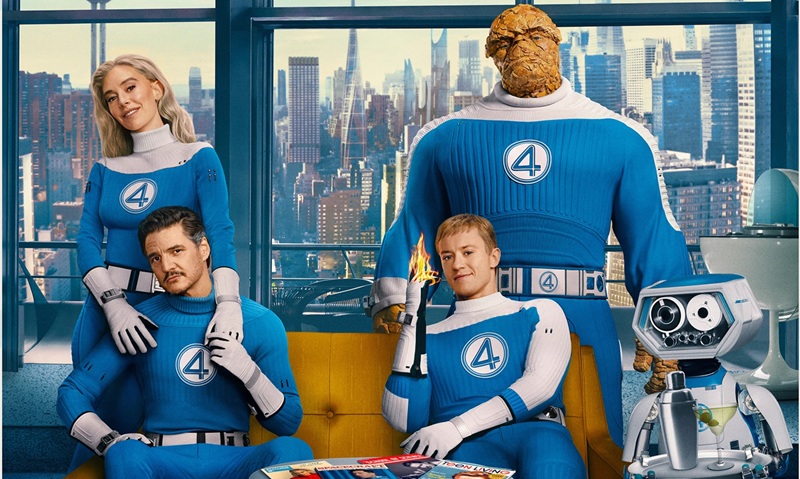
I have to tell you, I wasn't sure what to expect from The Fantastic Four: First Steps. The history of Marvel's first family on film has been more than rocky, what with the Roger Corman boondoggle (financially if not creatively) in 1994, the two entertaining but lightweight attempts in the 2000s (which I liked more than many, it seems), and the atrocious 2015 version ('nuff said).
Ten years on, we finally get Marvel Studios' first swing of the bat… and I'm happy and relieved to say it was a home run. I'll start with general, spoiler-free comments, and then get into plot details below the fold.
As the trailers and preview footage made clear, the tone and palette of The Fantastic Four: First Steps is overall decidedly light. It takes place in a retro-futuristic 1960s-ish world—with very little Kirby aesthetic to it, though, which was a little disappointing—the first sign that this is not a typical MCU movie. (Literally: it takes place on Earth 828, as shown in the opening shot, and the meaning of which is revealed at the very end.) This movie had a refreshing earnestness about it, with no Whedonesque pop culture references or snarky sarcasm, but rather warm humor that makes you chuckle rather than gasp. (Think Cheers rather than Curb Your Enthusiasm.) This is not to say the story had no drama or stakes: indeed, the light tone established in the beginning contrasted very well with the impending arrival of Galactus (as well as other tragic events later in the film).
My main interest was in the portrayal of the Fantastic Four members, and each of the four was spot on, referencing their classical character traits as established in the comics (and described in my book). Here are my spoiler-free thoughts on each (with more detail to come below):
- Reed Richards (Pedro Pascal) balances optimism with an outsized sense of responsibility, not just for the accident that changed all their lives but also for the world he feels he has to protect. Pascal's quiet, reserved portrayal of Reed never lets you forget he feels the weight of the world on his shoulders, which helps excuse the occasional cluelessness that has earned him some scorn from comics readers over the years.
- Sue Storm-Richards (Vanessa Kirby) proves herself to be the powerhouse of the team, both in terms of physical force as well as force of will. Her focus is on family, both in terms of the birth of their son Franklin as well as their community—as Reed said recently in the comics, her true superpower, contrasting nicely with her invisibility, is the ability to make people feel seen, and that is on full display here.
- Johnny Storm (Joseph Quinn) thankfully avoids the caricature of the brash and egotistical hothead, instead being playful but not goofy, with the maturity to know when to joke and when to be serious. Thankfully, he shows both his intelligence and heroism here, and avoids being the hapless comic relief (or slobbering horndog).
- Ben Grimm (Ebon Moss-Bachrach)… what can I say. I almost broke down the first time the Thing appeared on screen, even though I'd seen the shot numerous times in trailers, because the ever-lovin' blue-eyed Thing is finally on screen in all his glory. Through the CGI, Moss-Bachrach embodies Ben's simmering ennui over his situation, happy to be a part of the family when they're together but distinctly lonely and despondent while wandering on old stomping grounds on Yancy Street. (There wasn't as much emphasis on Ben's self-loathing as I had hoped, but there wasn't a lot of time for it; the movie was very tightly paced, and most of it saw the group dealing with Galactus.)
Even H.E.R.B.I.E. was adorable—how's that for impressive?
Let me say a word also about Shalla-Bal, the Silver Surfer played by Julia Garner. Anyone who's seen Garner in Ozark or The Assistant knows what she can do, and she brought her combination of steely intensity and breathtaking sensitivity to this role—and in silver "paint," no less. (I guess that's the modern version of "backwards and in heels," as Ginger Rogers was described while matching Fred Astaire step for step.) And for anyone in a tizzy over the "gender swap," there is a plot rationale for that (which I'll talk about below the fold).
Before I get to spoilers, let me sum up by saying this is not only the best FF film to date (by far), it is one of the best superhero films ever. It simply hit all the right notes: inspiring heroism, devastating tragedy, and jokes that made you smile. There were no concessions to overriding cynicism or despair, just legitimate concern and pathos where appropriate. The cast embodied their roles completely, in the same way that Robert Downey Jr., Chris Evans, and Chadwick Boseman became Tony Stark, Steve Rogers, and T'Challa (respectively).
SPOILERS BELOW THE FOLD
OK, now for the specific details that fascinated me (mostly positive and ALL SPOILERS):
- Where was Alicia? Granted, there was not much time for Ben's love life, but at least we did see some spark between him and Rachel Rozman, a woman who works at a synagogue on Yancy Street (played by Natasha Lyonne). (Kudos for explicitly referencing Ben's Jewish heritage!)
- Without Alicia, who formed a connection with the Silver Surfer in the comics that brought out his repressed compassion and inspired him to rebel against Galactus, it fell to Johnny to fill that role—and provides an in-story explanation why the Shalla-Bal version of the Surfer was used here (as they have a few "moments" of their own here).
- I appreciated that they gave a quick recap of Shalla-Bal's origin, which gave them a chance to introduce a child of her own that she saved, along with her entire world of Zenn-La, by becoming Galactus's herald. This gave her a more specific reason to side with Fantastic Four, given that Galactus was after Franklin more than the Earth.
- And Franklin, oh yes—this was Franklin Richards in all his nascent omnipotent glory, which Galactus recognized before anyone else (and before he was even born!). We even see his incredible power when… nah, I can't reveal that. You have to see it for yourself, because it is an incredibly powerful moment.
- I was surprised when, as the four are escaping from Galactus's ship with the Silver Surfer in hot pursuit of Franklin, Sue yells to Johnny to kill her. Of course, this is completely understandable in general terms: A powerful force is trying to steal your newborn child and you're afraid for his life. Sue had literally given birth in him on the FF's ship moments before, and she could not be expected to be composed or reflective at this time. Nonetheless, it still sounded off, given Sue's well-established reverence for life in the comics and the numerous alternative lines the writers had ("stop her," "get rid of her," "get her away," etc.). "Kill her" has more dramatic impact, to be sure, but it ended up being the one and only bum note in a wonderful symphony.
- After the four return home and emerge from their ship with Franklin to a cheering crowd, Reed is forced to admit they couldn't defeat Galactus, who demanded Franklin in exchange for sparing the Earth (and the billions of lives on it). The crowd immediately turns on them, wondering what makes Franklin's life more important than all of theirs—and we find ourselves in a planet-sized trolley problem, which is common in superhero stories but never as large-scale as when Reed faces them (as I discuss in chapter 1 of my book).
- Sue takes cares of this issue magnificently when, soon afterwards, she bravely walks into the protesting crowd, with Franklin in her arms, and says, "I will not sacrifice my child to save this world—but neither will I sacrifice this world to save my child." (This may not be an exact quote, mind you.) With this, she commits to finding a way out of the trolley problem, or more generally the tragic dilemma, that Galactus put them in, as superheroes often do. UPDATE: I say more about this at Psychology Today.
- After Reed's plan to move the entire Earth out of Galactus' reach fails, he decides to use the same transporter technology to send Galactus away—and Sue realizes before Johnny and Ben that Reed has thought about using Franklin as bait. She calls him out on it, and Reed defends himself by saying it's his job to consider every possible solution before rejecting them, pondering the worst scenarios so he can make sure they never happen. This echoes Sue's traditional role in the comics (as I discuss you-know-where) of tempering Reed's often technocratic plans with humanistic concerns.
- As mentioned earlier, Johnny shows his self-sacrificing impulse when he commits to pushing Galactus into the transporter, reflecting his several similar acts in the comics, which I argue in my book is due to feeling less valuable, and therefore more disposable, than the rest of the group.
- The mid-credits scene: It was perfect. Yes, it's who you wanted to see (barely), just enough to whet the appetite for more to come. (The final after-credits scene was cute but not essential.)
- Also perfect: the meaning of Earth 828, revealed at the very end of the movie in very moving fashion.
 Mark D. White
Leave a comment