Mark D. White

Writer, editor, teacher

  • I'm back from another whirlwind ASSA conference, this one in Boston, where, if you're not careful, you can spend the entire conference in the hotels, Copley Place, and the Prudential Center, and never set foot on a Boston street!

    FRIDAY

    After arriving by train at Back Bay Station Friday afternoon—across the street from Copley Place, which is amazingly convenient—and registering at my hotel and for the conference, the first event was the opening plenary session for the Association for Social Economics (ASE), organized by my good friend (and successor as ASE president) Ellen Mutari and featuring Guy Standing of the University of London. Not only was the talk fantastic, but the plenary and the reception afterwards are always a wonderful chance to reconnect with all my good friends in the ASE.

    SATURDAY

    The first full day for the conference got off to a great start with a fantastic ASE session, chaired by the incomparable Deirdre McCloskey and featuring presentations drawn from her forthcoming Oxford Handbook, co-edited with George DeMartino, on professional economic ethics, featuring an all-star roster of Julie Nelson, Irene van Staveren, Rob Garnett, and John Davis. Next was an ASE session I chaired, focusing on ethics and motivations in global markets, which featured a presentation by DeMartino and his co-author, Kate Watkins, and other prominent ASE members, such as Tonia Warnecke and John Tomer.

    As I wrote about last year's ASSA, this year's was also, for me, chiefly an ASE conference, with fewer meetings with editors and publishers than in previous years, but I did enjoy some time with other people and associations. Saturday afternoon I participated in a session of the International Method for Economic Method (INEM), for whom I gave my first ASSA presentation back in 2002. (More on this later.) I'm grateful to my relatively new friend Erik Angner for inviting me to speak in this session on inequality, and for Don Ross (who contributed to several of my edited volumes in the past) for terrific comments. Finally, after the ASE membership meeting, during which I passed the crown and scepter to Ellen, I headed off to the History of Economics Society reception, where I reconnected with yet more old friends from previous ASSA sessions and HES conferences, including Steve Medema, who inspired my work in law and social economics (and who blurbed my forthcoming edited book on the topic, drawn from papers presentated at least year's ASE/ASSA sessions).

    SUNDAY

    ASE breakfast 2015 cropThis was the big day: my address to the ASE during our presidential breakfast, and the first presidential address to be recorded for posterity (otherwise known as YouTube). Until it's posted, though, you'll have to be "satisfied" with this snap, offered by one victim audience member, John Moreau, on Twitter.

    My talk was titled "Judgment: Balancing Principle and Policy," and was an overview of my thoughts going into my planned book on the topic for Stanford University Press (as a follow-up to my book on Kantian ethics and economics). In it, I gave (what I hope was) a concise summary of how Kantian ethics works with traditional economic models of choice and the limitations of this, which motivates the need for judgment, my conception of which is based on the practical jurisprudence of Ronald Dworkin. I ended the talk with some examples of how this could be applied to economic theory and policy, including my work on retributivist criminal justice. (Even though Ellen introduced me as "an expert on superheroes" and "a bit of a superhero himself," I neglected to mention my application of moral judgment to Superman!) The talk was very well received and generated some terrific comments (which, I hope, will be included in the video), and was a terrific way to end my year as ASE president.

    (One additional thing made that morning even more memorable. My first ASSA talk in 2002, mentioned above, was a crushing experience because of one particular person, who made me question my future in this profession. Other than one encounter in an elevator a couple years later, I haven't seen him since that session, but for some reason he was at the presidential breakfast this year, which I noticed before my talk. Although I was struck for a moment, I'm pleased to say this didn't rattle me; instead, I took it as vindication, that the young scholar he publicly and forcefully accused in 2002 of ignorance and incompetence was now giving a well-received presidential address in front of a prestigious audience. My good friend Wilfred Dolfsma was there for both events—in fact, he helped pick me up after the 2002 experience, for which I will always be in his debt—and I think he appreciated the significance of this "return performance" as well.)

    After a relaxing coffee and lunch with a friend—who also asked me more about my work on superheroes than anything else!—I attended the editorial board meeting for the Review of Social Economy, one of the two ASE journals, edited by Wilfred and another old friend, Robert McMaster, and published by Taylor & Francis (T&F). We met the new editorial team from T&F, who continued the tradition of helpful and innovative ideas for pushing and promoting the journal in new directions.

    After stopping into an ASE session for a few minutes, I ran off to the book exhibits—sadly, my only visit this conference, because one of my favorite parts of ASSA is wandering the aisles, seeing new books, meeting with editors and publishers, and running into people I've lost track of over the years. (It's like they say about Times Square in Manhattan: if you stand in one spot long enough, you'll run into everyone you ever knew.) After saying hi to the team at Palgrave and an old friend at Elgar, I kept an appointment with my editor at Oxford, Adam Swallow, to discuss progress on the book on economics and the virtues that I'm co-editing with Jennifer Baker (and which is progressing nicely but not precisely in what you might call a timely fashion). As we said goodbye, he thanked me for the funny Twitter feed, which I was delighted to hear—I'm always happy to hear that my more academic followers enjoy my usual frivolity.

    Next it was off to the editorial boad meeting of ASE's other journal, the Forum for Social Economics, also published by T&F, after which a group of us attended to a terrific dinner hosted by T&F for the editors of all of the economics journals they publish. ASE was represented by me, Wilfred and Bob from the Review, and John Davis, the previous editor of the Review, and it was a fantastic evening full of food, drink, and laughter, a perfect way to end a long, long day at the ASSAs.

    MONDAY

    My last day in Boston began with a breakfast with my old friend at Elgar, then two ASE sessions at which I said goodbye to all my dear ASE friends, who I'll see next at our World Congress in Ontario in June. I realize I referred to so many people in this post as friends, but the ASE, aside from being an impressive group of scholars, is also a tight but welcoming group of long-time and treasured friends, a group that I'm honored and grateful to be a member of. I have many friends outside of ASE that I enjoy seeing at ASSA, including those within INEM and HES, and even more casual acquaintances, but the other people in ASE are the reason I go to ASSA year after year.

    After a quick stop at Au Bon Pain with Wilfred, Bob, and new ASE vice president Quentin Wodon, I headed back across the street to Back Bay Station to catch the train to Newark—and who do I see there but a colleague from the College of Staten Island, also returning home after ASSA. Friends everywhere, I guess, which is a perfect way to start 2015.


  • 2014 in reviewI've seen a lot of other people (mainly writers I follow on Twitter) doing this, and I thought it might be a nice exercise to remind me of what I accomplished over this year. (Reminding yourself of accomplishments is often recommended for people who only seem to remember what they didn't do.) I'll abstain from linking to everything (besides the books), if only because I've mentioned most everything here in earlier updates.

    BOOKS

    I had two books out this year (one of which was written this year), The Virtues of Captain America: Modern-Day Lessons on Character from a World War II Superhero in February from Wiley Blackwell and The Illusion of Well-Being: Economic Policymaking Based on Respect and Responsiveness in September from Palgrave Macmillan, along with the normal assortment of affiliated blog posts (and a few radio interviews for the Cap book).

    For next year, I signed a contract with Wiley Blackwell for a new book on superheroes and philosophy, and I'm pursuing a chance to write another. Meanwhile, I have plans to write books on individualism for Palgrave and judgment for Stanford sometime later. Also, I postponed my contracted book on law and social economics for Palgrave that was due this year; I plan to return to that once the books above are completed (by the kind graces of my editor!).

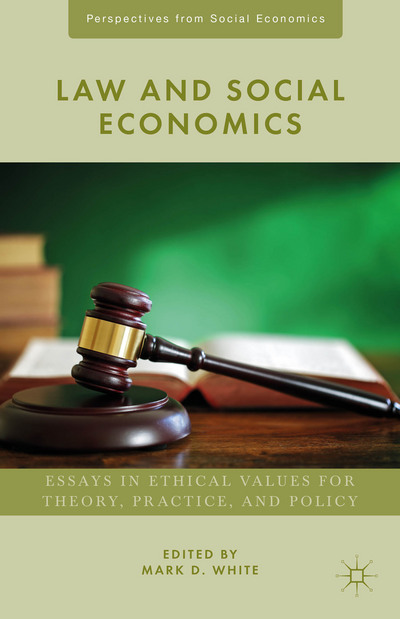
    This year I put together an edited book, Law and Social Economics: Essays in Ethical Values for Theory, Practice, and Policy, from papers presented at the Association of Social Economics sessions at the ASSA conference in January as well as the Law and Society Association meetings in May, which will be published next March in my "Perspectives from Social Economics" series from Palgrave.

    I also worked on three other edited books: one on economics and the virtues (co-edited with Jennifer A. Baker for Oxford); a two-volume set on the insanity defense for Praeger; and a co-edited four-volume collection of essential literature in social economics for Routledge (for which I'm curating the volume on philosophy).

    Finally, I signed on to edit a new book series from Rowman & Littlefield International on ethics and economics, for which I plan to edit the first book (on ethical issues with economic policy and regulation). More on that soon…

    ARTICLES AND CHAPTERS

    In terms of shorter articles and chapters, I seem to have written ten (or eleven):

    1. A journal article on Cesare Beccaria and law-and-economics (published)
    2. A policy paper for the Mercatus Center on happiness measures (published)
    3. A chapter on retributivism and law-and-economics (forthcoming)
    4. A chapter on teaching ethics using Marvel's Civil War storyline (forthcoming)
    5. A revised chapter on law-and-economics for a companion to social economics (forthcoming)
    6. Encyclopedia articles on retributivism and the lex talionis (forthcoming)
    7. A comment on a journal article about consent in libertarian paternalism (forthcoming)
    8. A chapter on nudges in health care (under revision, tentatively included)
    9. An article on the ethics of antitrust law (planned for a symposium)
    10. An article on externalities (submitted for a special journal issue).

    I also started writing a chapter on Kant and virtue in economics for the book I'm co-editing for OUP and an article on judgment (my presidential address for the Association of Social Economics, given at the ASSA meetings in January and normally published in one of the association journals later that year).

    So far, I've agreed to write four new book chapters next year—one on the ethics of work, one on positive psychology and policy, and two on libertarian paternalism—and one article for special issue of a law-and-economics journal on Beccaria.

    PRESENTATIONS/LECTURES

    I gave a number of talks this year, including the Law and Society Association in Minneapolis, the American Philosophical Association (Eastern Division) in Philadelphia, the Petrie-Flom Center at Harvard University, an antitrust symposium at Philadephia University, an invited talk on Captain America at Wagner College on Staten Island, and two invited talks on Kant and economics in Norway.

    I also withdrew from two conferences: the Law, Culture, and Humanities conference in Virginia and the "Oneself and the Other" conference in economics and philosophy in Strasbourg. I had my reasons; nonetheless, I regretted both.

    For next year, so far I am giving two talks at the ASSA meetings in early January, and I've agreed to speak on nudges in Switzerland in April, well-being policy in England in July, and (tentatively) the ethics of work in San Diego in May.

    BLOGGING

    Once again, this past year I didn't blog as much as I wanted to. I had eighteen posts at Psychology Today, including some very successful ones on dating, adultery, and sexless marriage (the last of which was the subject of a featured collection headlined by four of my posts). I blogged less at Economics and Ethics and The Comics Professor, although I did contribute several posts of substance at both.

    Outside my own blogs, I had several blog posts stemming from The Illusion of Well-Being hosted at the LSE British Politics and Policy blog, as well as an op-ed post on happiness policy, based on my Mercatus article, at U.S. News & World Report's Economic Intelligence blog. Finally, I was involved in launching and editing the new blog for the Blackwell Philosophy and Pop Culture series (though I've yet to write for it).

    ON A MORE PERSONAL NOTE

    I still managed to watch a lot of movies (mostly classic films from the 1930s and 40s) and TV on DVD (including the whole runs of Friday Night Lights and Grey's Anatomy), read quite a few books, and kept up with my regular comics (about 15 per week).

    Finally, just today I reached a milestone in my comics fandom: I finished reading every issue of Fantastic Four from 1961 to today—and I can't wait to do it again. If only one of my planned superhero-and-philosophy books were about them! But I will do something, sometime… or it'll be clobberin' time for sure.

  • Thing fancy sqThis seems like a good time for an update—not an end of the year wrap-up, but just what I've been doing since my last update in October.

    The paper I wrote for the Mercatus Center, "The Problems with Measuring and Using Happiness for Policy Purposes," based on my last book, The Illusion of Well-Being, came out earlier this month. Stemming from that, I had an op-ed at U.S. News & World Report's Economic Intelligence blog and a short radio interview with WTOP. More coming on this front in the coming months…

    The American Philosophical Association (APA) Eastern division meetings were last weekend, during which I gave a talk on moral judgment, reconnected with some old friends, and made some new ones. I had to leave after just one day, though, to get ready for the Allied Social Sciences Association (ASSA) meetings next weekend, at which I'll give the Presidential Address on judgment for the Association for Social Economics (ASE), a talk on inequality for the International Network for Economic Method (INEM), and attend all sorts of association and editorial board meetings (including conferring with my co-editors of the four-volume Major Works collection in social economics from Routledge).

    When I return, my work for spring begins: revising my paper on nudges in health care for the edited volume resulting from the Petrie-Flom conference in May; checking the proofs and constructing the index for my next edited book, Law and Social Economics: Essays in Ethical Values for Theory, Practice, and Policy, coming out it March; and writing book chapters on the ethics of work, positive psychology and policy, and two on libertarian paternalism.

    In terms of books, progress continues on edited books on economics-and-virtue and the insanity defense. I have several sole-authored books planned, and soon soon I will be launching a new book series on ethics and economics for Rowman & Littlefield International—more details to come on that (including the first book, which I will edit).

    Also, I had some blog activity since my last update:

    As far as 2015 goes, the New Year's resolution post for Psychology Today linked above contains my mantra of sorts for the upcoming year: find out what I can do. This next year will be one of expanding my activity beyond writing, which I hope will lead to a fuller life (and also better, more enjoyable writing), but will also take far better time management. After all, if I do keep doing these personal updates, I have to make them more interesting!

  • Health dataMark D. White

    In today's "The Upshot" in The New York Times, economist Aaron E. Carroll bemoans the fact that health policymakers, regulators, and spokespeople are reluctant, and sometimes even forbidden, to discuss and make use of information regarding the cost effectiveness of particular treatments. The fear is that they will invoke the spectres of rationing and "death panels," or more generally, medical decisions made on the basis of money alone and not the needs or interests of patients and their loved ones.

    I agree with Carroll that cost effectiveness is an essential and necessary topic for discussion; after all, health care has to be paid for by someone, who is responsible for making sure that scarce resources are used in the most beneficial way possible. And I think most people understand this principle as well, even if they don't want to acknowledge it at times of tragedy and impending loss.

    If people are afraid of calculations of cost effectiveness, it's because they don't want some distant, faceless, bureaucracy using cold data to make decisions that affect such an intensely personal aspect of their lives. But the problem isn't the numbers themselves—it's who is using them to make the critical decisions.

    If health care decisions had not been centralized under the Affordable Care Act (or a similar plan), and health care decisions were left in the hands of doctors, patients, and insurance companies unbound by government mandates regarding coverage, these parties together could use cost effectiveness numbers in a way that worked with each patients based on his or her interests, coverage, and resources. Each patient, together with his or her doctor and loved ones, could balance these various factors in a way that furthered his or her overall interests within available resources and insurance coverage. They could use cost effectiveness information as one input into a specific decision in a way that furthers that patient's interests.

    I wrote about this aspect of private health care in "Markets and Dignity: The Essential Link (With an Application to Health Care)," my chapter in my edited volume Accepting the Invisible Hand: Market-Based Approaches to Social-Economic Problems (Palgrave Macmillan), on pp. 13-14:

    The possibility of making private decisions regarding the benefits and costs of various treatment options, whether for minor illness or chronic disease, puts the choice in the patient’s hands (as well as with her doctor and whomever else the patient wants to join the process, such as family or friends). In consultation with her doctor, the patient can assess the value of various treatments, considering the merits compared not only to their costs, and the benefits and costs of alternative options, but also other uses towards which those resources can be devoted, which are all subjective valuations. Perhaps she will choose not to undergo the premium treatment, even if she could afford it, because she wants to leave the money for her children, or take a cruise in the final months of her life; or perhaps she will sell her house to pay for a little more time on life support and with her grandchildren. In a market setting, this choice is hers, along with its benefits, costs, and other consequences.

    I am not denying that the patient may not be able to afford the premium treatment because she does not have the resources for it; this is tragic, to be sure, but unavoidable in a world of scarcity. If she is not making these decisions, someone else is; an insurance company or HMO may also refuse her the premium treatment based on costs, and a government-run health plan may do the same. But in these cases, the decision would be made for her, according to someone else’s calculation of whether the treatment was “worthwhile” in terms of costs and benefits for the hospital, insurance company, or government health program, all of whom have scarce resources that must be allocated somehow. In a market context, the decision would be hers, even if it seemed she had no decision at all because she does not possess the resources, either due to bad luck or bad planning, or other choices made through her life.

    All is not lost, necessarily; just because the premium treatment is out of reach does not mean there are not lesser, more inexpensive treatments that will also be of benefit. In a market system, this is the patient’s choice, just as she can choose what size house to buy, what model car to lease, what size TV to own. Every person prioritizes the various interests on her life; some forego the large house to take frequent vacations, some do the opposite. Some may opt for the cheaper treatment option to retain more resources for another goal in life, or to give more to others rather than spend it on premium care for herself. And certainly, past choices will constrain or expand her present options; one who spends her income on lavish toys throughout life should not expect sympathy when she cannot afford top-line treatment at the end of it. But these are her choices, while in any other system, this decision may be made for her, according to calculations based on the imputed value of her life and her well-being compared to other persons. Not every person can afford to have the premium treatment, but this fact is due to scarcity of resources, not the way in which they are allocated or distributed, and it will be true under a state-controlled system as well as a market system. A state system focused on efficiency cannot allow everyone to have the premium treatment either, and the choice of who (if anybody) undergoes it will be truly arbitrary, with no role for choice on the part of the patient or her family. Choices that so closely affect a person’s life should be made by that person alone (or other persons to whom she delegates—or sells—that authority); they should not be made by another party that either presumes to know her “true interests” or serves the collective weal in the name of efficiency.

  • Mark D. White

    In this morning's installment of The Stone in The New York Times, anthropologist John Edward Terrell invokes against the individualist strain in modern politics, especially on behalf of "Republicans, especially libertarians and Tea Party members on the ideological fringe." But, as regular New York Times columnist David Brooks often does, Professor Terrell conflates individualism with self-interest, ultimately attacking a straw man.

    Most of Terrell's piece is uncontroversial. He surveys ancient philosophers who emphasized the social nature of persons and the modern science that supports them. (He finds this ironic, implying that some woud disagree; who, exactly, remains to be seen.) He discusses religious traditions that emphasize community and responsibility, and contrasts this with Enlightment thinkers that emphasized the individual (each in his own nuanced way).

    Near the end of the piece, though, he stakes a bold claim: "the sanctification of the rights of individuals and their liberties today by libertarians and Tea Party conservatives is contrary to our evolved human nature as social animals." This is a false dichotomy, for there is no contrast at all. Rights and liberties are necessary (if not sufficient) for a functioning civil society. Rights and liberties enable individuals to pursue their own interests broadly defined, which may and often do include their own well-being, the well-being of others, and ideals such as justice and equality. Libertarians and "Tea Party Conservatives" may place more emphasis on rights and liberties because they see support for them declining, but this does not imply that it is their only concern and that they think it is the sole metric of human progress and well-being.

    Terrell also writes, "the thought that it is both rational and natural for each of us to care only for ourselves, our own preservation, and our own achievements is a treacherous fabrication." I agree, it is a fabrication, but in the sense of a straw man fabricated by Terrell himself, not any prominent conservative or libertarian thinker.

    I'll end where Terrell began: politics. He writes that part of the divide between left and right in the US is over the "role of the individual," with the left "more likely to embrace the communal nature of individual lives" while the right (and libertarians) favoring rapacious self-interest. (I paraphrased a bit there.)

    Let me offer an alternative, although it doesn't strike such a stark tone. Both left and right appreciate and value the social nature of the individual and their responsibilities to each other. Where they differ is in the role of the state in executing those responsibilities. The left believes the state should take care of the needy, through social programs and redistribution, while the right (and libertarians) believe individuals, acting alone or through voluntary organizations, should help each other. (And they do, as numerous studies have shown.) In other words, those who Terrell accuses of worshipping at the altar of self-interest are actually expressing their responsibility toward other individuals as an exercise of the rights and liberties they value so highly.

    In short, rights and liberties are not always used to further self-interest, and the institutions of government often are. Individualism is not self-interest—on the contrary, the most noble and admirable acts of charity are those that result from the free actions of individuals acting in their sense of social responsibility.

    There is no contrast here—let's not fabricate one.

  • Mark D. White

    WightBecause he's too bashful to tell you, I'll tell you that Jonathan Wight's 2014 Presidential Address for the Association for Social Economics, delivered at January's ASSA meetings, has just been published in the Review of Social Economy, and the link has been posted to the ASE blog.

    The title is "Economics within a Pluralist Ethical Tradition":

    Ethical pluralism is the recognition that multiple ethical frameworks operate in social settings to solve problems of moral hazard. In particular, non-consequentialist considerations of duty and virtue operate to restrain self-interest and lower transaction costs in exchange, such as when asymmetric information exists. Positive economics has tended to rely exclusively on a behavioral model that assumes utility maximization, but this approach fails to give credit to the neglected foundations of duty and virtue. Consequences, duties, and virtues all play a role in sustaining businesses, for example, and in promoting the search for truth within the economic research community. Normative welfare economics can also benefit from understanding vertical and horizontal pluralism.

  • AxisMarvel's current crossover event, AXIS, involves various characters having their ethical orientation "inverted": heroes become villians and vice versa. A deceptively simple premise that has been used throughout the history of superhero comics—but rarely on this scale—it has potential for interesting stories (as well as culminating in "things will never be the same" changes to the status quo).

    Ironically, however, it is precisely the aspect of Marvel's characters that makes them unique—their moral complexity and nuance—that confounds efforts to "flip" them from good to evil or from evil to good, resulting in strange adn confusing choices in storytelling and characterization.

    There are very few characters in the Marvel Universe who are unambiguously good or evil: Captain America (that is, Steve Rogers) and the Red Skull, who are not among the inverted, are the two obvious exceptions. (There could be others too: for instance, I'd throw in Spider-Man, pure of heart but imperfect in execution, who interestingly was also not inverted.) The vast majority of the Marvel heroes and villains, however, are more complex, the heroes struggling against their more base natures and the villains striving to some degree to find redemption or achieve noble ends. But this complexity, a hallmark of Marvel Comics since the firm of Lee, Kirby, Ditko, and Associates dreamed them up in the 1960s, makes it diffiult to simply "flip" their moral characters. As a result, in AXIS we see a wildly inconsistent approach to inversions, especially regarding several heroes and one villain in particular.

    Throughout this series and its tie-ins, I've been fascinated and frustrated by two characters in particular, Iron Man and Doctor Doom, whom I've long found to be very similar in their moral characters. Essentially utilitarian in their ethics, both pursue their personal visions of "the good" while believing that the ends justify the means. This leads Iron Man, for example, to take the controversial actions he took during Civil War in order to protect the superhero community, and leads Doom to try to take over the world, time and time again, because—as shown well in the miniseries Doomwar—he believes in his heart that only his rule can save humanity. Of course, both also have massive egos which serve to enable their extreme actions in pursuit of their singular visions, granting each the perception of entitlement, even the duty, to use their superior intelligence to save the world, damn the costs (as well as indulge personal vendettas and grudges along the way), and it is this arrogance which often foils their greatest ambitions (especially in Doom's case).

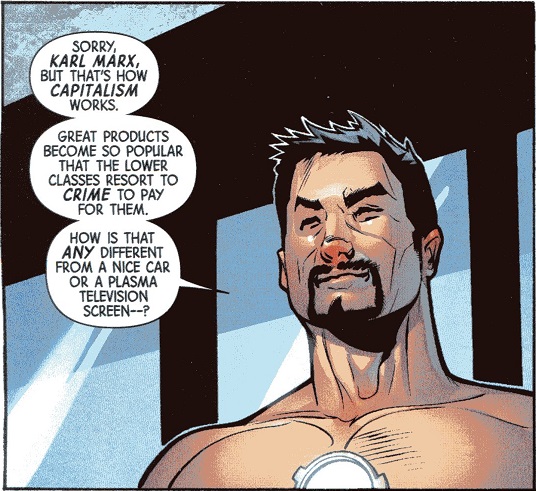
    Tony-axisBut after they are inverted during AXIS, these two similar characters are spun in completely opposite directions. Iron Man is portrayed as a mustache-twirling Snidely, teasing the citizens of San Francisco with an Extremis app that can make them "perfect" and then charging them $100 per day to maintain it. (This could be seen merely as leveraging an extremely attractive—and presumably legal—product for maximum revenue, but that sort of behavior often represents evil in popular fiction, and in any case is quite a departure from Tony's recent corporate altruism.) In other words, whatever restraints Tony Stark once felt on his pursuit of the good, for himself or for the world, have been removed. But this is not Tony "inverted"—this is Tony squared, Tony unleashed, his buffers removed, all second-guessing forgotten, resulting in even more of a caricature of himself than (according to some) in Civil War.

    On the other hand, Doom has been all but neutered, now positively apoplectic about all the pain he caused his beloved citizens of Latveria, on whom he bestows democracy (by fiat, natch) before embarking on a program of making amends like a charter member of Villains Anonymous. The once proud and noble Doom simpers to Valeria Richards (daughter of Sue and Reed, currently living with Dad's greatest enemy in a delightful act of childhood defiance) about his need to right his past wrongs and also protect himself Latveria from an inverted Scarlet Witch who wants revenge for the events of Avengers Disassembled, House of M, and her wimple. (He had nothing to do with last one, but she could be understandably pissed about it all the same.) He even admits to Valeria—brace yourself, true believers—that Reed Richards has "always been right."

    While Doom-axisIron Man's "inversion" magnified his worse impulses, Doom's robbed him of his best. He either no longer seems to want to save humanity—a change that, in itself, hardly seems heroic—or he no longer feels he can do it and that the way he was doing it was incorrect—which is not an ethical change but an empirical one about methods. The thing that was evil about Doom was the steps he was willing to take to serve his goal of saving the world, but his nobility came from his sense of purpose and the moral lines he was not willing to cross (matters of honor such as truthfulness and keeping promises). Where he was once a fascinating man of extremes, now he's been reduced in both his ambition and his arrogance.

    How interesting it would have been if, instead, Doom had been inverted into a traditional one-dimensional villain instead, using his brilliance to rob banks. Then, at least, the reader would have been led to ponder the true complexity of Doom's character and wonder if he was really a villain to begin with, and in what ways he was different from a hero like Iron Man. (At least they didn't make him an angry blogger.)

    Cap_ma1It seems that what the inversions did was not to flip the overall ethical orientation of the affected heroes—except in the most simplistic way possible, turning nuanced moral characters into one-dimensional caricatures—but merely flip the degree to which they perceived limits on their activity: for example, Iron Man sees fewer limits and Doom sees more. Apart from Tony and Vic, the Scarlet Witch indulges her desire for revenge against Doom; the all-new Captain America (Sam Wilson) still fights crime, but more like the Punisher than he did as the Falcon; and the X-Men become very pro-active against humanity (making Cyclops look like Gandhi). None of them has become a villain per se, but simply less traditionally heroic by virtue of crossing lines that once they refused to cross.

    The main idea of AXIS is to flip heroes and villains along the "axis" of good and evil. But given the complexity granted to most of the Marvel characters by their creators, and maintained over the years out of dedication to that vision, there is no simple axis to be found. Most Marvel characters express their heroism or villainy in nuanced and multifaceted ways, so there are many axes along with they can be inverted. For example, they can be flipped in one aspect of them (such as what remained of Tony's restraints on his pursuit of goals), flipped along more than one of them (such as Doom's loss of ambition and arrogance), or reduced to a simple black-and-white caricature (such as the Scarlet Witch of Vengeance).

    Of course, the "fuzzy" method of inversion in AXIS may have been part of the creators' plan—it did result from a magical spell, after all, and magic is known for its unpredictability. But I think some great story possibilities were missed by not considering what truly makes the various Marvel characters heroes or villains—or both.

  • Mark D. White

    BrooksDavid Brooks' New York Times column this morning, titled "The Quality of Fear," makes a number of claims regarding the source of the panic surrounding the Ebola virus. As usual, he makes useful and insightful points, but he falls a bit flat when he tries to tie this episode into his persistent theme of deference for authority, especially when this episode—as he describes it—reinforces the very skepticism he laments.

    His opening point about Ebola points out this dilemma:

    In the first place, we’re living in a segmented society. Over the past few decades we’ve seen a pervasive increase in the gaps between different social classes. People are much less likely to marry across social class, or to join a club and befriend people across social class.

    That means there are many more people who feel completely alienated from the leadership class of this country, whether it’s the political, cultural or scientific leadership. They don’t know people in authority. They perceive a vast status gap between themselves and people in authority. They may harbor feelings of intellectual inferiority toward people in authority. It becomes easy to wave away the whole lot of them, and that distrust isolates them further. “What loneliness is more lonely than distrust,” George Eliot writes in “Middlemarch.”

    So you get the rise of the anti-vaccine parents, who simply distrust the cloud of experts telling them that vaccines are safe for their children. You get the rise of the anti-science folks, who distrust the realm of far-off studies and prefer anecdotes from friends to data about populations. You get more and more people who simply do not believe what the establishment is telling them about the Ebola virus, especially since the establishment doesn’t seem particularly competent anyway.

    His point about isolation within social classes is a familiar one (although somewhat redundant, given what social class means), but more troubling is his transition to leadership and authority. Maybe I'm too young, but at what point in our nation's history have people known or felt "one with" those in authority? Aside from the elites in government, business, and the media, I doubt many Americans have ever considered an elected leader or appointed bureaucrat to be "one of us." After all, it is very difficult for people who have no power to connect with people who have power.

    (When he writes of the changing perception of authority, perhaps Mr. Brooks is thinking of the increase in distrust in government following Watergate, but this is a separate issue from feeling connected with authority. I would also add that, given what we know how about government operated before Nixon, we would have been wise to be more distrustful back then as well. Trust based on ignorance is hardly a virtue.)

    I would have preferred Mr. Brooks to end the piece with his last sentence above: "You get more and more people who simply do not believe what the establishment is telling them about the Ebola virus, especially since the establishment doesn’t seem particularly competent anyway." In my opinion, that's the core issue: incompetence. I'm sure the American people would love to be able to trust their elected leaders to have a handle on crises and a plan to deal with them—and to tell us when a crisis is not in fact a crisis. But we have seen little such competence from government leaders in a long time. Of course, the people behind the scenes, the (mostly) apolitical researchers and scientists and analysts who toil in anonymity for presidents and Congress, are not incompetent. But when their message is filtered through political interests (especially so nakedly and shamelessly) before they get to the people, they become suspect and unreliable. As a result, many people turn to television and the internet to listen to speakers who seem to talk directly to them, with no apparent agenda, even if what they say is hyperbole or simply utter nonsense.

    (Brooks touches on the role of the media later in his piece, stressing how they intensify news and cause disproportionate panic. This is true, of course—but this would not have such an impact if people could rely on the true authorities to give them the information they need without having to doubt their motivations almost by reflex.)

    Mr. Brooks makes his best point near the end of the article, but again I read it as giving more reason to be skeptical of authority, not less:

    The Ebola crisis has aroused its own flavor of fear. It’s not the heart-pounding fear you might feel if you were running away from a bear or some distinct threat. It’s a sour, existential fear. It’s a fear you feel when the whole environment seems hostile, when the things that are supposed to keep you safe, like national borders and national authorities, seem porous and ineffective, when some menace is hard to understand.

    In these circumstances, skepticism about authority turns into corrosive cynicism. People seek to build walls, to pull in the circle of trust. They become afraid. Fear, of course, breeds fear. Fear is a fog that alters perception and clouds thought. Fear is, in the novelist Yann Martel’s words, “a wordless darkness.”

    Of course people are frightened, and Mr. Brooks is correct to point out that it is an amorphous, "existential" fear. We often make a distinction between risk and uncertainty, in which risk deals with known probabilities (such as the roll of a fair die) while uncertainty deals with unknown probabilities (such as keeping your job). But our current fears reflect another level of uncertainty altogether: not only uncertainty about what is likely to happen, but what can possibly happen at all.

    Just think of the things people worry about these days (reasonably or not). Ebola. ISIS. Climate change. Economic inequality. Human trafficking. Civil war. Terrorism. Not as exhaustive list, and obviously skewed by my perspective, but I hope it gets the idea across, which is that these are not risks that can be insured against or "mere" uncertainities that can be planned for. These are perceived threats that, many of them, could not have been imagined before they occurred, have unknown and potentially catastrophic consequences, and have no clear solution. As a result, they all speak to the fragility at the core of human existence—they merit a certain level of fear that is not easily assuaged by political statements from authorities who do not seem to appreciate their gravity or the trepidation they reasonably cause.

    As Mr. Brooks wrote, "It’s a fear you feel when the whole environment seems hostile, when the things that are supposed to keep you safe, like national borders and national authorities, seem porous and ineffective, when some menace is hard to understand." In such conditions, I think skepticism about authority is entirely justified, and should not be reversed until authority shows the people it deserves to be trusted. When Mr. Brooks writes that Ebola "exploits the weakness in the fabric of our culture," I think he is spreading the blame too widely. When authority tries to respond to such existential threats but cannot do so outside an explicitly political lens, the message, as valuable as it might be, becomes soiled, and people turn elsewhere for information (and misinformation). But can we blame them?

    I fear I will never understand David Brooks' blind appeals to authority and his unshakeable trust in people with power to use that power responsibly. Then again, I was raised to be distrustful of authority (an attitude he would likely attribute to my class upbringing). I have not yet had reason to change my mind, though, and the incompetence he himself identifies this recent episode is hardly going to give me one.

  • OfficeBlame my office staff, one of whom told me the other day that she looked at this site and saw my "final update" from June. While I have been updating my activity page regularly—more to mark progress for myself than for anyone else—that final update post lingers, implying the abrupt cessation of progress. (Not yet!) Maybe I'll change the landing page for this site someday, but until then, I'll post a new update from time to time.

    It was a good summer, by which I mean a productive summer during which I finished most of the items on my to-do list. I don't know if that means I accomplished more or simply planned less, but I choose not to dwell. (That's what psychiatrists call growth.)

    IllusionWhen we last "spoke," I had finished my production work on The Illusion of Well-Being: Economic Policymaking Based on Respect and Responsiveness, which is now available and the subject of a dedicated page on this site as well as several blog posts:

    "There Is Little Happiness to Be Found in Happiness-Based Policy," Economics and Ethics, September 10, 2014 (also at Psychology Today)

    "Government policy should be based on respect and responsiveness rather than statistics," LSE Politics and Policy blog, September 8, 2014

    "Basing government policy on happiness or well-being is misguided," LSE Politics and Policy blog, September 2, 2014

    L&SEAfter that, I drafted a paper on happiness policy for the Mercatus Center and finished most of the work on the edited book, Law and Social Economics: Essays in Ethical Values for Theory, Practice, and Policy, submitting the final manuscript in early August after wrapping up a couple final details. I wrote a chapter on retributivism and economics for Law and Social Economics as well as a paper on externalities for a special journal issue and a paper on antitrust for an upcoming conference and journal symposium (the latter which I recently finished, not quite making my end-of-summer deadline). Since the fall semester started, I also revised my Mercatus paper in response to comments and submitted the formatted version of my chapter on Marvel Comics' Civil War as well as my Petrie-Flom paper on nudges in health care for the edited volume drawn from the conference.

    I think that brings us up to date—as I said, it was a satisying summer (and early fall). Now attention turns to my chapter for Economics and the Virtues, the book I'm co-editing with Jennifer Baker, and my paper on moral judgment that I'll present at the APA Eastern meetings in December and also as the presidential address for the Association for Social Economics at the ASSA meetings in January. I also have three chapters to write for edited volumes—on the ethics of work, new developments in nudge theory, and positive psychology and policy—before I start writing my next popular book on superheroes and philosophy. That should take me through the end of next summer, after which I start working on a third book for Palgrave and my long-planned book on moral judgment for Stanford (for which my APA/ASSA talk will be the starting point).

    Finally, I had a brief flurry of posts at Psychology Today:

  • Mark D. White

    IllusionGovernments around the world are starting to measure happiness (or subjective well-being) with the goal of a more humane process of policymaking. According to supporters, happiness-based policy will focus governments’ attention on what really matters to their citizens, their essential well-being, better than economic measures such as gross domestic product or national income that are too far removed from the day-to-day concerns of the people.

    While the intentions may be good, the benefits of happiness-based policy are illusory at best and counterproductive at worst. There are fundamental problems with defining and measuring happiness, as well as implementing policy based on it, that prevent it from being a viable alternative to traditional policymaking based on GDP and other economic statistics.

    First, the term “happiness” is notoriously difficult to define. Philosophers have tried to do this for centuries, identifying and detailing many types of happiness but arriving at no universal definition. Songwriters, poets, and novelists have done a better job describing happiness in all of its nuance and glory, but this does not provide a solid basis for measurement. For the most part, psychologists and economists who try to measure happiness do not worry about definitions, satisfied that “everyone knows what is,” but with no guarantee that everyone knows it to the be the same thing. Happiness is simply too vague a concept to define precisely enough for measurement without excluding what many people consider happiness to be to them.

    Second, there is no straightforward way to translate an essentially qualitative and subjective feeling such as happiness into quantitative data. Most happiness surveys consist of questions about the respondents’ current state of happiness or satisfaction with their lives, which they answer on a numerical scale with the units labeled “very unhappy” to “very happy” or “the least satisfied I can imagine” to “the most satisfied I can imagine.” Even if the definition of happiness were clear, these labels are not. For instance, how a person interprets these labels depends critically on the experiences and circumstances of his or her life. A wealthy and successful CEO may feel she has not lived up to her potential, while the janitor in her building may be very pleased with his lot in life. Human beings have the ability to adapt to their life circumstances, which explains why people living in deplorable conditions may nonetheless report high levels of happiness and well-being. This also implies that the steps on the happiness scale are inherently subjective, nonuniform, and incomparable, rendering them unable to support the mathematical processes researchers need to perform on them to provide information for policymakers.

    Finally, even if there were no problems with definition or measurement, happiness-based policymaking raises numerous ethical and political issues when it comes to implementation. For example, would the government target a growth rate for happiness? This is problematic in light of the “hedonic treadmill,” by which we work hard to achieve more happiness, only to adapt to that level and strive for more. In the end, we work more and more and end up with little increase in happiness, and the same would likely hold for official happiness “stimulus.” Another concern is the possibility of significant inequality of happiness: due to adaptation, the underprivileged may report levels of happiness that mask their circumstances while the affluent express dissatisfaction and boredom. Would we then redistribute resources from the poor who seem happy to the rich who don’t? Finally, people often give up some happiness now in exchange for more later, such as when they go to school or on a diet. How would government measures focused on the now take account of investments in the future? All of these are questions that policymakers will be forced to struggle with if they choose to base policy on measures of happiness.

    Given the inherently vague, qualitative, and subjective nature of happiness, it is impossible to define and measure it well enough for the purpose of policymaking. This is not a simple matter of refining statistical techniques; the problems with happiness measurement are more fundamental than that.

    There is, however, a better way. Instead of trying to determine what happiness is and how to measure it, the government can trust individuals to make choices in pursuit of their own interests. Instead of trying to boost the happiness of those doing fairly well, the government can devote its resources to alleviating the suffering of the poor. Instead of targeting the general level of happiness based on arbitrary definitions and inaccurate measurement, the government can address specific problems that their citizens tell them need to be addressed.

    In short, the government does not need to define, measure, and evaluate happiness in order to find problems to address. There are enough problems facing the country that are readily apparent. Liberals, conservatives, and libertarians may disagree about the scale and scope of what government should do, but I think they would all agree that the government should deal with the problems at hand rather than invent new ways to find them. In the end, that may be the best way to make people happy.


    For more, see my latest book, The Illusion of Well-Being: Economic Policymaking Based on Respect and Responsiveness (pictured above), as well as a longer two-part treatment of the above at the LSE Politics and Policy blog (here and here).