Mark D. White

Writer, editor, teacher

  • Sam capIf I knew the official announcement of Sam Wilson (the Falcon) picking up the mantle from an aged Steve Rogers was coming so soon, I would have waited to write my post on the new Thor, since many of the points I have to make are the same. But here I'll focus on the aspects unique to Cap.

    1. Ever since this was hinted several weeks back, I've thought about it in terms of two issues: who becomes the new Cap, and why are they replacing Steve Rogers at all. The first is a no-brainer, and personally I'm thrilled to see Sam as the next person to wield the shield. I think this a win all around: it flows naturally from the story Rick Remender has been telling, and Sam is the natural successor to Steve (given that Bucky already had a shot), having been his crime-fighting partner and close confidante for years. Furthermore, it helps to diversify the Marvel line in the same way that the female Thor does, which I only hope will be justified and motivated in-story as well as Sam's ascension is. (The same issues with legacy that I expressed in my Thor post hold, even though there have been almost as many different Caps as Thor has had helmets.)

    2. The bigger issue for me is: why is Steve Rogers being replaced again so soon after he came back from "the dead" several years ago? (It seems like yesterday, but possibly that's because I have no life.) There are a number of possible reasons.

    First, it may have been motivated for the express purpose of putting Sam in the red-white-and-blues. Nothing wrong with that, though it does seem to make Steve Rogers disposable and imply that Sam Wilson can't be made a more prominent fixture in the Marvel Universe as the Falcon—which, after all, is an original, nonderivative superhero identity without "Black" in the name, and something I think should be celebrated.

    Second, it may be part of a larger character arc for Steve Rogers—in much the same way that Rhodey first served as Iron Man during Tony Stark's fall and rise from the depths of alcoholism, only to have Tony reclaim the armor when he was all better—but this would diminish Sam's stature as a "true" successor as Captain America and make him little more than a placeholder. He would get his moment in the sun, true, but he deserves better.

    Third, it may simply be a "hail mary" on the part of the creators. I've found Remender's run to be less than inspiring after an impressive start, and this may have been the best Cap story they could come up with. If I remember correctly, Cap has been "depowered" twice since he was reborn, and that well has run dry—which leads me to think this was motivated by one or both of the reasons above (or simply a desire to mix things up, as I'll discuss below).

    3. Let's abstract away from the new Cap and talk about Marvel in general. In my post on the new Thor I expressed my suspicions that all of these abrupt changes in major characters were leading to a Marvel reboot down the road. Maybe it's not, and many if not all of these changes will be reversed in a year or so. Regardless of how long these changes stay in place, however, and no matter how much I support each of these changes individually and look forward to the stories that can be told with them, taken together they reek of the same desperation that led DC to reboot their universe three years ago: short term shock to goose sales. As Brevoort says in the interview announcing the New Cap, “Change is one of the watchwords of the Marvel Universe, so there are even more startling surprises to come!” This sounds to me like "change for the sake of change," which I regard as a shortsighted alternative to solid, innovative storytelling rooted in the rich history of beloved characters.

    But I'm not running Marvel Comics, and I'm no expert on what sells comics to the majority of current fans (or the elusive "new fans" they hope to elicit). Maybe current readers want rapid change that keeps them on the toes. Maybe they don't have the same appreciation of decades of continuity and character development that we old fogeys have. DC certainly seems to have banked on that, and even though their editorial and PR problems of late are well documented, few of them seem to deal directly with lost continuity. As long as Marvel avoids a total reboot, they will retain that history that many fans love, and will also be adopting a concept of legacy similar to what DC had before the New 52 (as I discussed in the last post). This may be inconsistent with the appreciation many longtime fans have for the characters, but may appeal more to new ones. (I don't know.)

    Again, I sincerely hope I'm wrong. After all, look at the Superior Spider-Man, which exceeded almost everyone's expectations in terms of storytelling, after which (to me, at least) Peter Parker as Spider-Man once again seems almost blasé. Fantastic stories were told of Bucky Barnes when he served as Captain America, and I hope the stories of Sam Wilson as Captain America (and the new Thor) will be just as good. At the end of the day, there are two things that matter to me: story and character. If good stories are told that respect the characters and develop them organically, I'll be the happiest fan knocking down the door of my local comics shop every Wednesday morning. But with Marvel right now (or "Right NOW!"), it just seems like too much all at once, and that worries me.


  • Thor femaleRecently it was announced—on "The View," of all places—that the next person found worthy to wield the power of Thor in the Marvel Universe would be a woman, after the current Thor is judged unworthy. (See here for the best write-up I've found, including an interview with writer Jason Aaron and EIC Axel Alonso.) Predictably, the comics internet went crazy, with some fans excited and supportive of the move and others very upset, many of them angry that "their Thor" could possibly be a woman.

    After following the news and conversation all that day, I want to offer a few random thoughts.

    1. It's a bold move on the part of Marvel Comics and I think it's a positive one. Those of us in comics fandom who want a more diverse range of characters would of course prefer that new, nonderivative female characters would be created and promoted, but we also realize the reality of the marketplace and how difficult that is. Personally, I would love to see Sif or Valkyrie put forward more—and to Marvel's credit they have tried—but it may be the case that the best way to diversify the line is substitute women and other minorities for established characters (as they did so well with Miles Morales) and hope that over time they establish themselves as beloved and independent iterations. (From what I've seen, few consider Miles to be a replacement but a fascinating character in his own right.)

    Furthermore, there is a tradition of the current Thor losing his "worthiness" and the mantle being passed to another character, such as Beta Ray Bill (a horse-faced character for people like me to identify with), and we all know that Thor himself became a frog for a spell (after which an independent Frog-Thor was created, because you demanded it!). A female Thor was a natural next step in the evolution of the Thor mythos (just like I believe Sam Wilson-as-Cap is), and it allows the current Thor to go through a redemption storyline. I have no doubt the current Thor will come back, but as long as good stories are told in the meantime, I'm all for it. (And this is Jason Aaron, one of my favorite writers in the medium right now, so I have no doubt the stories will be fantastic.)

    2. I think another reason this change is being met with skepticism—aside from issues with the character's gender—is that Marvel does not have an established traditon of legacy in the same way that DC does (or did before the New 52). There have been a number of Flashes, Green Lanterns (even just counting the Sector 2814 ones), Robins, and even Batmen. In particular, Wally West and Kyle Rayner served as "the" Flash and Green Lantern, respectively, for over a decade after their predecessors "went away," and a large contingent of fans embraced them, largely because their characters were more fleshed out than Barry Allen and Hal Jordan were at the time. While they were beloved, Barry and Hal's original adventures were mostly about using their powers to fight bad guys, not explore their deepest character traits, which made them relatively easy to replace with new people that, given the times in which they were introduced, were explored in more depth.

    But when the Marvel heroes were created (or defrosted) in the 1960s, they were instilled from the get-go with well-defined character traits that served to make their superhero identites indistinguishable from their "real" identities. So even though there have been others to use the names, many fans don't see them as the authentic versions. With all due respect to Bucky and Rhodey, Steve Rogers is Captain America and Tony Stark is Iron Man because Steve and Tony's personalities are as much a part of the identities of Cap and Shellhead as are the shield and the armor. (Even in DC, the trinity of Superman, Batman, and Wonder Woman have become inseparably tied to Clark/Kal, Bruce, and Diana, but few others have.) And Thor takes this even further because Thor is his given name—there is no difference between the hero Thor and the "civilian" Thor (now that Don Blake has been rendered irrelevant). (Apparently the current Thor will go by a different name after he is "deposed," but even that highlights how odd this transfer of title is.)

    This doesn't mean that "mantles" can't be passed on in the Marvel Universe, but merely that replacing Thor or Cap has more impact—and receives more resistance aside from issues of gender and race—than it would in DC, where multiple generations of heroes was once a grand tradition.

    3. Who will be the new Thor—and who should it be? The safe bet is that it will be Angela, newly revealed to be Thor and Loki's sister. Less likely, it could be Valkyrie, another natural choice for her longlasting popularity and close ties to Asgardian lore, or Jane Foster, who recently moved to Asgard as an emissary from Midgard (Earth) and is suffering from cancer (which could be cured with the Odinforce, even though she doesn't want this). My ideal choice would be Sif, who seems to be the natural successor to the current Thor just as Sam Wilson is the natural successor to Steve Rogers (after Bucky had his shot). (As for hair color, I have it on good authority that people can change their hair color, especially if they undergo a transformation to become the Norse God of Thunder.)

    4. Finally and most speculatively, I can't help but think that so many major changes at once—new Thor, new Cap, newly dead Wolverine, possible cancellation of the Fantastic Four—are increasing the odds that there is some sort of reboot coming at Marvel after this "Time Runs Out" business coming in the Avengers titles. I may be wrong, and I really hope I am, but it seems that the powers-that-be at Marvel are playing with their favorite toys one last time, taking bold chances with them, before they get all new ones. They've done radical things before—killing Cap, replacing Peter Parker, taking Dazzler seriously—but now they're doing a lot of it all at once, and frankly it worries me. Again, I hope I'm wrong, because I love the Marvel Universe and its rich history that, for the most part, the creators there respect. 

  • Supes criesOh, don't cry, Superman—it'll be OK.

    I've decided to end this little experiment in giving periodic updates on my projects and activity. It was originally meant as a precommitment device, relying on social scaffolding to make sure I kept up my activity, especially blogging, but it wasn't effective (obviously!). After a while, what I did have to report seems like naked self-promotion or bragging—which is ironic, since I had less and less to report.

    For now on, I will maintain an activity page on this site with a list of current projects as well as forthcoming and recent publications, which you can check periodically if you're so inclined. But I no longer want to draw attention to them. I hope to use this blog for personal reflections of academia, writing, and publishing, beginning with some thoughts about self-promotion itself (something with which I'm growing less and less comfortable).

    So, as Count Basie said, "one more time…"

    IllusionThe last several months have been busy, with May taken up with the end of the spring semester and the Law and Society Association meetings, and June dedicated almost solely to writing and editing—much of which was spent on correcting the proofs and constructing the index for The Illusion of Well-Being: Economic Policymaking Based on Respect and Responsiveness, which comes out in September. I have some thoughts about a follow-up book, which will be the third in a "trilogy" that began with The Manipulation of Choice, with the common theme of respect for individuals' pursuit of their interests, free from interference or coercion other than that necessary to ensure equal freedom for all. In the meantime, I hope to have a dedicated page on the site for The Illusion of Well-Being soon (UPDATE: the page is here), including fantastic endorsements from Richard Epstein and Peter Boettke.

    In disappointing news, I decided to table my monograph on law and social economics that I was supposed to finish this spring. As the deadline drew closer, I found I could not write the book I wanted to write at anywhere near the level of quality it deserved. My editor at Palgrave was amazingly understanding, and we agreed to turn it into a longterm project, one to be developed over time rather than driven by a schedule. (I have issues with deadlines also, which I hope to explore later.)

    However, the edited volume on law and social economics, planned as a companion to my monograph, is well on track to be completed this summer (and on time!). Work on edited volumes on the insanity defense and economics-and-virtue-ethics are also proceeding well. I'm also awaiting word on a new book series and initial edited volume for it.

    Since my last update, I also revised my chapter on law-and-economics for the second edition of The Elgar Companion to Social Economics; drafted a chapter for an edited volume on Marvel Comics' Civil War storyline; and started a paper on happiness policy for the Mercatus Center, with whom I'm thrilled to be working. The rest of the summer will be spent planning and writing papers for special issues/conferences on externalities and antitrust, as well as for presentations at the APA Eastern meeting in late December and the ASE/ASSA meetings in early January. I did cancel on several fall conferences, including one that was right up on the alley of my book Kantian Ethics and Economics, but that was for scheduling reasons than anything else—though it did take a bit of pressure off the writing schedule.

    In philosopy-and-pop-culture news, a new website for the Blackwell Philosophy and Pop Culture series was launched last month, including a blog, edited by me and Bill Irwin, featuring original essays and news on breaking pop culture topics. Closer to home, Wiley Blackwell engaged the services of a publicist for The Virtues of Captain America, resulting in one or two radio and print interviews a week for the last month or so, with more to come. Finally, I am one signature away from a second sole-authored book on a superhero for Wiley Blackwell—too early for details, but I'm very much looking forward to doing another book like the Cap one. (I also have thoughts for other writing on superheroes, with the format yet to be decided.)

    Finally, my online activity has been practically nil, with just two posts for Psychology Today: "The Pros and Cons of Dating Deal Breakers" (May 30) and "Is Divorce a Failure?" (June 28). I actually have several ideas for new PT posts, so keep an eye out—on Twitter, preferably, not here, not anymore.

  • NightwingI'm posting this fon behalf of my Kristen Geaman, who's putting together a fantastic book on the hero who has been called the heart of the DC Universe (at least pre-New 52), Dick Grayson.

    CFP: 75 Years of Dick Grayson (Robin, Nightwing, Batman)

    Book Project

    To date, there has not been a single scholarly book published on Dick Grayson, the original Robin who grew up to become the hero Nightwing and serve as Batman. In conjunction of Grayson’s 75th anniversary in 2015, this book seeks to examine any and all aspects of Grayson as an influential comic book character and cultural icon.

    We welcome contributions from all scholarly fields, including history, literature, psychology, philosophy, art, art history, cultural studies, media studies, and more.

    Given that this project is the first of its kind, the range of topics is extremely broad. Possible topics include, but are not limited to:

    -Dick's influence on the development of comic book conventions (especially as the original kid sidekick)

    -Dick in comic-book art

    -Dick's role as leader

    -Dick's relationships with other heroes (Bats, Titans, JLA, etc)

    *** We are especially looking for an article about Dick and his relationship with Barbara Gordon

    -Dick in the New 52

    -Dick and his fans (who they are, why he might have more female fans than Batman, etc)

    -Dick and representation (especially the ret-con that gave him Romani heritage)

    -Dick in fanart, fanfiction, and/or cosplay

    -Dick in non-print media

    -Dick and his villains

    -cosplay

    -looking at Dick through any number of theoretical lens: gender theory, queer theory, etc.

    -Dick and philosophy, psychology, etc

    Please contact Kristen Geaman (kgeaman@gmail.com) for more information. Currently, we hope to have first drafts written by the end of August 2014. That will give us time to circulate them among the participants before we write final drafts.

  • Well that was quite a month, especially the last couple weeks, during which I was rarely at home!

    • Oslo postersI made my first trip to Norway, where I gave two talks on April 25, arranged by the indefatigable Anita Leirfall, on my work on Kantian ethics and economics. The first was at the Norwegian University of Life Sciences (NMBU), delivered to an audience largely made up of economists (both faculty and students) with a few philosophers, and focused on how Kantian ethics can enrich economics. The second was at the University of Oslo (co-sponsored by the Norwegian Kant Society) and was a more philosophically-oriented presentation and discussion, focusing more on the elements of Kant's ethics I use in my work (including my upcoming work on judgment). (UPDATE: A podcast of the University of Oslo talk can be found at this site.) The audiences in both cases were very engaged, offering insightful comments and criticism, and I found Oslo to be a gorgeous and multifaceted city, one to which I hope to return soon!
    • Next was the Petrie-Flom conference on behavioral economics and health policy held at Harvard Law School on May 2 and 3, where I gave a talk critical of the use of nudges in health care contexts. (Happily, I was not the only one expressing that point of view!) It was wonderful to meet and talk with eminent figures in the field as Cass Sunstein, Russell Korobkin, and Glenn Cohen, and to get valuable feedback on my talk and my book The Manipulation of Choice; I was especially happy to hear that it has been read in the offices of the Behavioral Insights Team in the UK.

    Both of these trips were a tremendous honor for me and have helped me look at what I do in a different light. Only the future will tell if there is any lasting effect on my attitude toward writing and academia, but I am very encouraged by all of the generous support and positive comments on my work I received in Norway and Boston.

    ———-

    PT hot list front page 2014-04-22It has also been an exciting several weeks for me at Psychology Today, as I had three new posts that received significant promotion from the magazine (both on the front page of the site as well as their popular Facebook page): "The Real Problem With Adultery" (April 8), "Does a Sexless Relationship Justify Adultery? Part 1" (April 15), and "Does Sexless Marriage Justify Adultery? Part 2" (April 16). PT even went so far as to collect the two posts on sexless marriages with a couple other posts of mine on commitment in one of their daily collections (as shown to the right).

    ———-

    Now that I'm firmly ensconced in lovely New Jersey once again, I'm finalizing my book on law and social economics, continuing work on several edited volumes, and (most urgently) checking copyedits for The Illusion of Well-Being. (I received the cover mock-ups just before I left for Boston, and they're amazing — the Palgrave Design Team really outdid themselves on this one.) It will be a busy month, especially when the semester ending at CSI and commencement at the end of the month just before I leave for Minneapolis for the Law and Society Association meetings… let's just say I'll be very happy to see June!

    ———-

    BeckerFinally, one of my key influences as an economist and as an academic in general, Gary S. Becker, passed away recently — my personal remembrance can be found at Economics and Ethics. Rest in peace, Professor.

  • Mark D. White

    BeckerI was very sad to hear of Professor Gary Becker's passing. Although I never met him, and heard him speak only once, he had a tremendous impact on my life and career.

    As an undergraduate economics major in college, I was focusing on monetary economics and anticipating a career with the Federal Reserve — I wasn't even thinking of graduate school at that point. And like many an economics geek, I would confuse amaze my friends by applying reasoning based on marginal benefit and cost to everything in their lives, advising them (for instance) to ignore the sunk costs of "everything they'd put into a relationship" and focus on whether they were likely to derive positive net benefit from it going forward.

    Oh how they mocked me.

    But then two things happened. One was the publication of Richard Posner's book Sex and Reason, which applied basic economic reasoning to a variety of sexual topics. The other was Gary Becker's being awarded the Nobel Prize and my subsequent introduction to his work on crime, discrimination, and the family.

    Validation at last! Here were two brilliant scholars, at the top of their fields, applying economic reasoning to topics other than the traditional subject matter of undergraduate economics: interest rates, GDP, and widgets. I loved the internal logic of economics since my sixth-grade teacher Mr. Dalton drew a supply-and-demand diagram on the chalkboard, but I was bored by the topics to which it was normally applied in my college classes. And here were Becker and Posner, doing interesting things with economics — dare I say, sexy things — and being heralded for it!

    Furthermore, they showed me that I could have an academic career studying these things using economics. So I forgot about Alan Greenspan's job and instead applied to graduate schools (which I would have had to do anyway, but I hadn't thought that far ahead yet). My eventual graduate program didn't focus on "Becker topics," so instead I took the full range of microeconomics courses to get the basic modeling techniques under my fingers. And while I wasn't working on marriage or crime as I progressed toward my PhD, I did always have them in the back of my mind — and I would include these topics in the introductory economics courses I taught in graduate school and beyond.

    By the time I addressed topics like marriage and the family in writing, it was as part of a critique of the ethical foundations of mainstream economics. The same topics that fascinated me and drew me into academic economics as an undergraduate later frustrated me because of the difficulty mainstream economics had dealing with their inherent normativity. People don't help their family members and obey the law simply because the expected payoff exceeds the expected cost — there's often more to it than that, ethical factors that are not easily reducible to raw utility. Economics has a valuable perspective to offer on these issues, although it is neither complete nor dispositive.

    But, I repeat, it is valuable. And for that value, anyone who studied topics such as crime, discrimination, and the family — or economics in general — owes Professor Becker a tremendous debt of gratitude. My personal debts go much deeper, of course: I thank him for showing me a new avenue for my curiosity and, indirectly, for inspiring my shift to philosophy to supplement the economic approach he helped to teach me. Rest in peace, sir.

  • This update will be short and sweet because there isn't much to report:

    • In early March I submitted the manuscript for The Illusion of Well-Being: Economic Policymaking Based on Respect and Responsiveness, which will be out from Palgrave Macmillan in September.
    • Since then I wrote the draft of my paper from the Petrie-Flom conference on "Behavioral Economics, Law, and Health Policy," a short paper on Cesare Beccaria and the economics of crime for a special journal issue celebrating his book On Crimes and Punishments, and encyclopedia entries on retributivism and the lex talionis.
    • Currently I'm working on the final draft of the Petrie-Flom paper, my draft for the upcoming Law and Society Association meetings (after pulling out of the Law Culture and Humanities conference last month), and my monograph on law and social economics, as well as ongoing work on several edited books.
    • At the end of the month I visit Norway for the first time, speaking on the topic of Kantian ethics and economics at both the University of Oslo (cosponsored by the Norwegian Kant Society) and the Norwegian University of Life Sciences, both talks graciously arranged by Anita Leirfall.
    • My abstract for "The Kantian-Economic Agent: Individual in Essence, Social in Orientation" was accepted into the "Oneself and the Other" conference on economics and philosophy being held in Strasbourg in November.

    My online output was low again:

    As always, work continues apace while I continue to wonder why…

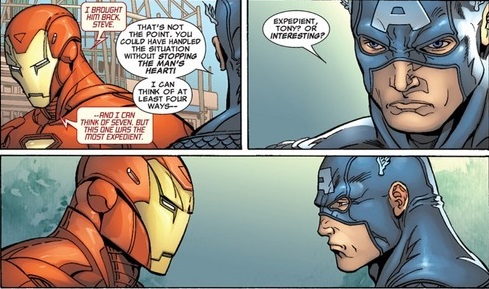
  • Captony_cwImagine you’re a leader in your community, fighting on behalf of a principle for which you are personally willing to sacrifice anything. Your own well-being is of no concern to you as long as your actions are protecting and promoting the ideal in which you believe so strongly. One day, however, you notice that your actions are hurting those around you, both those who are similarly invested in your cause as well as others who are not involved—including, perhaps, many whom you’re trying to help. You may even be winning the fight, until you notice that its costs, especially those borne by others, are simply getting too high to bear. Do you fight on, regardless of the cost, or do you stop, cutting the losses but losing the larger fight?

    This sounds like the type of hypothetical situation that philosophy professors give to their students to work through. But it’s not hypothetical to people around the world who fight for social justice, gladly sacrificing their own livelihoods for their cause, while perhaps also inflicting collateral damage on others. It’s also a situation that the superhero Captain America faced in the Marvel Comics storyline “Civil War” in which he defended the freedoms of his fellow heroes against a law that would compel them to reveal their secret identities to the government and register as agents of the state.

    Cap v batman 2When we think of complex and nuanced moral decision-making, comic book superheroes probably don’t immediately spring to mind. If they did, most people would choose the psychologically complex Batman rather than the flag-waving Captain America. “Cap” is often criticized, by fans in the real world as well as his fellow heroes in the Marvel Universe, as embodying old-fashioned, “black-and-white” ethical thinking that is anachronistic in our modern, morally ambiguous world. What Cap actually shows, however, is how values are of no use in realistic moral dilemmas without the essential faculty of judgment.

    Each of the three major schools of moral philosophy needs the help of judgment to result in specific actions. Unique among them, virtue ethics highlights the importance of nuanced and contextual decision-making, such as in Aristotle’s emphasis on practical judgment (phronesis). Virtue ethicists recommend the cultivation of character traits such as honesty that promote moral action but stop short of formulating rules to guide it, leaving it to judgment to determine how to balance virtues in any given ethical dilemma.

    Tony utilJudgment is essential to the other two schools of ethics as well, although this is often minimized in favor of their rule-focused aspects. Utilitarianism seems straightforward once you get to the final step, adding up the effect of individual utilities and comparing this sum to alternatives. But the process of determining those utilities, as well as deciding whose utilities to include and which contingencies you want to account for, require judgment—and the result can have an enormous impact on whether the utilitarian calculation results in a “yea” or “nay.”

    Deontology, which emphasizes duties and principles, seems more clear-cut, avoiding the messy empirical details of moral dilemmas. But it has no obvious way to deal with conflicts between two duties or principles, nor to decide when the costs of standing by principle become too great. Even Immanuel Kant, a strict deontologist, stressed the necessity of judgment, which he considered “a peculiar talent which can be practiced only, and cannot be taught” (Critique of Pure Reason, A133/B172). As Onora O’Neill wrote about Kant, “Discussions of judgment . . . are ubiquitous in Kant’s writings. He never assumes agents can move from principles of duty, or from other principles of action, to se­lecting a highly specific act in particular circumstances without any process of judg­ment. He is as firm as any devotee of Aristotelian phronesis in maintaining that prin­ciples of action are not algorithms and do not entail their own applications” (“Kant: Rationality as Practical Reason,” in The Oxford Handbook of Rationality, edited by Alfred R. Mele and Piers Rawling, p. 104).

    Cw7While Captain America’s moral character is based on virtues and duties—giving the impression of simplistic, “right and wrong” thinking—he shows the importance of moral judgment in balancing these moral factors before making a decision. Take the example from the Marvel “Civil War” that led off this essay: at the end of the story (Civil War #7, January 2007), Captain America and his allies were winning the climactic battle against Iron Man and other heroes defending superhero registration. As Captain America was about to deliver the final blow against his fellow Avenger, a group of ordinary people pulled Cap away and showed him how the battle had destroyed much of Manhattan. After realizing how much the battle was costing the residents of New York, he signaled to his allies to stop fighting and surrendered. Cap didn’t abandon his principle of freedom; he simply decided it was no longer worth the cost it was imposing on others. His values didn’t change—but his judgment did.

    Simple rules such as “stand by your principles” or “minimize harm” are no good in situations like this. Captain America had to keep both of these rules in mind and balance them using his judgment. As Kant emphasized, there is no way to explain judgment as a rule or algorithm; rather it is what a person turns to when rules or algorithms fail to solve a moral problem. In this way judgment resembles Ronald Dworkin’s theory of judicial decision-making, in which a judge balances the various principles relevant to a “hard case” according to the principles and ideals he or she believes best explain the broader legal system. Similarly, in a moral dilemma a person must balance his or her various principles and beliefs to arrive at a decision that maintains the integrity of his or her moral character.

    Capjudgment003Captain America’s core principles and virtues may be “black and white,” but the way that he balances them is complex, nuanced, and sensitive to context. In the dramatic, life-threatening situations he faces in his comic books and movies, Cap demonstrates how the basic ideas of ethics serve merely as guidelines that by themselves cannot determine the best or right action on their own. As the narration to Captain America, vol. 1, #184 (April 1975) read, "he thinks in principle… tempered on the forge of understanding, and honed to the edge of reality." Moral philosophy can help identify the critical elements of a problem, but each person’s judgment is crucial to finding what Dworkin called (in the context of jurisprudence) the “right answer,” the one that is consistent with his or her moral character. By doing so, we can craft our own character much like Cap’s writers craft his—with or without the red, white, and blue costume.


    For more on Cap and philosophy, pick up The Virtues of Captain America: Modern-Day Lessons on Character from a World War II Superhero, available now.

  • Mark D. White

    Family eatingLast week I submitted the manuscript for a book that argues that all measures of well-being or happiness are arbitrary and reflect the judgments of those who designed them, rather than the interests of the people whose well-being is ostensibly measured. (A precis of sorts for the book appeared in this article, published late last year.)

    Last week The Telegraph provided a perfect (if a bit outrageous) example of this in an article titled "Family mealtimes to become official measure of national ‘happiness’." The article begins:

    Eating meals together as a family is to be officially recognised as a mark of happiness as part of David Cameron’s plan to measure Britain’s national “well-being”.

    For the first time, the number British families who maintain traditional mealtimes is to be monitored, under plans to expand the so-called “happiness” index.

    Children as young as 10 are to be asked how often they argue with their parents and whether they are being bullied at school, including Internet bullying.

    They will also be asked to share how they feel about their personal appearance, whether they can confide in their parents about problems and whether they have signed up to social networking sites such as Facebook.

    Before I get to the broader issue here, let me say that these "elements of happiness" are not uncontroversial. Family mealtimes are usually good, sure, but being signed up to Facebook? The latter has been linked with some measures of happiness, and some have even questioned the mental health of people who aren't on Facebook. But this is hardly a settled matter, and it seems hasty (at best) to suggesting using Facebook enrollment in official government statistics meant to guide policymaking. (I hope you can appreciate the self-restraint required in keeping this paragraph relatively snark-free.)

    There are good arguments for composite indices of well-being (such as the United Nations' Human Development Index), but this latest effort by the British government seems more like a kitchen sink approach to measuring well-being. Are public policy decisions seriously going to be taken based on Facebook enrollment and family mealtime frequency? Do British policymakers actually think this will capture the well-being of their citizens accurately enough to guide policy decisions in their interests?

    Clearly somebody feels that these aspects of life are important to the well-being of the British people. This is what philosopher Sissela Bok meant when, in her book Exploring Happiness, she compared happiness measures to Rorschach tests: they often reveal more about those who designed them then about those whose happiness they are used to assess. The question is whether any haphazard collection of statistics about daily life—even those shown to have some connection to some measure of well-being—can hope to accurately capture the interests of any one person, much less a nation's entire population, in order to ground responsible and effective policy decisions.

    In the article linked above and my forthcoming book, I argue that the answer is a resounding no. A person's interests are complex, multifaceted, and subjective, and they're combined and balanced in ever-shifting ways by his or her judgment before they issue in a choice that reflects them. No statistical measure of happiness or well-being can even begin to approach people's true interests, and governments should stop pretending they can. This practice is ineffective, wasteful, and—more important—disrespectful to their citizens' right to live their lives as they wish (consistent with all other dong the same).

    Instead, I argue that governments should focus on restructing laws and other institutions to enable the maximal freedom possibe for people to pursue their own interests, while focusing on addressing problems that present themselves—minimizing suffering where it exists rather than trying to maximize well-being according to measures they invent.