Mark D. White

Writer, editor, teacher

  • This month (and last) I've been quite busy with school matters, but there's also been plenty of time for other pursuits, such as…

    • Work continues on The Illusion of Well-Being; I've struggled with the structure and presentation of the argument, but I made a breakthrough recently, and things seem to back on track. (Lesson learned: Every book is different and must be treated as such.)
    • A good chunk of this month was spent reviewing the copyedits for The Virtues of Captain America — the copyediting was very light but I did an enormous amount of rewriting (plus adding a few references to comics that had come out since I submitted the manuscript, including the conclusion to Rich Remender first arc on Captain America and Warren Ellis and Mike McKone's graphic novel Avengers: Endless Wartime).
    • I submitted abstracts to the spring 2014 meetings of the Association for the Study of Law, Culture and the Humanities and the Law and Society Association, based on my delayed law-and-economics book project.
    • I accepted a generous invitation to speak to the PPE program at Duke University in early November, where my book The Manipulation of Choice was assigned in a capstone seminar class.

    And a few online items that may merit a note:

  • Mark D. White

    There’s been a lot of discussion of late regarding economics’
    claim to be a science; Harvard economist Raj Chetty recently answered this question
    in the affirmative
    in The New York Times
    in response to mutterings about Robert Schiller and Eugene Fama sharing the
    2014 Nobel Prize (with Lars Peter Hansen) despite having different views on the
    efficiency of financial markets. Several months ago, Phil Mirowski (Notre Dame)
    made headlines criticizing neoclassic economics and its claims to be a science
    while discussing his book, Never Let a Serious Crisis Go to Waste: How Neoliberalism Survived the Financial Meltdown.

    All of this makes me wonder: why is it so important to decide whether economics
    qualifies as a Science anyway? (The pretentious superfluous capitalization is
    intentional, by the way, representing the quasi-religious importance placed on
    this title.) Some thoughts follow below the fold…

    (more…)

  • Mark D. White

    I read with great interest Amia Srinivasan's contribution to the New York Times' philosophy column "The Stone" titled "Questions for Free-Market Moralists." After introducing the political philosophies of John Rawls and Robert Nozick, she states that "on the whole, Western societies are still more Rawlsian than Nozickian: they tend to have social welfare systems and redistribute wealth through taxation. But since the 1970s, they have become steadily more Nozickian." Then she presents four statements that she claims describe Nozick's minimal state — and are representative of what she terms "free-market moralism" — with which she assumes most people will not be comfortable. (Certainly not readers of The New York Times, by any rate.) But I'm not so sure, especially once we clarily what the four statements are talking about.

    The four statements are:

    1. Is any exchange between two people in the absence of direct physical compulsion by one party against the other (or the threat thereof) necessarily free?

    2. Is any free (not physically compelled) exchange morally permissible?

    3. Do people deserve all they are able, and only what they are able, to get through free exchange?

    4. Are people under no obligation to do anything they don’t freely want to do or freely commit themselves to doing?

    For each statement, Ms. Srinivasan provides an example of what such a world would look like: for instance, after statement #2, she suggests the following. (Note that this example also invokes statement #3 about inherited wealth.)

    Suppose that I inherited from my rich parents a large plot of vacant land, and that you are my poor, landless neighbor. I offer you the following deal. You can work the land, doing all the hard labor of tilling, sowing, irrigating and harvesting. I’ll pay you $1 a day for a year. After that, I’ll sell the crop for $50,000. You decide this is your best available option, and so take the deal. Since you consent to this exchange, there’s nothing morally problematic about it.

    This example points out my problem with Ms. Srinivasan's argument: she conflates political philosophy with moral philosophy. It is perfectly consistent to maintain, as in statement #2, that free exchanges are morally permissible while also believing that that is something morally problematic with the situation described above — as long as you don't subscribe to a perfectionist system of morality that fails to distinguish between forbidden and merely "problematic" actions.

    But there's more. Statement #2 really isn't speaking to morality — instead, it's talking about legality that's simply based on a certain morality. How statement #2 should be read (based on my understanding of Nozick, at any rate) is as saying that the state has no moral basis to question free exchanges. Of course, the situation above is distasteful to most, but does this mean should it be forbidden by law? This is a different issue than the one Ms. Srinivasan addresses in her example — and I suspect many would answer "no, it shouldn't be illegal" even if they regard the landowner's behavior as despicable. This doesn't imply a moral free-for-all, but simply a state that stops short of legislating all moral (or immoral) behavior.

    Consider also Ms. Srinivasan's example for statement #4 regarding forced obligation:

    Suppose I’m walking to the library and see a man drowning in the river. I decide that the pleasure I would get from saving his life wouldn’t exceed the cost of getting wet and the delay. So I walk on by. Since I made no contract with the man, I am under no obligation to save him.

    The problem of duties of beneficence is an old and well-worn one in moral philosophy: while most would say we do have a general obligation to help those in need when it would come at little cost to ourselves, not as many would be willing to make that a strict requirement, much less a legal one (though some jurisdictions have). Ms. Srinivasan seems to draw a extreme and false dichotomy between coerced beneficence and rapacious self-interest — I would like to think that no matter what kind of state we live in, people would still extend a hand to those in need when they can. (Furthermore, I see no reason to believe this would be any more likely to occur in a Rawlsian system where the state, not the individual, is the party understood to do most of the helping.)

    As I understand him, Nozick was describing a state that enables people to make choices when they don't wrongfully harm others, and the market was but one framework in which they could do that. (For that reason, I disagree with the term "free-market moralist," but that's of little concern.) He did not, as Ms. Srinivasan writes, maintain that "the market can take care of morality for us," nor did Rawls hold that morality was the sole responsibility of the state. Fundamentally, Rawls and Nozick differed on the degree to which the state should exercise individuals' collective responsibility to each other on their behalf. Neither Rawls nor Nozick denies a role for private morality outside of the state. But Nozick and the "free-market moralists" believe that individuals, as parts of families and communities, bear the bulk of the responsibility to take care of one another, a responsibility borne voluntarily and, yes, imperfectly (unlike how perfectly the state conducts it, of course).

    Ms. Srinivasan also holds Nozick's system to an incredibly high standard, arguing that to concede any weakness in any of the four statements "is to concede that the entire Nozickian edifice is structurally unsound. The proponent of free market morality has lost his foundations." But she neglects to mention the problems with Rawls' system, especially the very particular psychological assumptions that ground the "results" of the veil-of-ignorance exercise — a brilliant metaphor also found in the work of other philosophers and with various predictions regarding the terms of the social contract.

    Ms. Srinivasan states clearly that she believes that Western societies should be tilting back towards Rawls (I would say "further" rather than "back," but that's a difference of interpretation) and away from Nozick. Fair enough — we disagree on that. But she makes Nozick's system an all-or-nothing proposition while ignoring problems with Rawls, and further misinterprets Nozick's work as describing the whole of morality rather than the operation of the state alone. In the end, her article shows a troubling lack of faith in people to care for each other outside the confines of the state — and an overly optimistic belief in the power of the state to do the same.

  • Well.

    I'm growing less and less comfortable with the idea of active self-promotion, especially when I seem to have less and less to promote. I'm tempted to abandon this experiment with timely "hey, look what I done did now" updates. Maybe I should make them shorter and more frequent when things come up to announce (akin to a Tumblr but by Jove with vowels placed where they are duly needed), or maybe I should just close this blog and keep the rest of the site as a resource for finding my work (a.k.a. passive self-promotion). Or maybe I'll use this space for album and movie reviews, interesting links and articles, or (egad) ruminations on life. (This sunny attitude is part and parcel of my ongoing reconsideration of where my life and career are going… move along, nothing to see here.)

    Anyway.

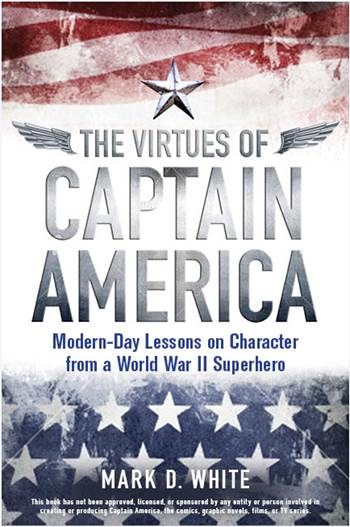
    CapIf you caught my subtle hints in my August post, you'll have guessed that the book shown to your right (my left) is the project I wrapped in July: The Virtues of Captain America: Modern-Day Lessons on Character from a World War II Superhero, which comes out from Wiley-Blackwell in March 2014, ahead of the Captain America movie sequel the following month. You can read more about it at The Comics Professor, and the smaller picture to your left (my right) will take you to Amazon where they will be more than happy to let you pre-order it.

    Meanwhile, along with the usual fits and frustratations associated with chairing an academic department in CUNY (even one a quarter the size of the one I chaired previously), work continues apace on The Illusion of Well-Being (sole-authored) and Economics and the Virtues (co-edited with Jennifer Baker), as well as a new project I signed on for since we last spoke: a two-volume edited set from Praeger titled The Insanity Defense:
    Multidisciplinary Views on Its History, Trends, and Controversies
    , for which I already have several top people in the field(s) recruited. (Friends have joked that if I don't finish it, I have a ready-made excuse!)

    In terms of print and electronic work, I can offer the following:

    Until next time, my friends…


  • Cap coverWell, it's time to let the Cap out of the bag… I'm very pleased to announce my next book, The Virtues of Captain America: Modern-Day Lessons on Character from a World War II Superhero, which will be published by Wiley-Blackwell next March ahead of the film sequel Captain America 2: The Winter Soldier. (If you're so inclined, you can pre-order it now from Amazon.)

    Unlike the books I edited or co-edited for the Blackwell Philosophy and Popular Culture series (such as Batman and Philosophy), this one is written solely by me—for better or for worse! Also, rather than presenting a survey of philosophical ideas presented through the lens of its topic, The Virtues of Captain America has a specific focus: showing how the "old-fashioned" ethical code of Steve Rogers is just as essential today as it was in the past, not only as a role model for individual character but also as a way out of America's current political divisiveness.

    I had several goals in mind as I wrote this book:

    • Similar to the approach of the Blackwell Philosophy and Popular Culture series, in this book I introduce basic concepts of moral philosophy, especially virtue ethics, using examples drawn from decades of Captain America stories. In particular, I wanted to address the complexity of moral decision-making, for which simple rules, formulas, and virtues can be a guide but never the final answer. For this reason, judgment is a constant theme in the book (and takes up an entire chapter in itself).
    • I wanted to address the perception that Captain America's ethical code is anachronistic, simplistic, and "black and white." As I argue throughout the book, none of these could be farther from the truth. The ideals that ground Cap's ethics are timeless, and while his core principles may be simple, the process of using judgment to balance them to make moral decisions in specific circumstances is anything but black-and-white, as Cap shows time and time again in the comics.
    • More ambitiously, I wanted to show that Captain America's relationship to his country—in particular, the way he emphasizes principle over politics—can help Americans in the real world to start to heal our radical political divisions. If we focus, as Cap does, on the core ideals of justice, equality, and liberty that Americans share, we can better put into context our differences of opinion regarding how best to put these ideals into practice.
    • And, most personally, I wanted to share my love of this classic superhero character through his decades of stories in comics such as Captain America, Avengers, and the countless other titles in which he's appeared over the years (hundreds of which are cited in the book). In the process, I also pay tribute to the dozens of talented creators who have crafted his stories, starting with Joe Simon, Jack Kirby, and Stan Lee, and continung with legends such as Jim Sternako, J.M. DeMatteis, Mark Waid, Ed Brubaker, and Paul Jenkins (just to name a few).

    I'm sure to bombard you with more details and sneak peeks as the book approaches publication, but for the time being, you might like the following articles and blog posts I've written about Cap in the past (many of which laid the groundwork for the book):

    Finally, I discussed Captain America, directly or indirectly, in a number of chapters in the Blackwell Philosophy and Popular Culture series:

  • Mark D. White

    CoaseI am extremely saddened to say that Professor Ronald Coase passed away on September 2, 2013. He had a tremendous impact on economics, writing two seminal papers, "The Nature of the Firm" and "The Problem of Social Cost," that paved the way for both law-and-economics and new institutional economics and were the chief citations for his Nobel Prize in Economics in 1991. My copies of his books The Firm, the Market, and the Law (containing the two papers above) and Essays on Economics and Economists are well-worn but I still benefit every time I return to them. Always skeptical of excessive formalism, in recent years he had been working to return the focus of economics to real-world concerns with a new journal titled Man and the Economy.

    He was a tremendous influence on me and my thought, and I will miss him dearly.

  • Cap10

    Today's Captain America #10 concludes the Dimension Z storyline that launched the Marvel NOW! volume of Cap's title (volume 7 for those of you playing along at home). It points to a revised status quo for the Sentinel of Liberty–and one of his supporting characters–as he escapes Zola's dimension in which he has spent over a decade, during which less than an hour passed in his own world. Also, he spent this time raising a young boy, Ian, as his son, only to lose him when he was shot by Sharon Carter when she arrived to rescue Cap. 

    SPOILERS BELOW THE JUMP


    (more…)

  • Mark D. White

    Recently it was David Brooks, today it's Peter Reiner writing at Slate, reporting that people are less opposed to nudges the more they align with their interests, and interpreting this as weakening the case for autonomy.

    Using the crowdsourcing website Mechanical Turk, we polled 2,775 people, asking
    them to what degree they were willing to trade autonomy for better outcomes when
    presented with nudges that helped with everything from healthier food choices to
    spending money more wisely. The short answer is just what one might expect:
    Sometimes they liked the nudges and other times they didn’t. When we presented
    people with nudges that clearly allowed them to deliberate on the issue—to fully
    authenticate the decision—participants in our surveys were more receptive than
    when the nudges appeared to manipulate them by tapping into subconscious
    thinking. But overall people were not terribly averse to being gently pushed in
    the “right” direction. Apparently, autonomy is not quite as exalted a value as
    libertarians might believe.

    In fact, this reinforces the value of autonomy, which is more about having a measure of control over how one's life is conducted rather than simply making individual choices freely, and easily encompasses self-constraint if freely chosen. The people above preferred nudges that were consistent with autonomy, those that "clearly allowed them to deliberate on the issue" and "fully
    authenticate the decision." These are not, however, your ordinary nudges, which subvert the rational decision-making process, relying on cognitive biases and heuristics to generate their intended effect.

    Also, like Brooks, Reiner does not seem to appreciate that the interests promoted by nudges are not people's own interests, but rather policymakers' idea of those interests (as I explain in The Manipulation of Choice). Again, Reiner states that "when people recognized that their objectives in life aligned
    with the nudge and knew that they were struggling with achieving that
    objective
    , they generally endorsed the nudge" (emphasis in original). Of course they did, again consistent with autonomy and choice. If Mary is trying to lose weight, she may very well appreciate a nudge that promises to help her eat less and exercise more. Her approval of this is akin to joining Weight Watchers: a deliberate action to constrain her own choices, which is a reflection of her autonomy as well as a recognition of her own lack of self-control. This doesn't imply, however, that she'd welcome the nudge being forced on her; even if the nudge is truly in her interests, she may still value the option of approving the nudge herself.

    Reiner ends with:

    In a world awash with temptation, a mark of wisdom might be taking a hard look
    at ourselves and understanding the reality of our natural strengths and
    weaknesses. Were we to do so, we would likely welcome a helpful nudge now and
    then.

    "Now and then," yes, but we rarely have the choice. In cases such as Mary's, we often  recognize our own strengths and weakness and many of us welcome some help, whether in the form of nudges or not. The problem with most nudges, such as the paradigm cases in Thaler and Sunstein's book, is that they are not voluntarily chosen nor are they made apparent to the decision-maker. They are "helpful" only in the sense that someone else thinks we need help, because we are not making the choices they would have us make—in their idea of our interests.

    Mary might approve of a weight-loss nudge, but her friend Martha may not, feeling that it does not align with her interests. She prefers to exercise her autonomy by making her own choices free of paternalistic manipulation. Does she need "help"? Does she have a choice?

  • Cap001Whew. What a month July was.

    Most important, I finished the book that needed to be done by the end of the month—and one day early at that! Actually, I asked for and received an extra five days (until the first Monday in August), but it turned out that I didn't need them (or I did need them but didn't realize it!). I'm still not ready to talk about at length; for now I'll just say that it has more than a little to do with that fella at the right.

    And now it's straight into my follow-up to The Manipulation of Choice, titled The Illusion of Well-Being, which broadens the former book's argument about value substitution to welfare economics and policymaking in general. (A short editorial on the topic was just accepted to the Review of Social Economy; I'll let you know when it's availabler online.) While I work on that, as well as editing Economics and the Virtues with Jennifer A. Baker and staring down the school year that starts in late August (with no help whatsoever from Jennifer), I am also looking into several new book projects, including several more edited volumes, a textbook, and a follow-up to the July book (which will be quite a stretch but I'm on fire to do it). Keeps me off the streets and out of trouble.

    I did manage a couple blog posts during July (and one earlier today):

    If anything significant happens this month, I'll try to make an update before school starts, but until then, enjoy the rest of summer!


  • Mark D. White

    In today's New York Times, David Brooks comments on libertarian paternalism in "The Nudge Debate." There is not a lot in his article that is surprising or unreasonable, but it does suffer from some vagueness and misunderstandings. For instance, Mr. Brooks conflates interventions of a paternalistic nature (such as nudging people into retirement plans) and those of a nonpaternalistic nature (such as nudging people into registering for organ donation). While the mechanisms in both cases are similar—and raise the same issues of unconscious manipulation and subversion of rational decision-making processes—the purposes and motivations are very different, with only the former involving the policymakers substituting their interests for those of the decision-makers themselves.

    Of more concern is Mr. Brooks' contention that libertarian paternalism does not involve value substitution. He writes,

    Do we want government stepping in to protect us from our own mistakes? Many people argue no. This kind of soft paternalism will inevitably slide into a hard paternalism, with government elites manipulating us into doing the sorts of things they want us to do.

    As I explain in The Manipulation of Choice, there is no way for the government to know what we value well enough to help us make decisions in our own interests. Because they lack this information, policymakers necessarily impose their idea of people's interests on them when they design nudges. Policymakers think that it's in our interests to save more; policymakers think that it's in our interests to drink less soda. These are not unreasonable assumptions, of course, but they are assumptions nonetheless, and it is pure hubris on the part of policymakers to presume that they bear any necessary relationship to people's actual interests.

    Because Mr. Brooks apparently doesn't recognize this, he concedes the "theoretical" point but dismisses any real-world concerns:

    I’d say the anti-paternalists win the debate in theory but the libertarian paternalists win it empirically. In theory, it is possible that gentle nudges will turn into intrusive diktats and the nanny state will drain individual responsibility.

    But, in practice, it is hard to feel that my decision-making powers have been weakened because when I got my driver’s license enrolling in organ donation was the default option. It’s hard to feel that a cafeteria is insulting my liberty if it puts the healthy fruit in a prominent place and the unhealthy junk food in some faraway corner. It’s hard to feel manipulated if I sign up for a program in which I can make commitments today that automatically increase my charitable giving next year. 

    This last paragraph is illuminating, because it conflates three different types of nudges. The first, organ donation, is a social issue; such a nudge is not paternalistic and therefore does not raise any issues of value substitution (though, as I said above, the mechanism still subverts rational processes). The third, self-commitment, is vague; there is nothing manipulative in the concept of commitment, but if such commitment is elicited using a nudge that bypasses a person's rational decision-making faculties, then it's a problem. Only the cafeteria example is by definition a paternalistic intervention; Mr. Brooks may not be insulted by the management of the cafeteria putting their idea of his interests above his own and manipulating his actions in those imposed interests, but that does not justify an action which would insult many others.

    Finally, I do not see the issue of libertarian paternalism as one of theory versus empirics—in the case of paternalistic interventions, the theory iself discounts any attempts to measure its success. Mr. Brooks finishes the paragraph above with this sentence: "The concrete benefits of these programs, which are empirically verifiable, should trump abstract theoretical objections." In the case of paternalistic interventions, the "theoretical objections" render any "concrete benefits" questionable and inherently unverifiable. How do you measure the "concrete benefits" of an action meant to improve people's choices according to their own interests if you have no way to ascertain those interests? Such knowledge is necessary in order to "verify" any benefits from such a program. With socially-motivated nudges, like automatic enrollment in organ donation programs, this makes some sense, but with measures explicitly intended to "help" people better make decisions in their own interests, the idea of verifying "concrete benefits" makes no sense whatsoever, given the inherent subjectivity of those interests.

    Rather than an issue of theory versus evidence, the nudge debate is a matter of autonomy. Each person's right to further his or her own interests, in a way consistent with all others doing the same, is violated by policymakers who impose their own conception of people's interests on them and then design policy tools that subvert people's rational decision-making processes to steer them towards those imposed interests. Given Mr. Brooks' antipathy towards individualism, I am not surprised that he disregards concerns about autonomy as an "abstract theoretical objection." To some, however, the right to pursue their own interests without the government questioning them is a very "concrete benefit" to living in a free society.

    Then again, if policymakers really knew our true interests, they'd know that already, wouldn't they?