Mark D. White

Writer, editor, teacher

  • Superman unchained 2In Superman Unchained #2, Scott Snyder and Jim Lee show Superman facing insurmountable odds at the hands of an unknown but incredibly powerful foe. Rather than relying on brute force and heat vision to try to save the day, "this a Superman who is all about taking a deliberate, systematic approach to the business of being a superhero," as Forrest Helvie notes in his review at Newsarama. He continues:

    There is a certain way that the Man of Steel thinks through every step he will take to save the day. But instead of being an uncomplicated tactician who’s able to think himself out of every situation, which would feel somewhat two-dimensional, Snyder subtly sneaks in a little more nuance to his vision of Superman. There are various plans he could employ to deal with the situation he faces in the beginning of the story with varied outcomes, some of which would necessarily include civilian casualties.

    Rich Johnston at Bleeding Cool emphasized the trade-offs in terms of lives saved that we see Superman explicitly considering (thanks to inner dialogue—Superman’s, that is, not Rich’s). He does find a way to save the day—Superman again, not Rich—and as Rich puts it, “Situations avail themselves, and there is an answer to be found. But there might not have been, we see here a Superman willing to sacrifice some to save more.”

    Forrest and Rich capture much of what I appreciated about what Snyder and Lee did in this comic:

    1. They showed Superman facing what a situation in which he might not be to save everyone and determining which course of action would save the most lives. (I've written about the need for even Superman to use this kind of moral judgment in Superman and Philosophy and elsewhere on this blog.)

    2. In the end, Superman saved everybody, even when—especially when—it seemed that he couldn’t. As I wrote in my commentary on the Man of Steel film, that’s what Superman does. Just when you think all is lost, there's no way he can win or save everybody, he does. Because he's Superman.

    It’s easy to write Superman into a situation in which there’s no easy solution, a tragic dilemma from which he “cannot escape with clean hands.” It’s much harder—but more gratifying to fans of the classical Superman concept—to write a situation like that, from where there's no way out, and then show Superman figuring a way out anyway.

    Call me old-school—I’ve certainly been called worse—but when I read a superhero story, I expect to see the hero faced with unbeatable odds, wonder to myself “how will my hero get out of this one?”, and then when he or she does, think to myself, “wow, I would have never thought of that!” When I was a kid, my first thought may been about the hero and how smart and strong he or she was. But now that I’m older—much, much older—I give more credit to the creators, in this case Snyder and Lee, not just for being clever enough to develop a fresh take on a well-trod comics plot device, but also for retaining the classic sense of heroism that fans like me want from our superheroes.

    To me, it seemed like the writers of Man of Steel wanted to show that they could "beat" Superman by writing him into an impossible situation, exclaiming "a-ha, we got 'im!" and pounding another nail in the coffin of fans' "foolish" idealism. Instead, Snyder and Lee are giving us a Superman who acknowledges difficult decisions but rises above them, showing that true heroism rises above defeatism. Luckily for fans like me, Snyder and Lee's "S" does stand for hope after all.

  • I'm not a big fan of summer—give me January over June any day!

    That said, it was a productive if not particularly eventful June. I spent most of my time on a book that needs to finished by the end of July—and will be, thanks to a good June! (I'm still not ready to talk about it, but when I am, you're hear more than you ever wanted to!)

    However, I managed to write a litte in other venues:

    Finally, some professional news I finally feel free to share. As of July 1, the academic department I currently chair—the Department of Political Science, Economics, and Philosophy (PEP) at the College of Staten Island—will no longer exist. Following a unanimous departmental vote, I worked closely with several members of my department and key adminstrators at the college over the last year to split the PEP Department into three separate departments. I was honored to receive invitations to join all of them—and I hope to continue to teach classes in all three areas—but my heart and mind belong to philosophy, so I will be joining and chairing the new Department of Philosophy.

    Now I return to writing, and I'll leave you with Der Bingle singing the song that lent its title to this June update:

  • Mark D. White

    Recently, at The Weekly Standard, David M. Smick opined in a piece titled "The Death of Economics" on the decline of the field over the last 50 years, focusing on the last decade in particular and the increasing hubris among policy-oriented economists:

    For decades, hubris has been the common currency of the economic policy world. It is killing the economics profession. In the 1960s and 1970s, for example, liberal economists believed they could eliminate all poverty. In the 1980s, conservatives thought tax policy could permanently raise the savings rate. It turns out other factors also influence a person’s decision to save.

    In the first decade of this century, some central bank economists thought they could engineer monetary policy (with the help of global capital inflows) to eliminate the U.S. business cycle. What happened? The underpricing of financial risk helped lead to the global financial crisis.

    After outlining the perilious state of the world economy (for those who haven't noticed), he asked some probing questions, such as how we can know when much debt is too much debt; how we can hope to understand entrepreneurship and its relation to regulation; and how we can stop making "the little guy in America the permanent fall guy." He concluded:

    An economic policy rethink won’t be easy. But the first step is to deep-six the hubris. This year should mark the death of all government five-year economic forecasts.

    I agree, as I've written before. As Smick stated in the beginning of his piece, a five-month forecast might be reasonably accurate, but a five-year forecast… fuggedaboutit.

    But I found this statement from the middle of the piece more intriguing:

    So at worst, the field of economics is dying. It is becoming less a science and more an art.

    Let's not go that far… yet. Economics is dying only if one conceives of it as a science like physics in the first place. If one doesn't, however, one can see economics emerging from this internal crisis a more holistic, thoughtful—and yes, ethical—discipline.

    • An economics which doesn't purport to understand and model the entire economy in precise quantitative terms (reflecting the hubris Smick decries), but one which uses sound qualitative judgment, based on experience, to move economic indicators by small increments in the desired direction, reflecting improvement in people's lives.
    • An economics that doesn't claim to have "the solution" to a crisis, but has a good idea what to do to get there (in the sense described above).
    • Finally, an economics that will assess its own progress and will admit when the first choice of action has failed and it needs to move to the second one.

    If economics were reconceptualized along these lines, it would resemble neither science nor art, but rather practical philosophy—which, after all, is how it all started. While economists trained in the current quantitative, positivistic paradigm would resist it, I believe this approach to economics would recapture people's faith in its predictions and recommendations—in no small part based on its humility rather than hubris.

  • MOSHmm. [Opens mouth to speak, nothing comes out.] Hmm.

    Before I start, a caveat: I couldn't help but notice the controversy over Man of Steel on Twitter, much of it involving Mark Waid, one of the standard-bearers for a view of Superman I share. Passions are running hot over this one, which is both good and bad—it's good that people are talking this much about a Superman movie (or a DC Comics movie in general), but it's disheartening that they're arguing over the fundamental nature of a character that should be well established by now. Anyway, I've avoided reading any reviews or commentary, so other people may very well have said what I'm about to say, and if so, likely much better.

    I'm going to offer some general comments about the movie, and then some discussion about some ethical topics raised by it. I'll keep the spoilers until the second part, and I'll warn you when they're coming.

    First, Man of Steel as a movie (not as a Superman movie): I liked it. I loathe long films—90 to 100 minutes is perfect as far as I'm concerned—but even at 143 minutes it didn't feel long, and no parts of it dragged. Henry Cavill impressed me as Clark/Superman, having only seen him in The Tudors, and Amy Adams (whom I've seen in most everything she's done) played an effective Lois, but neither blew me away. The finest perfomances by far were Russell Crowe as Jor-El and Michael Shannon as Zod—both stole every scene they were in, and interactions between them were marvelous to watch. (The filmmakers cleverly found a way for Jor-El to appear throughout the movie despite… well, you know.)

    The action scenes were spread throughout the movie nicely, broken up by emotional dialogue or flashback. This was important, because the action scenes themselves were intense—while there was little blood, there was more than enough destruction and explosions to earn the PG-13 rating. (I would not be comfortable taking my kids, 5 and 10, to this movie, and they've seen all the recent Marvel superhero movies.)
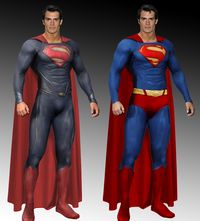
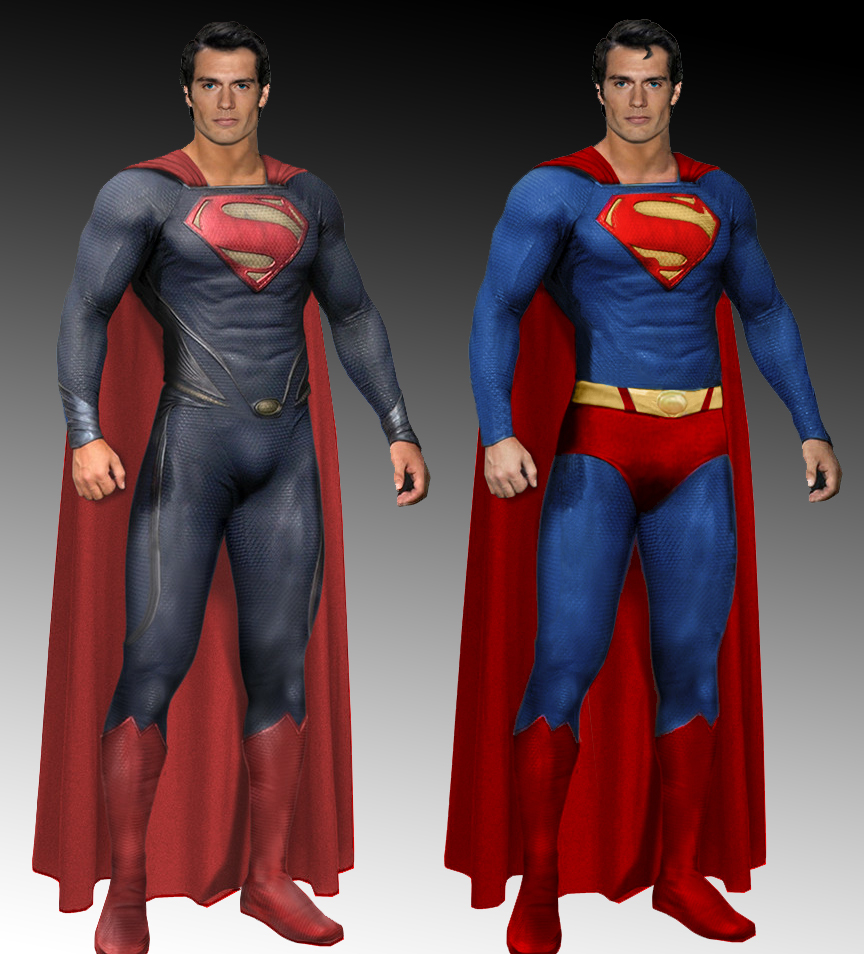
    Superman costumeVisually, the movie was very stylish. While the Smallville and Metropolis scenes were by necessity reminiscent of past depictions, the designs of Krypton and Kryptonian technology were breathtaking, from their 3-D sculpting technology (for lack of a better term) to the armor the Kryptonians wore on Earth. But the movie was just so dim, like it was all shot through a fine gauze. There were no bright colors at all: Krypton was gray with accents of gray. Smallville was brown. Metropolis was—guess what—gray. And if you thought Superman would bring a ray of sunshine into any of this, you would be wrong. We've all seen the movie costume, all muted red and blue, with just a touch of muted yellow thanks to DC Comics' New 52 redesign. (And don't even get me started on the costume's texture, which reminds me of that rubber thingie you use to open the jar of pasta sauce that's been in your refrigerator since Superman Returns was out.)

    But the dull tinge of the movie matched its narrative tone well—this is a dark movie through and through. Not quite Nolan-Batman dark, but more like Webb's Spider-Man but with none of the humor. The team behind The Amazing Spider-Man was able to give us a superhero film starring an upbeat character that fit with the current times but still retained some of the irreverance we expect from Webhead. But Man of Steel, featuring a character whose big red "S" stands for hope, was sorely lacking in hope, optimism, or joy. This is definitely a movie for a generation that is more likely to look in the sky and say "it's a bird, it's a drone—yep, it's a drone" with little hope of seeing a hero.

    And nothing illustrates that point better than the ethics-loaded notes in the movie. This is where the SPOILERS start, so read on at your own risk if you have yet to see the movie.

    ———-

    I have very mixed feelings about how Man of Steel showed Superman's heroism and ethical decision-making. Don't get me wrong, there are several inspiring scenes of heroism in the movie, such as the scene from the trailers in which young Clark pushes the schoolbus out of the river (at the risk of revealing his powers), and the scene near the end of the movie in which he destroys the world engine while it robs him of his powers. Other characters get in on the action too: Lois, Perry White, and Jonathan Kent all get chances to be heroic. These were fantastic moments in an otherwise dour film.

    Unfortunately, these moments we expect from a superhero movie are overshadowed by other scenes that we don't. Clark/Superman makes some questionable moral choices in the movie, choices that may be understandable if any other person made them, but not Superman (or even any other cinematic superhero outside of Wolverine).

    I've written a bit the last couple years about Superman's need to use moral judgment, rather than his incredible powers, to resolve tragic dilemmas, conflicts in principles or duties from which he cannot excape "with clean hands." In the comics, this usually takes the form of Luthor leaving Lois dangling off the ledge at the top of a skyscraper in Metropolis while a tidal wave threatens to wipe out a town in Indonesia. What will Superman do? If he can't save both, he has to make a choice, and by necessity that choice will involve a foregone option.

    But guess what? In the comics, he manages to do both, to save Lois and the Indonesians. Because he's Superman. He does the impossible. He doesn't let the situation (or Lex Luthor) define his options—Superman defines his own options. He finds a way.

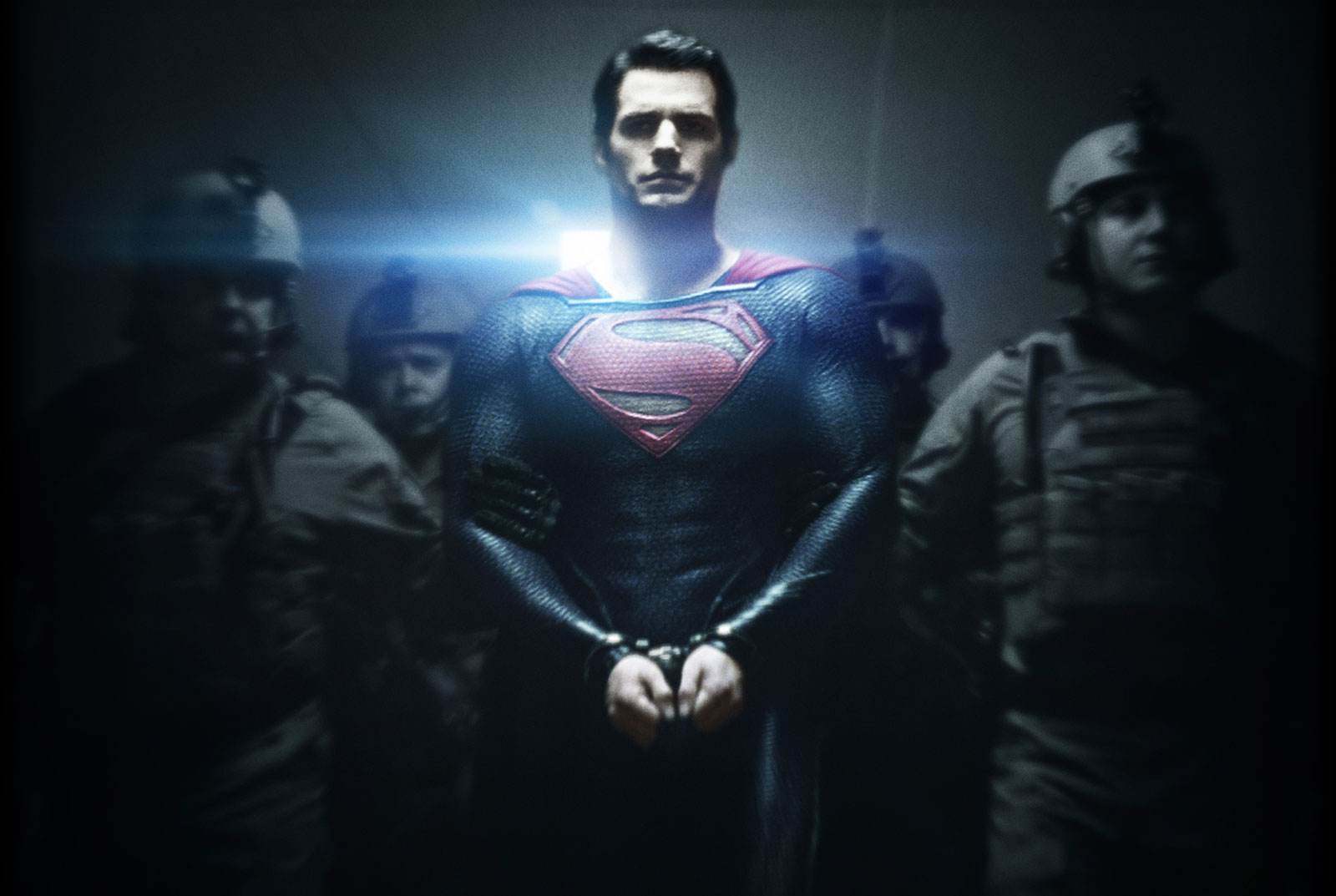
    This is most relevant to the end of the movie when Superman kills Zod. After Lois helped the government scientists send the other Kryptonians and their battleship back to the Phantom Zone, Superman faced Zod alone. Zod indiscriminately used his heat vision to reap destruction and murder on Metropolis, and even after Supes had him in a chokehold, the deadly rays from Zod's eyes crept closer and closer to a small group of innocent bystanders. At the last moment, Superman snapped Zod's neck; Zod fell to the ground and Superman fell to his knees in tears.

    Superman's remorse was obvious—and so was mine. (Not everyone felt this way; many in the theater cheered, which I've heard was not an uncommon reaction across the country.) This resolution to the story doen't work for me in a number of ways.

    First, if Superman had the strength and control to twist Zod's head to snap his neck, why couldn't he turn Zod's head just to divert it from the bystanders? I can let this one go: Zod is a more experienced fighter than Superman is, and perhaps Superman had to put the last of his might into twisting Zod's head without being able to moderate his exertion sufficiently to avoid killing him. Also, this is a young Superman, fighting a physical equal for the first time in his short career. I can excuse him for not having the experience and wisdom to consider other options—people were going to die and he had to make a choice. I get that.

    But I don't blame Superman for what he did in the story—I blame those who wrote the story and chose to portray Superman killing his opponent, presumably to make an "edgy" Superman for the 21st century. Even if I accept that Superman had no other choice in that situation, the people who made the movie had a choice whether to put him in that situation. They didn't have to show Superman killing someone—they chose to. They didn't even wait until the third movie, after his heroic ideals had been established and then his "necessary" compromise takes on more weight. No, they chose to show Superman killing someone in his first movie, thereby setting up his moral code for the rest of this appearances in this cycle of films. (Watch out, Luthor.)

    And I find that choice despicable. I know full well that tough decisions sometimes have to be made, and Superman is not immune to them. And I love stories that show that moral struggle. But I also love to see Superman find a way to rise above the moral struggle, to show us that if you try hard enough, think the situation through, and refuse to compromise, you can find a way out.

    This won't always work for normal human beings, but Superman isn't a normal human being. Superman is an ideal. The ideal. He shows us the best of what we can be. As Mark Waid said on Twitter, Superman shouldn't be written to more like us—he should be written so we want to be more like him. But this is not how the Man of Steel was written, and that's why it fails as a Superman movie.

    ———-

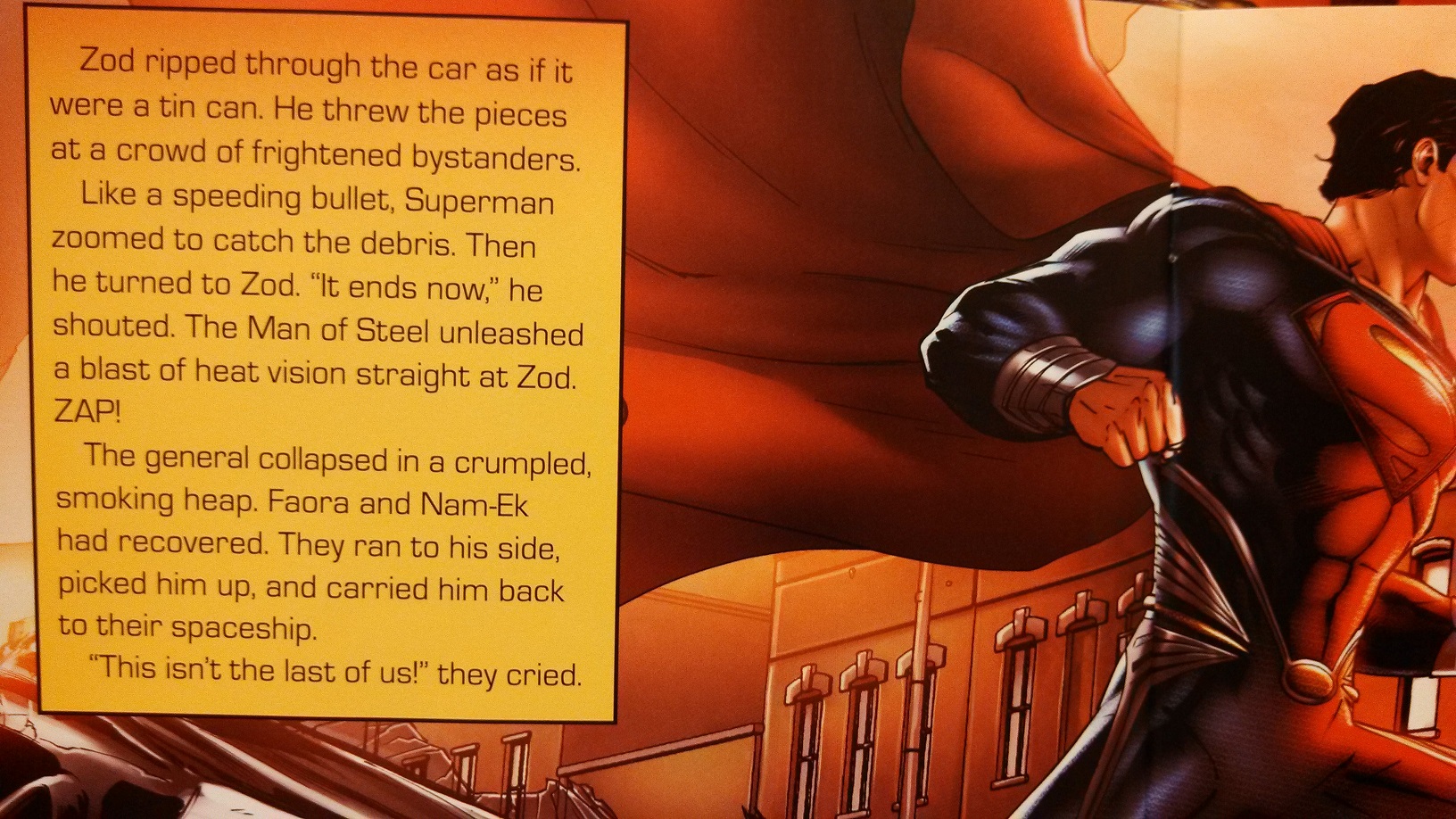
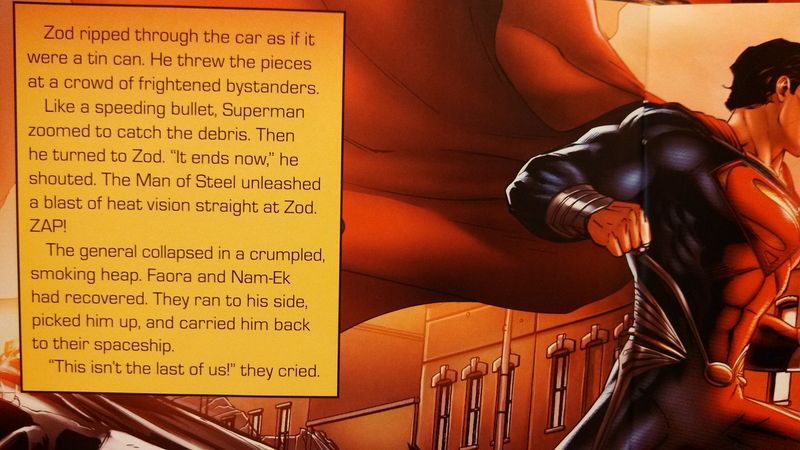
    I saw Man of Steel Friday afternoon, and Saturday morning I went to Barnes & Noble with my son, who loves superheroes. We always look at both the regular graphic novel section and the rack in the kids' section with superhero books. (And we might happen to pass the philosophy shelves in between, just to make sure all my books are facing outwards. I'm a helper.) There's a new book in the kids' section titled Man of Steel: Superman Saves Smallville that tells a simpler version of the story in the movie, including the climactic ending. But it tells the ending a little differently:
    Supes storybook

    So there were other ways to end the story without Superman killing his enemy—whew, and here I thought it was just me. (Ironically, the one reviewer so far at Amazon says even this book is too violent for small children!) Sure, in the storybook the villain got away. But that's one of the ways superhero movies usually end: either the villain is captured, gets away, or dies by his own hand (as the hero tries to save him, of course). More to the point, that's how Superman movies should end.

    Of course, we can easily imagine situations in which Superman would have no choice but to kill his enemy, and skilled creators could craft an engaging story around it. (See my chapter from Superman and Philosophy for one example.) But an argument can be made that not only would it be a bad Superman story, but that it would not be a Superman story at all. Superman isn't the guy who usually does the right thing—Superman is the guy who does the right thing by definition. Any less and it just isn't Superman.

    ———-

    Epilogue: I couldn't find anywhere to mention this, but I was also disturbed by the scene in which Clark lets his father walk into the path of the tornado to save the family dog and help people get to safety. I get that it was supposed to show Clark the folly of hiding his abilities at the cost of innocent lives. But it threatens to introduce an "Uncle Ben" aspect to the Superman mythos in which Clark would forever be plagued by the knowledge that his father died because he stood back. Furthermore, it made no sense in story: Clark could have done exactly what Jonathan did (rescue the dog and help people to safety) without revealing his powers, and in the process protecting his father. As shown, it was a confounding story element that introduces an unnecessary and possibly disturbing element to the Superman backstory—another disappointing choice on the part of the filmmakers.

  • Mark D. White

    The worst thing to do when I'm trying to write is have Twitter open. Not only is it distracting (obviously), but it can be positively engrossing. So why do I do it? Because it helps me keep me up-to-date on the state of the world and what smart people are saying about important things.

    In the last hour, I've seen two articles that pose questions, which I'll take a shot at answering—please feel free to offer your own answers in the comments below.

    Question: "Should We Trust Economists?" asks Noah Smith in The Atlantic.

    Answer: Yes, but with serious qualifications.

    Smith recounts some familiar and valid criticisms of economics and economists, largely focusing on the limitations of economic models and the lack of experimental data with which to test them. He falters, though, when he dismisses alternative approaches, such as Austrian economics, and in a particularly infantile and insulting way. (I'll leave it to my friends at Coordination Problem to address this if they choose.) Except for that piece, Smith gets a lot right. I'll just mention two reservations that Smith fails to address:

    a) Economists have a strong ideological and political bent, which consciously or unconsciously influences their work. This may be true of all scientists and researchers, of course, but the arbitrary and heuristic nature of many assumptions in economic models grants economists a great deal of discretion to insert their values and beliefs in their "scientific" models. So when an economists says "my model recommends stimulus" or "my model recommends austerity," keep in mind that this is not an entirely objective statement—nor can it be.

    b) Somewhat related to the first point, economists are much better at saying what will happen than what should happen (and that's true even if you're very doubtful about how well they know the former!). When economists say what should happen—that is, what the government should do or what society should aim for—they're assuming a certain goal which is not an economic concept but an ethical or political one, about which economics training lends little specialized insight. So to the extent we should trust economists, we should trust them to recommend ways to get different places, leaving it to our elected representatives, acting through us, to decide where we want to go. (Or, ask a philosopher!)

    So should we trust economists? Yes, if we restrict and temper that trust to focus narrowly on what economists do best—trace out the implications of various actions for key economic variables—and keep in mind the limitations of their prescriptions, based on both the limitations of economic science and the inherent ideology of economic models.

    Question: "The question libertarians just can't answer," which is: "If your approach is so great, why hasn’t any country anywhere in the world ever tried it?" This comes from Michael Lind at Salon.

    Answer: Many reasons, but the most important one is probably the temptation of power and the wealth it artifically creates, which libertarianism minimize. Even if we want to take a more optimistic approach, then I would cite the presumption of some people to think that a) they know what is better for other people and b) they have the right—nay, the responsibility!—to impose this better way of life on them. This is temptaton of a different sort, born of beneficence but grounded in hubris and disrespect. (I trust Bleeding Heart Libertarians will have more to add to this before long!)

  • So much for monthly updates, ha.

    To make a long story short, for the last three months I've been spending most of my time working on a book and managing quite a bit of change at school—both of which I hope to talk about soon—as well as giving invited talks, which I enjoyed. Because of those and other assorted things that can be lumped under the heading "life," I don't have much to show for the time since my last update.

    In terms of academic work:

    In terms of popular writing and blogs:

    I leave this afternoon for the Law and Society Association meetings in Boston; after I return, the summer push starts, and I'm hoping for a very productive three months, including a return to more regular blogging. (If nothing else, I have to have something to report here more often!)

  • As Zap2It reported early this morning, part of Grant Morrison's sprawling DC Comics series Multiversity will tell the story of a stranger from another planet landing in Nazi Germany rather than Smallville, Kansas:

    "Imagine you're Superman and for the first 25 [years] of your life you were working for Hitler," Morrison says, "And then you realize, 'Oh my god, it's Hitler!'" Morrison further explains, "Not only is he a Nazi Superman, he's a Nazi Superman that knows his entire society, though it looks utopian, was built on the bones of the dead. Ultimately it's wrong and it must be destroyed." The issue will see the caped hero going up against enemies he knows are right, as he comes to terms with the fact that the principles he was raised with are wrong.

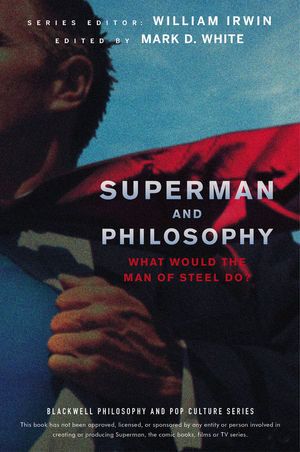
    Supes and philAs it happens, Robert Sharp explored this possibility in his chapter "Could Superman Have Joined the Third Reich? The Importance and Shortcomings of Moral Upbringing" in Superman and Philosophy: What Would the Man of Steel Do?. His tale starts like so:

    It’s 1926, and on a small farm with a few fields of wheat, a meteorite has just charred its way through a good bit of the crop. The farmer who owns the land is dismayed. His life has been hard since the Great War, even though prices for his food have skyrocketed, at least in terms of the actual bills carried around. In fact, one of his neighbors joked that he needed a wheelbarrow to carry around the cash to buy a loaf of bread, given how worthless the money had become. He and his wife are barely scraping by. Perhaps it is just as well that they had not been able to have children. Where would they find the money? His wife is fond of saying, “God will provide,” but sometimes he has doubts. And now a large part of his best field has been destroyed by a rock from space!

        As the farmer heads toward the damaged area, he calls back to his wife to bring a shovel in case there are any scattered fires to smother. He can see the hot smoke from the house, though the meteor itself is buried. His wife is almost half way to him when he reaches the crater, his eyes widening. “Magda!” he shouts, with a mixture of awe and anxiety, “Magda, bring a blanket! There is … a child!” The words seemed distant from him, as though said by someone else. His wife, believing she has misheard, runs toward him, shovel in hand.

        “Jonas? What is it? What is wrong?” she asks, her hands trembling. As she nears her husband she can see him, just emerging from some sort of space pod—a small boy! A gift from God! Her prayers are finally answered. Here in the German heartland, a miracle occurs, one that will soon have profound consequences for the world at large. The small child that had landed on Jonas and Magda Kuhn’s farm was the Übermensch himself, a “super man.” The Übermensch would vindicate Hitler’s claim that the New World Order would arise in Germany and prove that nation’s superiority.

        Only three years later, young Karl Kuhn, as he was named in the adoption papers, would join the Hitler Youth. Indoctrinated into the cause, his character was formed by the Nazi Party. He never knew any other life, and when the war finally came, Hitler used his young prodigy as the ultimate super-weapon. The war was over before it had begun, as the Allies had no counter to such raw power. A farm boy from the middle of nowhere had helped the Nazis take over the world.

    "…Or Not" is the title of the following section, and through the rest of the chapter Sharp explains the different ways this story could go and how moral character and develop influence it. (See also the four other chapters in the book on Superman and Nietzsche for more on the Übermensch—and why the true Übermensch may be named Lex.)

    As countless others do, I look forward to seeing Grant Morrison's version of this "what if" story in Multiversity—and in the meantime, be sure to pick up Superman and Philosophy!

  • Just a quick post to share a page from Matt Fraction and Joe Quinones' FF #6, featuring the Moloids (Mik, Korr, Turg, and Tong), which seems not to gotten the widespread attention it deserves:

    Ff6

    Both in this volume of FF as well as Hickman's that came before, the Moloids are usually adorable comic relief, often seen worshiping the Thing ("The Ben") or She-Hulk ("The Jen"). But on this page, their quirkiness is combined with a simple but touching message of acceptance for one of their own who is realizing who she really is. Kudos to all involved.

  • Mark D. White

    In his New York Times column today, David Brooks hails the movement for same-sex marriage as an admirable step away from personal freedom and autonomy:

    …last week saw a setback for the forces of maximum freedom. A representative of millions of gays and lesbians went to the Supreme Court and asked the court to help put limits on their own freedom of choice. They asked for marriage.       

    Marriage is one of those institutions — along with religion and military service — that restricts freedom. Marriage is about making a commitment that binds you for decades to come. It narrows your options on how you will spend your time, money and attention.

    Consistent with his views of individualism (which I've critiqued here and here), Mr. Brooks seems to have an overly simplistic view of freedom and autonomy, such as when he writes that "far from being baffled by this attempt to use state power to restrict individual choice, most Americans seem to be applauding it." Certainly, by marrying, people do give up some basic liberties to each other, but this is a choice freely made—and it is a choice to which gays and lesbians want access just as straights have long enjoyed. In other words, gays and lesbians want the higher-level freedom to restrict their own lower-level freedom (recalling Harry Frankfurt's conception of freedom of the will in which persons constrain their first-order desires based on their second-order ones). Marriage doesn't represent a diminuition of freedom: it is a higher level of it.

    He goes on to say, "Americans may no longer have a vocabulary to explain why freedom should sometimes be constricted, but they like it when they see people trying to do it." Perhaps if Mr. Brooks expanded his conception of individual freedom to encompass the choice to constrain yourself, he'd see that Americans understand it extremely well—when that choice is ours. We choose to marry (or form long-lasting relationships), take jobs, enter into contracts, enroll in college, and make all types of commitments to family, friends, and community, all of which restrict our personal freedom. But they are choices that we freely make for any number of reasons, some out of self-interest and others out of a broader morality, and we welcome the opportunity to make these choices—a choice, in the case of marriage, that not all Americans currently enjoy.

    The conclusion of Mr. Brooks' column conflates individual choices to make commitments with social pressure to do so:

    And, who knows, maybe we’ll see other spheres in life where restraints are placed on maximum personal choice. Maybe there will be sumptuary codes that will make lavish spending and C.E.O. salaries unseemly. Maybe there will be social codes so that people understand that the act of creating a child includes a lifetime commitment to give him or her an organized home. Maybe voters will restrain their appetite for their grandchildren’s money. Maybe more straight people will marry.       

    The proponents of same-sex marriage used the language of equality and rights in promoting their cause, because that is the language we have floating around. But, if it wins, same-sex marriage will be a victory for the good life, which is about living in a society that induces you to narrow your choices and embrace your obligations.

    My idea of the good life derives from Immanuel Kant's kingdom of ends, a world in which each of us embraces obligations to each other while we pursue our own interests, narrowing our choices as each of us chooses, not as society "induces" us. Mr. Brooks' alternate vision reflects his limited view of individualism as base self-interest in which moral imperatives must be imposed by outside, not necessarily by government but through societal pressure. The question, of course, remains why individuals should trust the wisdom of the crowd for their moral guidance.

  • Mark D. White

    At Psychology Today, I respond to the defense of paternalism offered this morning by Professor Sarah Conly (author of Against Autonomy) in her New York Times op-ed "Three Cheers for the Nanny State"—you can read my post here.