Mark D. White
 In the latest issue of The New York Review of Books, law professor and former OIRA chief Cass Sunstein reviews Bowdoin philosophy professor Sarah Conly's recent book Against Autonomy: Justifying Coercive Paternalism. I have not yet read Conly's book; while I am very interested in what Conly says, I am even more interested in what Sunstein, one of the chief advocates of libertarian paternalism, has to say about it.
Sunstein starts his review by citing Americans' widespead and deeply held disdain for paternalism, and then quotes the famous passage from John Stuart Mill's On Liberty in which Mill says that the coercive power of the state must be used only to prevent persons from harming each other and never to protect a person from himself or herself, based on the position that no one knows a person's interest better than that person. Then he summarizes the behavioral research (on the part of Daniel Kahneman, Amos Tversky, and others) that shows that people systematically and predictably make bad choices because of cognitive biases and defects in their decision-making processes. This much will be familiar to those who have read his academic work with Richard Thaler or their popular book Nudge, and in fact Sunstein finishes his introduction with a brief description of nudges, subtle changes in the choice environment (or choice arhcitecture) designed to steer people toward making better choice by taking advantages of the flaws in their decision-making. (This is the concept with which I take issue in my book The Manipulation of Choice: Ethics and Libertarian Paternalism.)
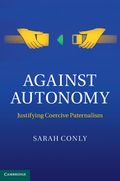 Then Sunstein turns to Conly's book, Against Autonomy. According to his review (which I will assume is accurate), Conly argues that coercive paternalism is justified by cost-benefit analysis—specifically, when the harms prevented are greater than the costs involved, including the possibly significant but finite amount of offense to persons whose autonomy is violated. Regarding people's self-knowledge, she makes a distinction between means and ends, arguing that people may be aware of their ends but are sometimes mistaken regarding the best means with which to pursue them. She believes, for instance, that everyone values his or her health, but nonetheless chooses unhealthy foods. Therefore paternalism, whether in the form of nudges, taxes, or bans, would promote people's final ends by helping them choose better means. Conly is much more willing than Sunstein and Thaler are to restrict freedom of choice—even while recognizing its very real value—if the benefits of the resulting behavior are large enough, arguing that the more important autonomy of ends is thereby promoted.
Sunstein admires Conly's ideas but has several criticisms, with which I agree (again, not having read the book). He suggests that autonomy may be considered an end in itself, making it different to trade off against means to achieving other ends. Alternatively, if autonomy is valued merely as means, that value may well be so great as to outweigh any benefits from paternalism. This is a common problem with any consequentialist system that admits its own costs as possible inputs to any decision: it risks defeating itself. (Louis Kaplow and Steven Shavell's book Fairness versus Welfare also suffers from this problem; I make this point in my criticism of the book here.)
Most interesting, Sunstein questions Conly's distinction between means and ends:
Conly favors a paternalism of means, but the line between means and ends can be fuzzy, and there is a risk that well-motivated efforts to promote people’s ends will end up mischaracterizing them. … In some cases, moreover, means-focused paternalists may be badly mistaken about people’s goals. Those who delay dieting may not be failing to promote their ends; they might simply care more about good meals than about losing weight.
I agree completely, but I would maintain that this criticism applies just as strongly to Sunstein and Thaler's libertarian paternalism as it does to Conly's more blunt paternalism, as both presume people have certain ends and then judge their decisions to be ineffective in pursuit of them; the only difference between them in this regard is how far they're willing to go to influence behavior in the "right" direction.
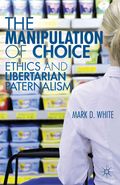 I respond to this element of paternalism—especially with regard to Sunstein and Thaler's libertarian paternalism—in The Manipulation of Choice. The idea is simple: people may make bad choices all the time, but no one knows that they're bad choices except the people making them. If I eat a donut, I may regard it as a bad idea because I'm watching my weight. Or, I may regard it as a good idea because I successfully used it as an incentive to finish a book chapter, or a chance to catch up with an old friend, or even an indulgence deliberately chosen in full awareness of its deleterious health effects because I like donuts. Since the paternalist has no knowledge of my ends, he or she cannot possibly judge my action to be an effective or ineffective means to reach them. Instead, the paternalist presumes common ends—such as health or wealth—on the part of a person (which I call value substitution) and then judges his or her decisions in light of those ends, resulting in paternalist interventions regarding diet and retirement planning (for example).
As Sunstein states, not all people are dieting or watching their weight, so we can't assume that unhealthy (but extremely tasteful) food choices are thwarting their ends at all. By that same logic, however, people have all kinds of financial plans too, so their "failure" to sign up for 401(k) programs cannot be assumed to be a bad decision (as Sunstein and Thaler claim in much of their work). However, the nudge of automatic enrollment would affect everybody equally, regardless of their reason for not enrolling, because it plays on the congitive biases and dysfunction that we all share. People are either too lazy to change the default choice or they're not, regardless of their preference; nudges don't discriminate between motivations, since they affect flaws in our decision-making of which we're not aware.
In his final paragraph, Sunstein recalls his introduction and agrees with Conly that behavioral research calls Mill's anti-paternalism into question. The pioneering work of Kahneman, Tversky, and their colleagues may make us question the decisions we make to achieve our ends, but it does not imply that there's anything opaque or unknown about our ends themselves. To be fair, there is psychological research that suggests this, such as the work described in Timothy Wilson's Strangers to Ourselves. But even if we do not know ourselves and our interests as well as we like to believe, we still know them a lot better than regulators and legislators do—and as long as this is true, it is impossible for paternalists to judge people's decisions or presume to improve them, whether with nudges or more direct measures.

 (available today), but this was too good not to pass up:
  –we can only hope that this played a role in his decision as well.




 Mark D. White