Mark D. White

Writer, editor, teacher

  • ManipThis update will be brief, folks–most of the month since I last posted has been spent working on my two books-in-progress and pushing other proposals forward, as well as dealing with the beginning of the spring semester. But I do have some items to mention:

    • The Manipulation of Choice: Ethics and Libertarian Paternalism is finally available for purchase (at least on Amazon–I've yet to see a copy in the wild).
    • The follow-up, The Illusion of Well-Being, was approved by Palgrave but I'm still working with my editors there on some issues with titling and format.
    • Jennifer Baker and I are submitting our response to the reviewers of our edited volume on virtue ethics and economics to Oxford on Monday, and the editor is planning to present it to the delegates near the end of the month.
    • I was asked by Praeger to edit a two-volume research volume on the insanity defense–very interested in that, and we're talking more about it now.
    • Despite my plans to blog more in the new year, my activity is that area was very light this past month. (Eleven months to go, though!) I had one substantive post at Economics and Ethics, "The Illusion of Mathyness" (January 10) and one new post at Psychology Today, "Are Wives Who Are Supported by Their Husbands 'Prostitutes'?" (January 10), following up on Lynn Beisner's piece at Role/Reboot on the characterization given by Elizabeth Wurtzel in New York.
    • I posted the call for papers for the Association for Social Economics sessions at the 2014 ASSA meetings, on the theme of law and social economics.
    • Finally, I have several presentations in the next month, one at Baruch College on Wednesday, February 20th, and the other at the Colloquium on Market Institutions and Economic Processes at NYU on Monday, March 4.

    Have to run to a meeting–if you're on the east coast, stay safe this weekend!

  • Mark D. White

    KimmoKevin Drum at Mother Jones recently highlighted a new paper by Kimmo Eriksson (Mälardalen University and Stockholm University) published in Judgment and Decision Making titled "The Nonsense Math Effect" (7/6, November 2012). Here's the abstract:

    Mathematics is a fundamental tool of research. Although potentially applicable in every discipline, the amount of training in mathematics that students typically receive varies greatly between different disciplines. In those disciplines where most researchers do not master mathematics, the use of mathematics may be held in too much awe. To demonstrate this I conducted an online experiment with 200 participants, all of which had experience of reading research reports and a postgraduate degree (in any subject). Participants were presented with the abstracts from two published papers (one in evolutionary anthropology and one in sociology). Based on these abstracts, participants were asked to judge the quality of the research. Either one or the other of the two abstracts was manipulated through the inclusion of an extra sentence taken from a completely unrelated paper and presenting an equation that made no sense in the context. The abstract that included the meaningless mathematics tended to be judged of higher quality. However, this "nonsense math effect" was not found among participants with degrees in mathematics, science, technology or medicine.

    It's a short paper and well worth the quick read (or read Drum's post, which summarizes it well). Eriksson reports that humanities/social science readers tended to be enchanted by the irrelevant equations, with 60-65% rating the adulterated abstract higher, but economists are not broken out of that very broadly defined group (which only includes 84 people as it is). Given some (most?) economists' predilection for mathyness, though, I would not be surprised at some degree of unconscious bias for research that promises greater mathematical sophistication (though I assume any such bias would melt away once the paper was read).

    But I think many other economists, especially heterodox economists who are more skeptical about the benefits of mathematical modeling, might go the other way. I know that when I read an interesting abstract and then skim the paper, my eyes glaze over when I hit math–not because it doesn't add anything to support the author's thesis but because I'm afraid it will leave out many things in the interest of abstraction and simplicity, such the very nonquantitative aspects of the model that I found fascinating in the first place! Some things must be left out of a model, of course, but these factors should be omitted because they are relatively unimportant, not because they're don't fit into the modeling framework.

    As Eriksson writes in his introduction to the paper,

    In areas like sociology or evolutionary anthropology I found mathematics often to be used in ways that from my viewpoint were illegitimate, such as to make a point that would better be made with only simple logic, or to uncritically take properties of a mathematical model to be properties of the real world, or to include mathematics to make a paper look more impressive.

    He very well could have included economics in there as well–I'm curious if his exclusion of it was intentional or random. Gee, I'll bet we could model that…


  • JmbMark D. White

    I just received word that Nobel laureate James M. Buchanan has passed away.

    I was just talking to David Levy at the ASSA meetings in San Diego about him, and hoped to meet him this summer. The loss to the profession cannot be overestimated, and my thoughts go out to his family, friends, colleagues, and students around the world.

    I am sure obituaries and remembrances will proliferate over the next several days, written by people who knew the man and his work far better than I did. But his seminal work in public choice, constitutional political economy, and professional economic ethics will remain influential on me as long as I continue to write. As I sat at my desk to write this post, his books What Should Economists Do? and Moral Science and Moral Order sit in my current reading pile, and his article "The Domain of Constitutional Economics" (from the inaugural issue of Constitutional Political Economy) recently opened my eyes to a new approach to my work.

    The man has left us but his scholarship lives on.

  • Happy new year, everyone! Turns out I have a lot to say about the last several weeks, which were taken up largely by two national conferences–and a lot of time in airports and airplanes!

    The last weekend of December was the Eastern Division meetings of the American Philosophical Association in Atlanta, my first APA in about ten years and also my first time presenting. Thanks to my good friend and collaborator Jennifer A. Baker and the American Association for the Philosophic Study of Society, I was able to present my work on Kant and economics, chiefly from my book Kantian Ethics and Economics and the planned follow-up on moral judgment. The audience of philosophers responded well and included Jan Narveson and one of my most important influences on Kant, Thomas E. Hill, both of whom I had the chance to talk with at length during and after the session. I had to leave the conference early, but I was able to attend the other AAPSS session as well as a panel focusing on Jerry Gaus' latest book, The Order of Public Reason: A Theory of Freedom and Morality in a Diverse and Bounded World.

    The first weekend in January, as always, was the Allied Social Science Association (ASSA) meetings, this year in San Diego. These are always very busy meetings, especially the last couple years; as I did last year, let me share some of the highlights. (Many people are much busier at the ASSA meetings, I know, especially the graduate students and recent Ph.D.s interviewing around the clock!)

    • I arrived in San Diego Thursday afternoon (January 6), settled in my hotel room for a bit before heading to the opening plenary of the Association for Social Economics (ASE), at which my Economics and Ethics co-blogger Jonathan B. Wight introduced Paul Zak, who spoke on "The Neuroeconomics of Trust," detailing some of his work on oxytocin and behavior. A reception followed, which gave me a chance to reconnect with my friends in the ASE before ducking out early (having been up since 1:30 AM California time!).
    • After breakfast Saturday morning I chaired an 8:00 AM session for the ASE on "Dignity, Status, and Social Exchange," including my talk previewing my book-in-progress on law and social economics as well as my plans for next year's ASE/ASSA program (which I am putting together as president-elect for 2013).
    • Following that session I went to the book exhibit and touched base with editors at various presses, including Oxford (where I met, for the first time, the UK economics editor with whom I've been discussing a volume on economics and virtue ethics to be co-edited with Jennifer Baker), Routledge (with whom I had a nice chat about future work), and Palgrave and Stanford (on whom more later). The rest of Friday afternoon was light, ending with the ASE membership meeting at which I presented my call for papers for the 2014 meetings (which I'll be posting online soon).
    • Saturday started with the ASE's presidential breakfast, at which various officers of the organization announce awards and the previous year's president gives a presentation: this year it was Martha Starr, who gave a masterful overview of recent work on corporate social responsibility.

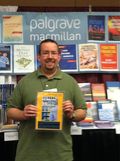
    • Palgrave booth pic
      Palgrave placardAt 11:00 AM I returned to the Palgrave booth at the book exhibit for a meet-and-greet focused on my next book, The Manipulation of Choice: Ethics and Libertarian Paternalism, which will be out near the end of the month. I can't say the crowds were overwhelming but a number of old friends did stop by to chat, which is always nice, and the Palgrave folks were extremely supportive.
    • After a 12:30 PM meeting of the editorial board of the Forum for Social Economics, I spoke at a session co-sponsored by the Union of Radical Political Economists and the International Association for Feminist Economists titled "Prospects for the Profession: Forecasting the Future of Economics." My presentation tried to link the incorporation of formal philosophical ethics into economics modeling with ethical behavior of economists themselves, urging reflection among economists about whether the means and ends of their professional activities as economists lived up to their own standards and ideals. It was not my best work, and it raised many tough but fair questions that will give me much to think about if I continue work on this theme. Happily, I had a chance myself to reflect as I unwound over a beer and a burger with an old friend (and editor) afterwards!
    • Before I left for the airport Sunday morning, I had a wonderful breakfast with my Stanford University Press editor, during which we discussed books, movies, and eventually our work together, including ongoing efforts to promote Kantian Ethics and Economics and plans for the follow-up on moral judgment that I hope to start writing near the end of this year.

    All in all, these were two wonderful conference experiences, which is ironic given my recent plans to cut back on conferences. (I did write something on this topic that I planned to post, but it ended up far too depressing.) But thinking back, those plans reflected the anxiety of not being prepared to speak rather than the rest of the conference experience. In short, I've found it very difficult to write something for a conference since most of my writing is oriented towards books these days–and even when I plan to discuss a book-in-progress, it's a matter of luck (or extremely good planning, which, y'know, ha!) whether I'll have part of a book ready for presentation when the conference rolls around. This ties into my talk at the URPE/IAFE session (as I noted at the time): this behavior doesn't just create anxiety and dread for me, but it lets down the people who graciously accepted my proposals or invited me to speak, and reflects a lack of professionalism on my part. Despite the positive experience at these conferences, I am rethinking how I participate in conferences; for instance, I had already decided not to submit a paper to the 2013 Eastern Economic Association meetings for which I organize a number of sessions.

    To wrap up the book news after the ASSA conference:

    • The Manipulation of Choice comes out later this month.
    • I submitted the final proofs for Superman and Philosophy; pre-orders are encouraging if the Amazon sales rank is any indication, which is wonderful.
    • I'm working on the law and social economics book as well as the secret project, both of which I hope I can finish by summer; I've begun carefully scheduling the first half of this year, trying to find a system that works. (I read a book on personal productivity recently, David Allen's Getting Things Done: The Art of Stress-Free Productivity, and have started implementing his system, which makes a lot of sense to me–I highly recommend it.)
    • While in San Diego I received reviewer comments on my follow-up to The Manipulation of Choice which were very positive and helpful, and to which I replied yesterday. (Not sure of the title yet, but people seem to like The Illusion of Well-Being.) Ideally I would start this book late this summer after the other two are finished, with the hope of having it done by the end of the year.
    • My outline for the book on moral judgment (the follow-up to Kantian Ethics and Economics) is still a bit sparse, so I suggested to my Stanford editor that I might need to write a bit of it before submitting a proposal, to which she agreed. If everything else goes according to plan, I would start of this near the end of this year–just before the next ASSA meetings.
    • The edited volume on economics and virtue ethics continues its progress at Oxford; the UK editor informed me he is very close to presenting our proposal, the reviewers' comments, and Jennifer's and my response, to his board.

    Finally, I have no new blog posts to report since my last post, but I do hope to post regularly across my several blogs this year. (If I made resolutions, that would be my main one for this year.) I also want to make more time for reading books and articles other than what I need to write my books, which I'm sure will prompt ideas for blog posts. So I hope to have more blog activity to report here in the near future (including some reflections on writing and academic life at this very blog).

  • I couldn't let a birthday pass without a reflective birthday post—and I worked quite a bit on one yesterday—but I don't know if I can improve on last year's post at The Good Men Project. I don't think I've progressed in terms of any of the issues described in that post, such as lack of direction or purpose. I've gotten things done, and I certainly have many things planned, but as we all know it's one thing to plan and another thing entirely to do. So I just soldier on, hoping to come across the answers on the way.

    In terms of updates:

    • I'm working on the proofs for Superman and Philosophy and anticipating the release of The Manipulation of Choice next month. (I understand Palgrave is arranging for a meet-and-greet at the ASSA meetings next weekend.)
    • My article "A Modest Comment on McMullin: A Kantian Account of Modesty" was accepted by The Journal of Philosophical Research; this article grew out of a series of posts at Psychology Today discussing Irene McMullin's paper on modesty. (See here for more.)
    • I wrote a couple pieces on the Iowa Supreme Court case dealing with the dentist who fired his assistant for posing a threat to his marriage, one at The Good Men Project (December 22) and another at Psychology Today (December 23).
    • I had another new post at Psychology Today as well, "Relationships Should Not Be About Exchange" (December 21).
    • Finally, I commented on the historic Amazing Spider-Man #700 at The Comics Professor.

    I'm leaving in a few minutes to talk about my work on Kant and economics at a session at the American Philosophical Association meetings in Atlanta. Wish me luck, and I wish you all a happy new year!


  • Spidey 700HUGE SPOILERS BELOW
    if you don't want to know that Mary Jane Watson is the new Spider-Man, read no further!

    As everyone in the comics community knows, Amazing Spider-Man #700 and Avenging Spider-Man #15.1 come out today, and the transformation revealed in Amazing Spider-Man #698 is confirmed: Otto Octavius, aka Doc Ock, is now aka Spider-Man, having successfully switched minds with Peter Parker in a well laid-out plan over the last year (in our time). Peter made a valiant effort to reverse the switch, but Doc Ock anticipated his every move, and at the end of the main story in ASM #700, Peter (in Doc Ock’s body) breathes his last breath.

    I was both impressed and disappointed by the way ASM #700 played out. I thought Dan Slott’s script was very well written and paced, with more than a few moments where I thought Peter would pull it off… but then Doc Ock would one-up him. But I was disappointed that the story ended with little more than a confirmation of what we learned in ASM #698. In ASM #699, we saw Peter, trapped in Doc Ock’s failing body, being the brilliant Peter we know and love, crafting a plan and setting up his return. Since we were promised an ever bigger surprise in #700 than we got in #698, I expected Peter to defeat Doc Ock and reverse the switch, only to have something else—or someone else—step in at the last moment and foil things up, and then that person would be the Superior Spider-Man starting next year. For me, the surprise ending was that there was no surprise: Doc Ock is (still) the new Spider-Man (for now).
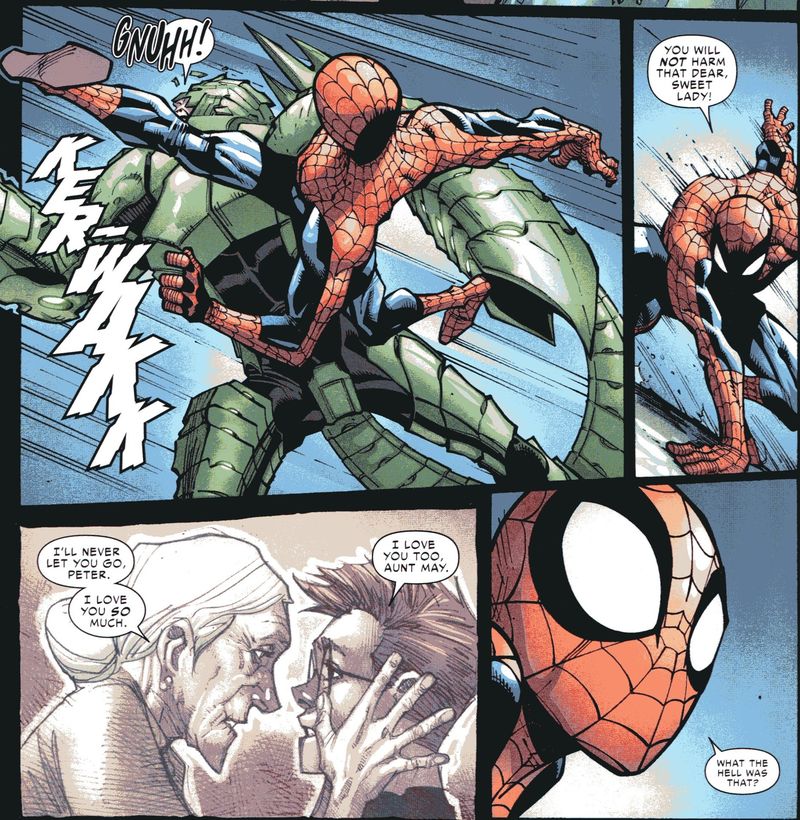
    Asm700 scorp

    If there was a surprise ending to #700, it was the transformation of character Doc Ock goes through, first by instinctively protecting Aunt May from the Scorpion, and then after Peter uses the weak mindlink that he was able to establish with the gold octobot to force certain key memories into Otto’s conscious mind. After this, Octavius comes to realize why Peter used his powers for good and how precious life is, and at the end of ASM #700 he vows to become a hero himself. (Literally.)

    Farewell, Peter Parker. Know this, I will carry on in your name. You may be leaving this world, but you are not leaving it to a villain. I swear. I will be Spider-Man. Better yet, with my unparalleled genius–and my boundless ambition–I'll be a better Spider-Man than you ever were. From this day forth, I shall become… the Superior Spider-Man!

    He decides to be the Spider-Man the world deserves, not what he comes to see in Avenging Spider-Man #15.1 as the scatterbrained Spidey that Peter Parker was while trying to balance a personal life with superheroics. This is where Avenging #15.1 fleshes out Amazing Spider-Man #700, laying out more of Doc Ock’s thinking going forward after he comes to the realization of his heroic destiny. In that book, written by Chris Yost, we see Otto sizing up all the aspects of Peter’s life, from his costume and equipment, his relationship with MJ, his work at Horizon, and most importantly how he fought against Spidey time and time again—and how Spidey always won. It is then that Otto realizes that Doc Ock, for all his genius, was a “pontificating, weak-chinned fool,” and that he will not only be a better Spider-Man than Peter Parker was, but he will also be a better man than Doctor Octopus was.

    Asa012

    It’s this transformation of Otto Octavius, with overlapping themes of responsibility, redemption, and renewal, that will have me buying Superior Spider-Man when it launches in 2013. I was planning to dropping Spidey after #700 and picking it up again after the inevitable Peter Parker Reborn event in 2014. But the premise that Slott has set up interests me, so I’ll see where he goes with it. (Hey, I’m as surprised as anyone!)

    Some random thoughts:

    1. The Superior Spider-Man is also the Brutal Spider-Man, as shown by how he takes the Scorpion’s jaw off while defending Aunt May, which adds a bit of Knightfall flavor to the proceedings. (The fact that J. Jonah Jameson takes a liking to this new Spidey is a bad sign in and of itself.) I imagine we'll see this impulse be tempered by friends like Daredevil (in whose book he'll appear soon) and various memories of Peter's as well (though certainly not this one).

    Asm700 scorp2

    2. I’m no neuroscientist, but as I understand it, intelligence has more to do with physical brain architecture than personality and memories do. Just in terms of the overly simplistic “software/hardware” analogy to mind and brain, switching personalities and memories between the two men would entail swapping “programs,” while swapping their respective “geniuses” would require more extensive rewiring of neurons and whatnot. (Note the subtle use of vernacular to distract from my whopping ignorance.) Of course, mental swaps are de rigeur in comics, so we shouldn’t nitpick, but since Otto makes such a big deal about how his genius surpasses Peter’s—although his personality resides in Peter’s physical brain—it raises the question anew.

    3. Of course, we all know that we haven’t seen the last of Peter—the obvious way to bring him back is for his brain patterns to have been stored in the gold octobot when Peter tried to return things to normal at the end of ASM #700. (Hey, it worked for Tony Stark after his protracted self-lobotomy, right?) Any other ideas?

    4. Doc Ock and MJ—eww.

    Asa011

    But seriously, the first time he calls her “woman,” she should’ve known something was up, not to mention all his other odd behavior. It would have been appropriate if MJ could have saved Peter from Doc Ock at after realizing that something was amiss—but she'll have her chance once “Just One More Day, We Promise” happens.

    Asm700 mj1

  • Superman and philosophy coverWow, an update is less than a month–it's like a Christmas miracle. 😉

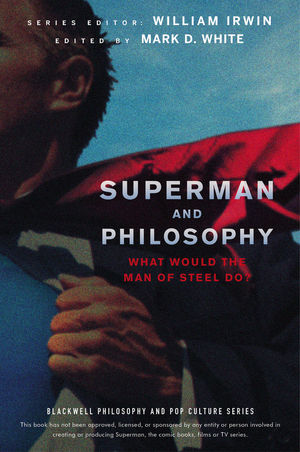
    The biggest news: the cover for Superman and Philosophy is finally available (as you can see to your right and also in the "book batch" to the left). I also posted the table of contents at The Comics Professor (and to the page for the book at this site as well). As I said before, I really like how the layout and title font match Batman and Philosophy–I hope the Superman book finds the same devoted audience that the Batman book did.

    In other superhero-and-philosophy news, my lead chapter from The Avengers and Philosophy, "Superhuman Ethics Class with the Avengers Prime," will be excerpted in issue 60 of The Philosophers' Magazine. (The chapter in its entirety is available for free here, courtesy of Wiley-Blackwell.)

    Also, the Blu ray for The Dark Knight Rises is out (or–ahem–so I'm told), and I'm featured on disc 2 in the documentary on the Batmobile. See the YouTube preview below:

    Meanwhile, I'm trying finish up the semester and preparing for the American Philosophical Association and Allied Social Science Associations meetings while proofing and indexing The Manipulation of Choice–unlike most of my work, I'm very happy with how this book turned out. For that reason and several others (including thematic similarity and intended audience), I decided to reformat the idea for my Stanford Brief into a follow-up to The Manipulation of Choice. The proposal is currently under review at Palgrave, and I hope to start reworking the journal editorial based on its theme soon. (It was a huge relief to make that decision–you'll remember from my previous post how this was driving me nuts.)


    VowFinally, today's Hot Topic at Psychology Today is "I Love Me!", and it leads off with two of my posts ("Loving Yourself—How Important Is It?" and "Can Self-Compassion Help the Self-Loathing Person?"). (For more of my posts on self-loathing, see here.) I also have a new PT post since my last update: "Knowing the One You Love: Lessons from 'The Vow'" (November 23).

  • Superman and philosophy coverIt's been a long wait–for me, at least!–but the cover to Superman and Philosophy is finally available (and visible to your right). As I said on my personal blog after I first saw it, I love how it parallels the Batman and Philosophy cover in general layout and title font, since the two volumes bookend my tenure with the series to date.

    Here is the table of contents–I'll share more about the book as publication approaches!

    Part One 
    The Big Blue Boy Scout: Ethics, Judgment, and Reason

    1 Moral Judgment: The Power That Makes Superman Human
    Mark D. White

    2 Action Comics! Superman and Practical Reason
    Brian Feltham

    3 Can the Man of Tomorrow Be the Journalist of Today?
    Jason Southworth and Ruth Tallman

    4 Could Superman Have Joined the Third Reich? The Importance and Shortcomings of Moral Upbringing
    Robert Sharp

    Part Two
    Truth, Justice, and American Way: What Do They Mean?

    5 Clark Kent Is Superman! The Ethics of Secrecy
    Daniel Malloy

    6 Superman and Justice
    Christopher Robichaud

    7 Is Superman an American Icon?
    Andrew Terjesen

    Part Three
    The Will to Superpower: Nietzsche, the Übermensch, and Existentialism

    8 Rediscovering Nietzsche’s Übermensch in Superman as a Heroic Ideal
    Arno Bogaerts

    9 Superman or Last Man: The Ethics of Superpower
    David Gadon

    10 Superman: From Anti-Christ to Christ-Type
    Adam Barkman

    11 Superman Must Be Destroyed! Lex Luthor as Existentialist Anti-Hero
    Sarah Donovan and Nick Richardson

    Part Four
    The Ultimate Hero: What Do We Expect from Superman?

    12 Superman’s Revelation: The Problem of Violence in Kingdom Come
    David Hatfield

    13 A World Without a Clark Kent?
    Randall M. Jensen

    14 The Weight of the World: How Much Is Superman Morally Responsible For?
    Audrey L. Anton

    Part Five
    Superman and Humanity: A Match Made in Krypton?

    15 Superman and Man: What a Kryptonian Can Teach Us About Humanity
    Leonard Finkelman

    16 Can the Man of Steel Feel Our Pain? Sympathy and Superman
    Andrew Terjesen

    17 World’s Finest Philosophers: Superman and Batman on Human Nature
    Carsten Fogh Nielsen

    Part Six
    Of Superman and Superminds: Who Is Superman, Anyway?

    18 “It’s a Bird, It’s a Plane, It’s … Clark Kent?” Superman and the Problem of Identity
    Nicolas Michaud

    19 Superman Family Resemblance
    Dennis Knepp

    20 Why Superman Should Not Be Able to Read Minds
    Mahesh Ananth

  • Mark D. White


    Adam Liptak has a "Sidebar" in today's New York Times titled "'Politicians in Robes? Not Exactly, but…" discussing judges' voting records and the politics of the president who nominated them, citing data that finds a clear link and accusing judges of deciding cases based on "ideology." My comment is below:

    Of course judges are ideological, but this does not necessarily translate into naked politics. Each judge has his or her own style of jurisprudence that may appeal more to presidents of one party or the other. A president will nominate judges with judicial philosophies that support his (or, someday, her) policy agenda. From the point of the view of presidents, judges and their judicial philosophies are tools, but to the judges, they are acting on principle. There is little ground for reading a judge's record as political rather then principled simply because his or her decisions are often in favor of the party of the president who nominated him or her.

    I have more to say on this theme in this earlier post (written before the Supreme Court decided the Obamacare case, obviously).

  • This blew me away this morning (courtesy of @the_stardust on Twitter): a picture from a protest against the emerging war between Israel and Hamas.

    Superman antiwar

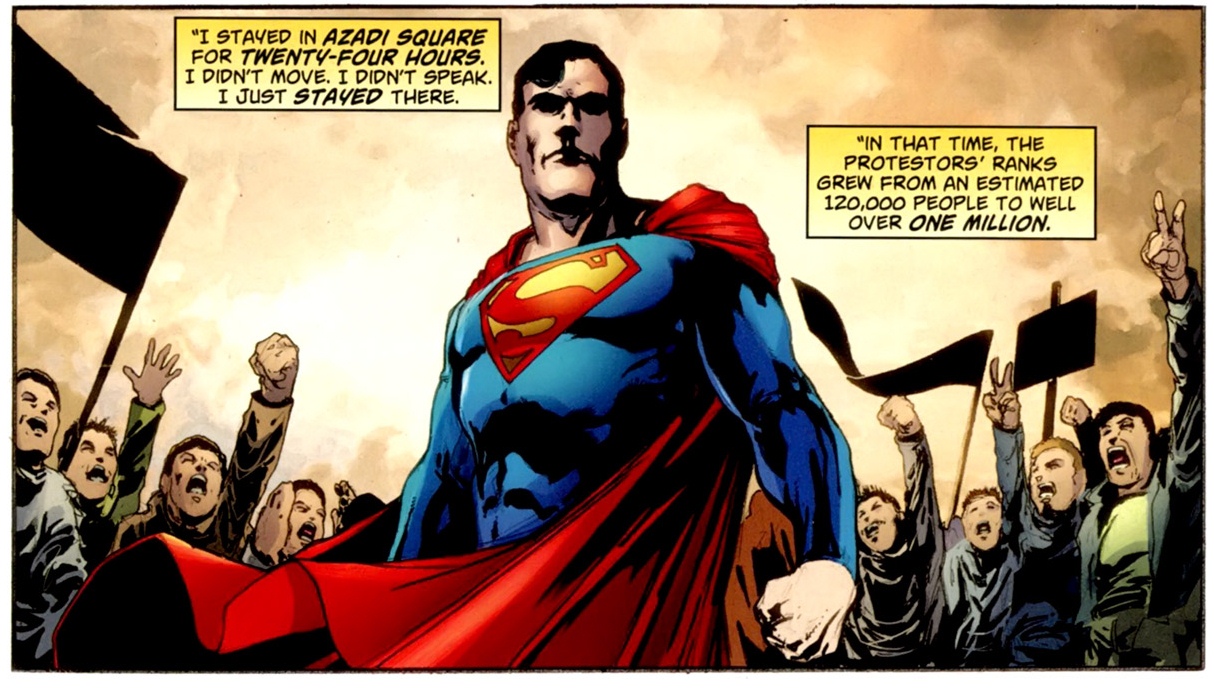
    Not only is this an inspirational picture, it strongly evokes David S. Goyer's story from Action Comics #900 in which Superman intervenes in an Arab Spring-like protest by simply standing amongst the protestors in solidarity:

    Act900

    This story received a lot of press at the time for Superman's subsequent renunciation of his US citizenship (discussed here and in a chapter in the upcoming Superman and Philosophy), but I hope what Superman–and that real-life little boy–did to support the worldwide march toward greater human rights for all will remembered for much longer.