Mark D. White

Writer, editor, teacher

  • Well that was quite a month.

    The less said about Sandy, the better. You've seen the pictures, you've heard the stories–the impact on me and those close to me was trivial compared to most.

    The less said about my day job the better–maybe I'll talk about this more once the dust settles. (Ooh, cryptic!)

    So what is there to relay to you good people?

    • I've seen the final cover to Superman and Philosophy, and it's fantastic–once it's online I'll link to it. I just approved the copyedits also–it's great to watch this project approach completion.
    • I expect the page proofs for The Manipulation of Choice on Monday, so I'll be checking those and preparing the index for several weeks after that. I recently approved the back cover copy, including terrific blurbs from Walter Olson (Cato Institute, Overlawyered) and Jonathan Wight (University of Richmond, Economics and Ethics).
    • I started working up the proposal for my follow-up to Kantian Ethics and Economics with my editor at Stanford University Press, focusing on judgment in ethics and economics. I hope to start working on this after I finish up my two books next spring.

    What about my Stanford Brief, you aks? Hmm… how much time ya got?

    I've gone back and forth, around and around… I've been all over the place with this. I know what I want to say, the core idea, and I think it's important. Very important. But I can't settle on a way to say it–the forum, the approach, the voice, anything. It could be a blog post and it could be a full-length book; it just depends on how elaborate I get and the amount of background information I give. Over the last month I've discovered some people who have said similar things–which makes me feel foolish and ready to pack it in–until I realize that in other ways they miss the point. Then I wonder if I'm just repackaging existing concepts a different way–a worthy enterprise, to be sure, but perhaps not worthy of a dedicated book (or even a journal article). But the next day I'll wake up and see an entirely different way to present it–maybe an academic trade like The Manipulation of Choice, taking my argument to "the people."

    And strangely enough, I've enjoyed this process–and that's not a word I use lightly. I'm charged up about this, reading a tremendous amount of material, and bouncing ideas off my Stanford editor (who is incredibly supportive and helpful but increasingly amused at the same time). I'm experiencing flow, which is truly wonderful. At the same time it's driving me just a little bit crazy, and preventing me from working on much else (including the two books I have under contract). But it's rare that I'm driven this strongly, and I'll be damned if I'm going to let this go. There's something here; I just need to find it.

    Oh well. I'm off to New Orleans this afternoon for the Southern Economic Association meetings where I'll talk about libertarian paternalism. Lots of time to ponder plans on the way there and back.

  • Mark D. White

    KadagaMy stomach turns at the news that Uganda is set to pass a law that imposes life sentences and sometimes the death sentence for homosexual acts:

    KAMPALA, Uganda (AP) — Uganda's anti-gay bill will be passed before the end of 2012 despite international criticism of the draft legislation, the speaker of the country's parliament said Monday, insisting it is what most Ugandans want.

    Speaker Rebecca Kadaga told The Associated Press that the bill, which originally mandated death for some gay acts, will become law this year.

    Ugandans "are demanding it," she said, reiterating a promise she made before a meeting on Friday of anti-gay activists who spoke of "the serious threat" posed by homosexuals to Uganda's children. Some Christian clerics at the meeting in the Ugandan capital, Kampala, asked the speaker to pass the law as "a Christmas gift."

    This is John Stuart Mill's tyranny of the majority at its ugliest: a majority of citizens using the machinery of government to negate the rights of the minority.

    Many Americans rejoiced at the success of same-sex marriage referenda in last Tuesday's election, and certainly there was tremendous cause for celebration. But why should gays and lesbians have had to wait for a majority of the electorate to "come around" and "grant" same-sex couples the same access to civil marriage that straight people have? Before this election all same-sex marriage referenda were voted down–a far cry from what Uganda is doing, to be sure, but the spirit is the same, a majority deciding what rights a minority may have.

    As I've argued several times on this blog (here and here, for instance), it is a poor validation of basic human rights to have the majority of the electorate vote for them (as encouraging as it may be in reflecting changing attitudes). Gays and lesbians shouldn't have to have their basic rights be "granted" to them by the electorate. They should be recognized as having existed all along by the only institution that can do that: the courts.

    The court in Brown v. Board of Education didn't say that "now" segregation is wrong–it said it had always been wrong. The court in Loving v. Virginia didn't say that "now" laws against mixed-race marriage are wrong–it said they have always been wrong. And when the Supreme Court decides that same-sex couple should have the right to marry, they will not say that "now" same-sex couples have that right, but that they have always had that right–and it just took a while for the law to catch up. 

  • Sabbath bookI've been spending a lot of long days at school the last several weeks, dealing with several major developments at the college, some good and some bad. That hasn't left a lot of time for writing, but I did manage a little, and there is some news to report on other fronts as well.

    • My editor at Stanford University Press read my outline and extended synopsis of my proposed Stanford Brief and offered some great advice along with encouragement; I hope to start writing that in earnest later today. (More details as it move along.)
    • Black Sabbath and Philosophy: Mastering Reality, edited by William Irwin, was published, featuring a chapter I wrote that asks whether bands (like Sabbath) should change their names as original members leave (related to issues of identity discussed by other contributors). The book also features one of my favorite taglines that we tack onto our short contributor bios.
    • I was shown the first cover mock-up for Superman and Philosophy (which is now listed on Amazon) and I think it's great; it evokes Batman and Philosophy in its overall design, which I like. (I'll also share that when it's finalized.)
    • My "secret" book project is now under contract, but I'm keeping that under wraps for the time being. It will, however, contribute to a very busy spring (along with writing Law and Social Economics for Palgrave) and more than validates my decision to take a sabbatical in the spring!

    In terms of blogging, I contributed one new substantive post to Economics and Ethics, "Have economists ignored clinical depression?" (October 5) and three new posts to Psychology Today: a pair of posts looking at relationships in terms of contract law, "Is Being Dumped Like a Breach of Contract?" (September 26) and "What Can We Learn from Break-Ups—and Can We Sue?" (October 2), as well as a new post on self-loathing, "Hypersensitivity Cuts Both Ways" (October 19). (I also performed a long-overdue update on this site's index of my PT posts.)

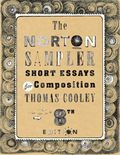
    NortonFinally—and this still blows my mind, even after knowing about it for several months—my op-ed on Batman and torture, written with my Batman and Philosophy co-editor Rob Arp and originally published in The Boston Globe in 2008 (but more easily accessed from The New York Times), will be included in the eighth edition of The Norton Sampler: Short Essays for Composition. The table of contents can be found here (I'm in chapter 12). That my writing will be used as a model for English composition students is incredible; that it's an essay about Batman is awesome.

  • Mark D. White

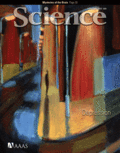
    ScienceA recent issue of Science (October 5, 2012) is a special issue on depression, and senior editor Peter Stern's introduction lays out the reason for it (emphasis mine):

    Depression is a devastating disease. It affects not only the directly afflicted but also the people around them, their families, and their closest relations. It indiscriminately hits all strata of society, no matter one’s intellectual background, age group, or economic situation. There are many cases of highly successful and widely admired individuals who have been struggling with depression for years. Unfortunately, for reasons we still do not fully understand, this condition has been on the rise over the past decades. Considering its impact on an individual’s quality of life and subsequently on the economy and society in general, gaining an understanding of what causes depression and trying to develop effective therapies is of utmost importance. Hence, this year’s Neuroscience Special Issue is devoted to different aspects of depression.

    I've long wondered why economists don't look more at both the microeconomic and macroeconomic effects of clinical depression. (I'm careful to add the modifier "clinical" because economists do, of course, spend a lot of time thinking about depressions, Great or otherwise.) Behavioral economists identify, quantify, and model the cognitive biases and dysfunctions that affect the choices of the average person, but have not yet (to my knowledge) looked into how depression affects decision-making. As Dr. Stern recognizes, choices affected by depression–given reported high rates of incidence of the disease–have potentially tremendous economic effects, not only on personal well-being but also on market outcomes, aggregate economic performance, and government policy.

    BeckThere are many theories of depression in psychology, but one that seems extraordinarily well-suited to incorporating the effects of depression into economic models of choice is cognitive psychology, as typified by the work of Aaron Beck. Beck maintains “the individual’s problems are derived largely from certain distortions of reality based on erroneous premises and assumptions” (Cognitive Therapy and the Emotional Disorders, p. 3). Examples of this negative thinking include: dichotomous reasoning (everything is either black or white, failure or success), selective abstraction (focusing on failures and glossing over successes), and overgeneralization (exaggerating the importance and incidence of failures). In economic terms, these have obvious effects on beliefs and preferences, the foundation of decisions in the mainstream model of choice.

    Depressives also report a lack of motivation or "paralysis of the will" that makes them less likely to act decisively to further their goals. In the mainstream economic model of choice, this can be be regarded once again as a result of distorted perceived benefits and costs (downplaying the former and emphasizing the latter) which result in a bias toward inaction (or at least decisional inertia).

    This is just one possible framework, and there are many others. I believe that behavioral economists could work within such a framework to refine the cognitive and conative effects of depression on decision-making. Behavioral economists have already told us that we're "presumably irrational"–now it's time to turn to the members of society who are "presumably depressed."


  • GoodwifeAs I find myself one month into the fall semester, teaching and chairing are now my top priorities, but I still managed to get some writing done as I continue to check things off of my summer to-do list. Foremost among the items struck are the first draft of my chapter for The Good Wife and Philosophy and a multi-volume book review for the Review of Social Economy. Next on my list: draft an editorial feature for the same Review previewing the short ebook I'm writing, tentatively for publication as a Stanford Brief.

    When those things are done (or at least well under way), I can begin thinking about books (on which more below) as well as presentations and/or papers for the trio of conferences in upcoming months: the Southern Economic Association meetings in New Orleans in mid-November, the American Philosophical Association Eastern Division meetings in Atlanta in late December, and the Allied Social Science Association meetings in San Diego a week later in early January. (Can I use to Kickstarter to fund these?)

    In book news, Law and Social Economics is now under contract with Palgrave Macmillan for inclusion in my series "Perspectives from Social Economics." My secret book project must remain secret for now, but I am expecting final word on it very soon. Luckily my sabbatical for spring looks to be approved soon, so I will be able to finish the law book–and possibly the other one–by June. Finally, Superman and Philosophy now has a page at the Wiley site, but no cover and details as of yet.

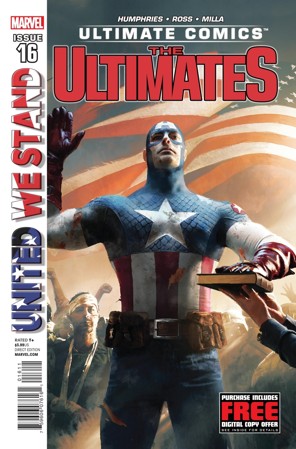
    Ult 16 oathI've been profoundly inactive online lately, but I did manage a post this past Wednesday at The Comics Professor on the recent election of Captain America to the United States presidency to the beleagured Marvel Ultimate Comics Universe, which was reprinted at the The Good Men Project later in the week. And also at GMP, I contributed a post titled "'Why Men Fail'? How about 'How Can We Succeed?'" commenting on David Brooks' recent New York Times column on Hanna Rosin's much-talked-about book The End of Men: And the Rise of Women.

    FInally, I've started to update this site a bit, including updating the bio and articles/chapters pages as well as redesigning the books page. Little by little this site will be complete!


  • Ult 16 cover
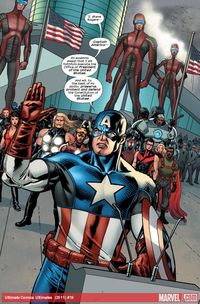
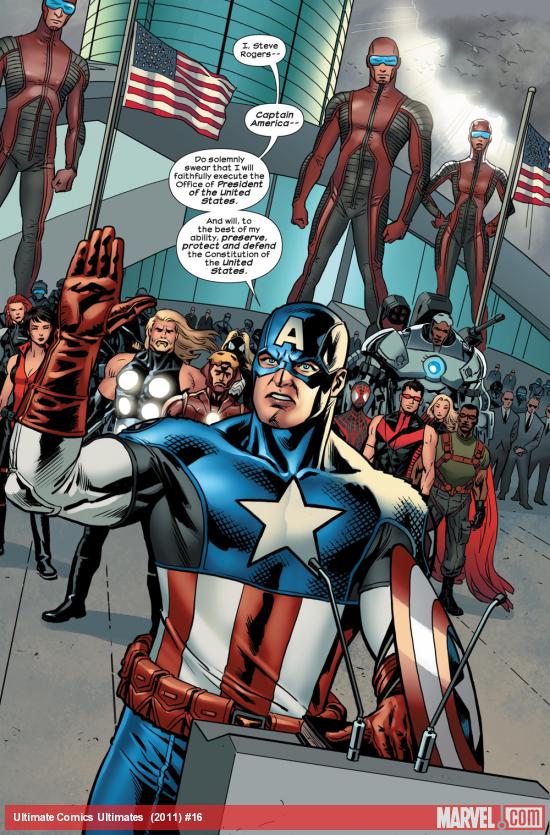
    As you might have heard by now, in today's Ultimate Comics: Ultimates #15, Captain America is elected president of the United States in a special election. (He takes the oath in #16, shown to the right.) America is the real world may be divided ideologically, but the Ultimate version is divided physically, with various grouping of states separated from the union and under various forms of government or rule.

    (MILD SPOILERS AHEAD)

    One of these is the West Coast, which has begun protecting its borders from refugees from the warlike southwest region using drones developed by the late Hank Pym (and called, naturally, Wasps). After the drones go offline and starts killing indiscriminately, Cap defies orders to stay out of the West Coast and leads the Ultimates into California to battle the Wasps. Americans across the country are so impressed and inspired by the TV images of Cap that they vote for him as a write-in candidate in the special election, and at the end of the issue, Carol Danvers calls him on a payphone to tell him he won.

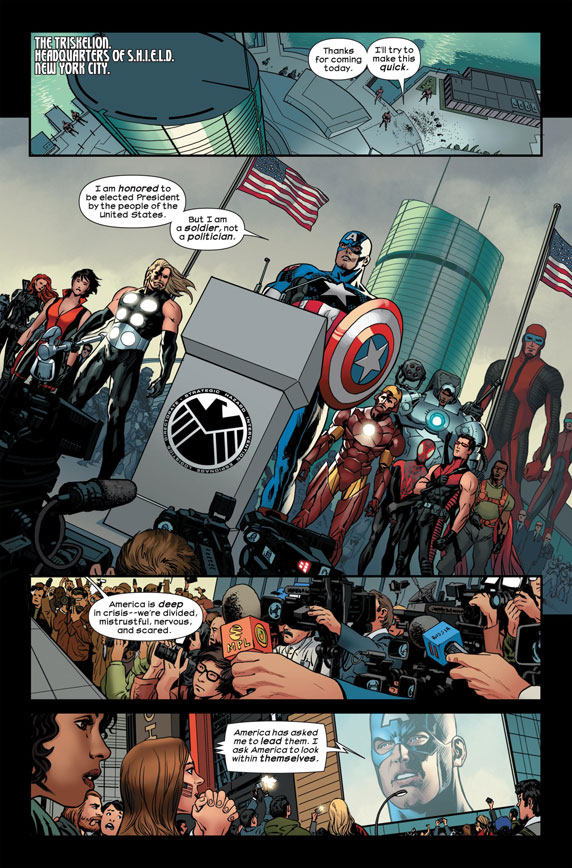
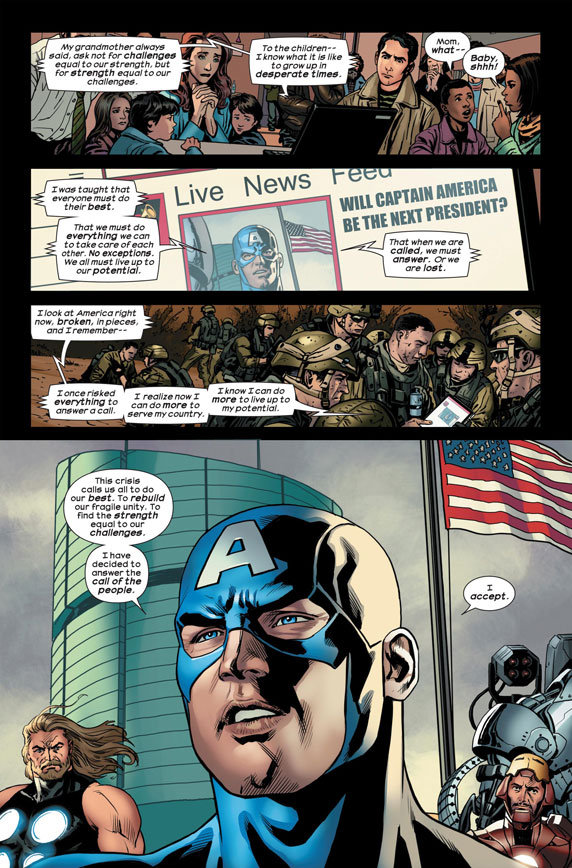
    In a press release, Marvel Comics released three pages from Ultimate Comics: Ultimates #16, written by Sam Humphries and pencilled by Luke Ross, showing Cap's acceptance speech (courtesy of Bleeding Cool)–click to enlarge.


    UltimateComicsUltimates_16_Preview1
    UltimateComicsUltimates_16_Preview2
    UltimateComicsUltimates_16_Preview4

    Whatever the differences in character or politics between the Captain America in the Ultimate Universe and the more familiar one from the mainstream Marvel Universe, this is Captain America who we know, love, and admire. As he says, "America is deep in crisis–we're divided, mistrustful, nervous, and scared." Appropriately for such times, Cap strikes a inspiring tone: "This crisis calls us all to do our best. To rebuild our fragile unity. To find the strength equal to our challenges." This is not a partisan message–it is a universal message, and one we hear all too seldom from our elected leaders or candidates for office.

    Can Captain America heal the once United States of America in the Ultimate Universe–can he be Abraham Lincoln, as Humphries said to the Washington Post? I think it's a fairly good bet he will, but since this is the Marvel Ultimate Universe, there's no way to tell what the country will look like when it's over. The Ultimate line gives Marvel creators leeway to stretch the realism the mainstream Marvel Universe is known for, so the usual fan assumption of "things will always go back to the status quo" doesn't always hold.

    What about America in the real world? As outlandish as it may seem, I think the character of Captain America, whether in the mainstream Marvel Universe, the Ultimate Universe, or the movies and animated series, can help bring the fractured interests in our country back together. As I've written before, he provides an example of principle over politics, exemplifying the founding virtues of justice and equality that all Americans can embrace in general, even if we disagree on how to understand or implement them. His ethics, so often caricatured as black-and-white, show us how we can and should act towards each other with both care and respect, so that each of us can pursue his or her own interests and dreams consistent with the rest of us doing the same.

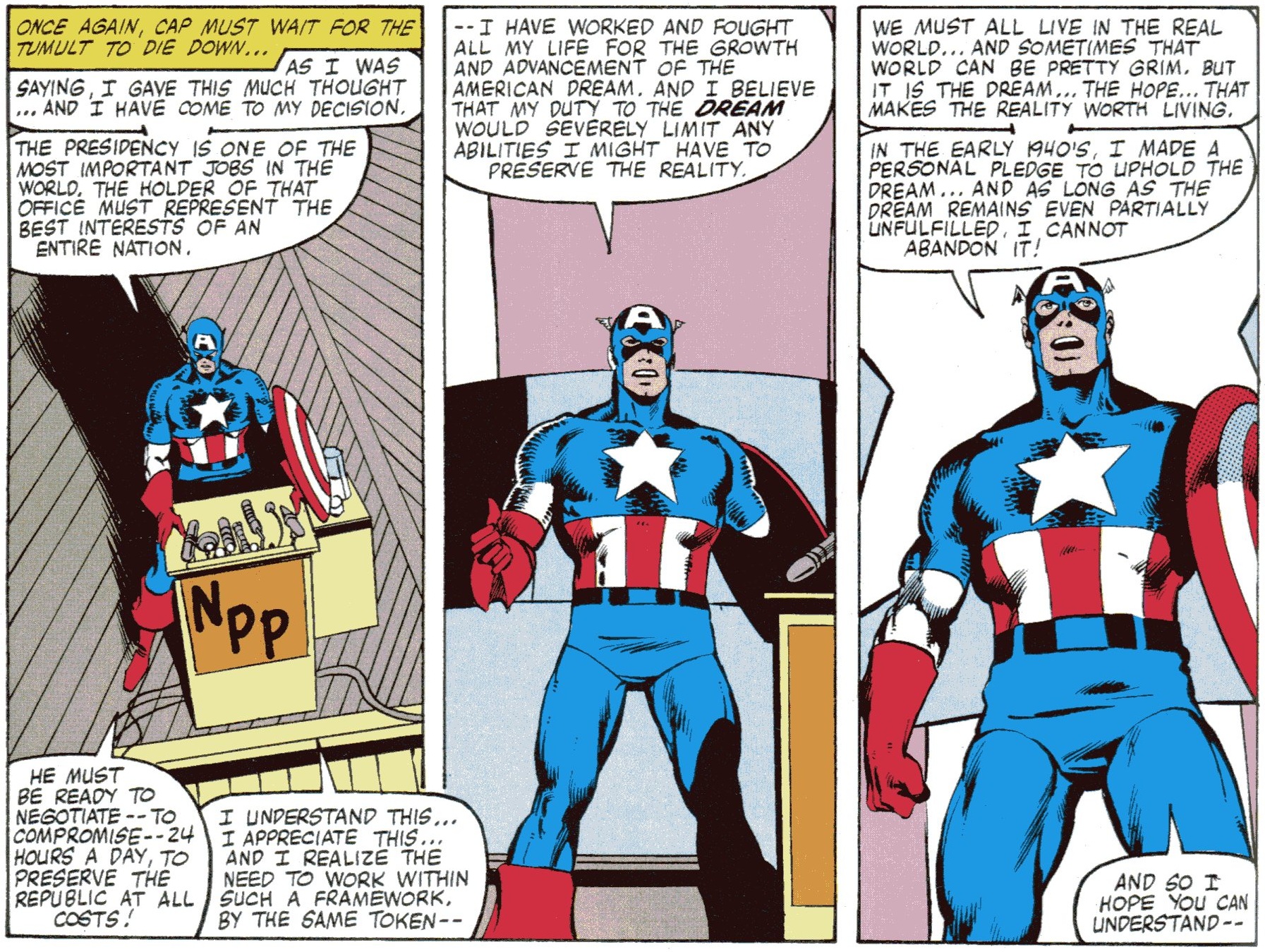
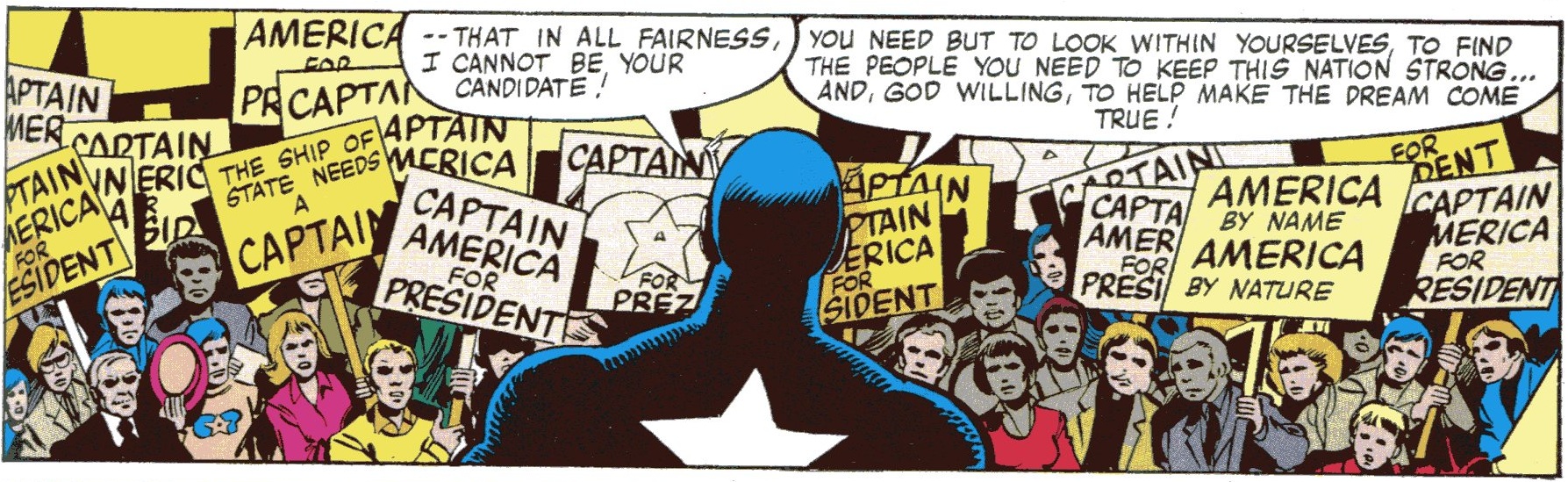
    It is interesting to note that Captain America dealt with presidential politics once before, as a candidate for a populist third party. This was also during an election year in the real world, in Captain America (vol. 1) #250 (October 1980), written by Roger Stern and co-plotted and pencilled by John Byrne. After an entire issue of deliberation and advice from half the Marvel Universe, in the end he declined:

    Cap 250 1
    Cap 250 2

    In this case, he turned down the candidacy to maintain his idealism and avoid the compromises that come with any position of political leadership. He makes a terrific point: any leader must find a way to balance the myriad interests within society, and in order to do that, he or she always risks disappointing or alienating one group or another. Cap wanted to stay above that so he can remain a symbol of the American dream for all.

    Ult 16 oathWhy did the Captain America in the Ultimate Universe make a different choice? Perhaps he felt that if he didn't accept the position of president of the United States of America out of a desire to avoid political compromise, all Americans would lose given their advanced state of national decay. Perhaps he felt that serving as president was the only way he could preserve the American dream in that reality, both through his actions and his example. The Cap in the mainstream Marvel Universe was not "ready to negotiate… to preserve the republic at all costs," but the Ultimate Cap did not feel he had that option, and "decided to answer the call of the people" in a time of near-collapse of that republic.

    But in both cases, Cap emphasized that it is up to the American people to take care of themselves however they can, whether through private or public cooperation. In 1980 he told the American people, "you need to look within yourselves to find the people you need to keep this nation strong… and God willing, to help make the dream come true!" and in 2012 he told them, "America has asked me to lead them. I ask America to look within themselves."

    In whatever form he takes, Captain America always stands ready to help, fight, and lead–but he demands that we all pitch in too. Ultimately (pun intended), perhaps that's the message we can take from this latest comics development and apply to the real world, especially when each of us votes in November for the person we think can best lead us out of our current economic malaise and identity crisis. In other words, who will be our Captain America?

  • GlannualAll in all, Green Lantern Annual #1, written by Geoff Johns and pencilled by Ethan Van Sciver and Pete Woods, is one of the most exciting books to come out of the DC New 52 so far. Faint praise, perhaps, but this felt like the build-up to Johns' previous GL events like "Sinestro Corps War" and "Blackest Night," and that feeling has been sorely missed over the last year.

    I don't think there will be any major plot spoilers in this post aside from what already appeared in the online preview (the first six pages on the comic). I will show a couple images from later in the comic, but nothing really revealing–but be warned in any case. SPOILERS!!!

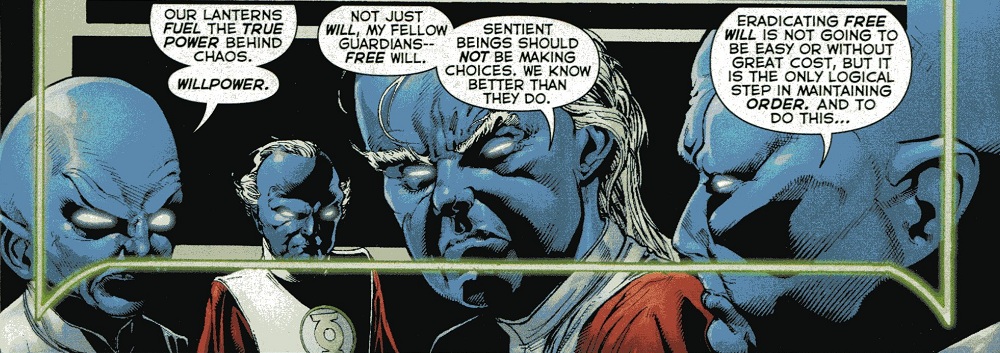
    As you may have seen from the preview, the Smurfs Gone Wild have decided that the threat to the universe lies not in emotion in general, nor in individual emotions, but in the very willpower that powers the Green Lantern rings–or, as they put it, free will.

    Glannual1

    We need to be clear on they mean by "free will." He does not mean it as the term is used in metaphysical debates over free will vs. determinism. That sense of free will describes any being's ability to be the "uncaused cause" and "first mover," to be able insert his, her, or its decision-making power or agency onto a world of physical cause-and-effect. It is not up to the Guardians or anyone else to eliminate free will if it exists–it either does or does not. And if there is no free will, no one has it–including our Guardians.

    No, what they mean by "free will" is true choice, agency, or autonomy, the ability to make choices independently of external (and possibly internal) authority or undue influence. Free will in this sense can exist regardless of whether metaphysical free will exists, since this variety of free will operates on a psychological level, not the level of elementary particle physics. Even if we are not truly "in control" of our thoughts and actions in a deterministic universe, we will still "make" choices independently of others' choices–in the end, they simply are not our choices at all. (For more on the various meaning of free will, see this article at the Stanford Encyclopedia of Philosophy.)

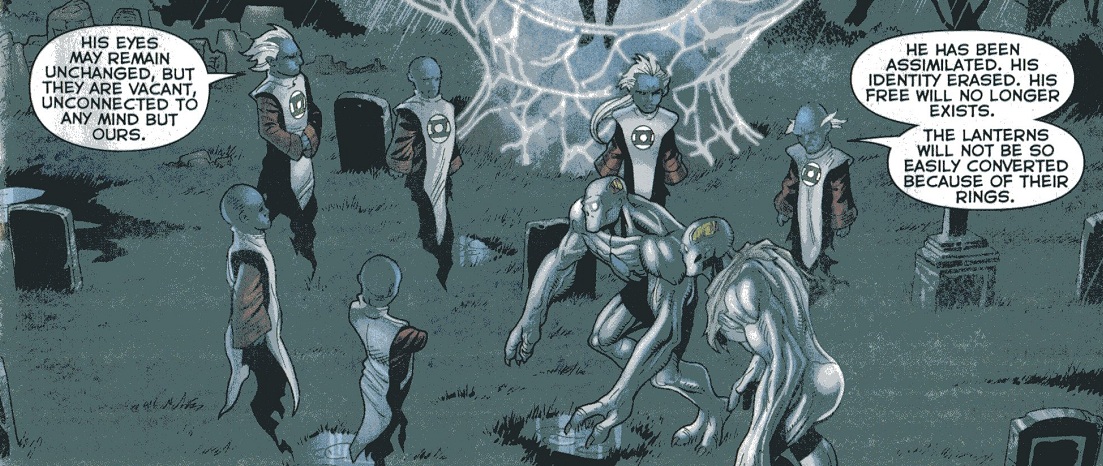
    Basically, the Guardians don't like that their Lanterns think for themselves, for then you end up with rebels like Hal Jordan and Guy Gardner. (In fact, the middle Guardian above sounds a lot like the mayor of New York, Michael Bloomberg–he probably thinks the Lanterns drink too much soda too.) They want mindless creatures that will do their bidding–hence, the Third Army. And they're purty, too:

    Glannual4

    (I would have thought the word "assimilate" had been trademarked by the Star Trek people by now, but I guess not.) These soliders (for lack of a better term) have no mind, no identity, no free will. They will not make their own choices, they will not question the orders of the Guardians–they will be tools, pure and simple.

    This story seems like a natural progression for Johns' broader Green Lantern arc, and I'm interested to see how it plays out. I do hope the Guardians eventually return to being good guys, if imperfect ones. Jordan and Guy Gardner disagreed with them often, of course, but at bottom they all sought the good, only disagreeing on how to pursue it. I hope Johns redeems them, or some of them, at the end of this storyline–but if the rest of New 52 universe is any guide, I'm not holding my breath.

    I can't end this post without a couple panels from this comic that I found hilarious. First, we have the long-lost Guardians of Middle-Earth:

    Glannual2

    I guess they're the Lords of the… nah, too easy.

    In the scene below, Hal and Sinestro have to combine the last flickers of energy in their rings to summon Sinestro's power battery. I guess Hal was a fan of the old Superfriends show, but Sinestro is none too happy with it.

    Glannual3

    Green Lantern powers, activate! Priceless.

  • Superman thinkingSummer is over, my friends, at least for me. As I write this, it is the second day of fall semester, and I just submitted the manuscript for Superman and Philosophy–missed the end of summer by two days, but that's OK. More news on that book as it works through the production process.

    All in all, it was a good summer, finishing both the Superman book and The Manipulation of Choice. There were a few things on my to-do list that I didn't get to, but they weren't urgent (or so I tell myself!). I did get several other things done, including getting two new book projects off the ground, one of which (Law and Social Economics) I should hear news about this week, and the other (still a secret) I hope to hear something next week. Plus, a third, super-secret project, which I started plotting. (Yes, I said plotting. Be very scared.)

    I did get two new posts up at Psychology Today since my last update: "Your Dream Lover Come True: Lessons from 'Ruby Sparks'" (August 14) and "Do We 'Grade' Potential Partners Like Teachers Grade Exams?" (August 17). I have ideas for several more, so I hope to return to blogging at PT more regularly (as well as Economics and Ethics and The Comics Professor).

    In the meantime, I delve back into work for my department at school–which never stopped but did slow down nicely for the summer, even through August, which was very intense the previous summer–as well as writing a chapter on legal realism for The Good Wife and Philosophy (which involves catching up on episodes not yet seen and reviewing older ones for instances of judges behaving badly). Then I need to finish off a couple projects that I set aside to finish the Superman book before I start on the new things mentioned above. (Good thing I'm taking a sabbatical in the spring!)

  • Man, I'm horrible at this "regular updates" thing. I still haven't returned to my earlier levels of online activity, so I'm hesitant to update until I have some things to tell you about. But most things are still in the planning stages, although they're further along than last time I "talked" to you. (How rude of me–how are you doing?)

    The biggest news is a few weeks old by now: on July 23 I handed in the manuscript of my latest book, The Manipulation of Choice: Ethics and Libertarian Paternalism, which is now in production at Palgrave Macmillan. I have a new book proposal under consideration with them, another one slowly moving along at Oxford University Press, and another one under development for yet another press. Several other smaller writing projects, ranging from multi-book reviews and short ebooks, compete for my attention as I finish up work on Superman and Philosophy and "look forward" to returning to school fulltime in two weeks. (Due to the writing workload and a growing conference schedule, however, I am planning to take my first sabbatical in 15 years this coming spring.)

    QueenAs Phyllis Diller says in A Bug's Life, "That's our lot in life. It's not a lot, but it's our life."

    Here's what I've managed to do online the last month or so (mostly the last week!):

    In other news, I noticed (thanks to Google Alerts) that The Avengers and Philosophy and Iron Man and Philosophy are both available as audiobooks from Audible.com. (Unlike Batman and Philosophy, I didn't narrate the new ones–I didn't even know about them!)

    Finally, I've received some good feedback on my piece on the ethics of adultery in the latest print issue of Psychology Today–I have a radio interview at the end of the month and I received an inquiry email from an agent with whom I had a great conversation last week.

    Now if I could only get an extension on summer (heat and all). I'll look into that…

  • Mark D. White

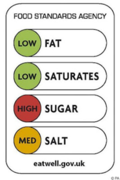
    Food labelsNew today from associate editor Brian Fung at The Atlantic is a piece on an experimental nutritional labeling system modeled on traffic lights. In use in the United Kingdom (where it was instituted by the British government's "nudge unit"), the revised nutrition labels would have color-coded icons for fat, calories, and other aspects of food products according to whether the levels are considered healthy or unhealthy. Mr. Fung reports the results of a study from Masschusetts General Hospital that–unsurprisingly–such labels increase the amount of healthy food consumered and lower the amount of unhealthy food consumed.

    I discuss labeling systems such as these in my upcoming book, The Manipulation of Choice: Ethics and Libertarian Paternalism, in which I differentiate between the information provided by such label–which allows people to make better decisions according to their own interests–and schemes like the traffic light one which nudge people toward some food and away from others based on bureaucrats' judgment of what is healthy and what is not. (I also discussed nutrition labeling in an earlier blog post.) As Mr. Fung acknowledges, "Bickering over what red, yellow, and green actually mean is likely to be as difficult — if not more so — than actually putting the system in place." Some of this bickering may be political, of course, but some will be due to disagreements among health experts over what a proper diet consists of–a debate unlikely to be settled any time soon among the experts, much less by government fiat!

    But what I found most interesting about Mr. Fung's article was the irony in the subheading:

    If soda bans take an implicitly cynical view of human nature, food labels that give consumers the impression of freedom might be their opposite.

    I don't know what could reflect a more cynical view of human nature then trumpeting proudly the prospect of "giving consumers the impression of freedom." These two approaches to paternalistic regulation are not opposites–the only difference is that one is clumsy and the other is "clever." This attitude continues as the article begins (emphasis mine):

    From New York City's point of view, humans are notoriously bad at making good decisions. That's what makes a ban on large sodas necessary: the idea that Americans can't be trusted with their own health. But maybe there's a middle ground between letting people gorge themselves on junk food and making it illegal. The key to making it all work is creating an environment where consumers still believe they're in control.

    No, there's no cynical view of human nature on display there.

    Finally, as the article ends, Mr. Fung writes:

    New York's faith in humanity must be low indeed if it thinks only the most blatant coercion can get people behaving differently. Whether collectively or alone, people are hopelessly incompetent, is the message Bloomberg's soda ban sends. A more accurate way to put it might be that people are incredibly malleable, open to having their decisions swayed in terrible ways by factors that are out of their hands. The difference is slight, but in the small gap between those two statements lies an opportunity to move people in the right direction without taking away their freedom.

    As above, I disagree with Mr. Fung: the difference is not slight, it is nonexistent. In my view, all paternalists have little faith in humanity, as shown by their willingness to substitute their own judgment for those of the people they claim to help, based on an overly simplistic view of decision-making and interests. And if you "move people in the right direction" by manipulation rather than by reasoned persuasion–subverting their deliberative processes rather than engaging them–you are taking away their freedom, little by little.

    But as long as they're left with the "impression" of their freedom, as long as they "still believe they're in control," I guess that's OK.