Mark D. White

Writer, editor, teacher

  • Mark D. White

    I've read an enormous amount of what's been written on the Chick-fil-A controversy the last couple weeks, although I'm sure I haven't scratched the surface. But I was fascinated by Will Wilkinson's recent post at The Economist's Democracy in America blog, titled "Feathers Flying," in which he casts the fast food company's stance against same-sex marriage as an example of corporate social responsibility (CSR), though not the typical social justice concerns usually associated with CSR.

    It's my view that this sort of skirmish in the culture wars is an inevitable consequence of trends in "ethical consumption" and "corporate social responsibility". Conservatives sceptical of the corporate social responsibility (CSR) movement have often charged that CSR is a stalking horse for liberal causes that have failed to get traction through ordinary political channels. This charge finds some support, I think, in the fact that few in the media seem to see Chick-fil-A's Christian-influenced culture and business practices as an example of CSR, though obviously it is. Doesn't the demand that corporations act responsibly in the interests of society, in ways other than profit-seeking, directly imply that corporate leaders who find same-sex marriage socially irresponsible should do something or other to discourage it?

    Rather than comment on Chick-fil-A's position itself, I want to point out Mr. Wilkinson's perceptive comments regarding the politicization of the marketplace itself:

    Matters of moral truth aside, what's the difference between buying a little social justice with your coffee and buying a little Christian traditionalism with your chicken? There is no difference. Which speaks to my proposition that CSR, when married to norms of ethical consumption, will inevitably incite bouts of culture-war strife. CSR with honest moral content, as opposed to anodyne public-relations campaigns about "values", is a recipe for the politicisation of production and sales. But if we also promote politicised consumption, we're asking consumers to punish companies whose ideas about social responsibility clash with our own.

    Those opposed to a particular company's moral or political position may consider their actions to exemplify corporate social irresponsibility (or worse) rather than just a different type of CSR. The issue for ethical consumption then becomes not just a matter of choosing companies who actively support the "right" causes rather than those who don't, but more important, staying away or boycotting companies that support the "wrong" ones. (This is not new: for examples, labor union members have long refused to patronize nonunion businesses, whether out of solidariry or some other principle.)

    Wilkinson's proposed remedy is elegant, and on first blush seems to make perfect sense:

    I'd suggest the best arena for moral disagreement is not the marketplace, but our intellectual and democratic institutions. We hash out our disagreements, as best we can, in public deliberation. The outcome of this deliberation becomes input to official policymaking, which in turn determines the rules of the game for business. Businesses then seek profits within the scope of those rules (and the consensus rules of common decency), and consumers buy the products that best satisfy their preferences.

    That would be the ideal, I agree. In unpublished work on CSR, I draw a distinction between internal and external actions: internal CSR would cover the operations of the business itself, such as treatment of employees and environmental production methods, while external CSR involves actions not directly related to the business, such as charitable giving–or political positions. My conclusion based on this distinction can be considered a restatement of Milton Friedman's oft-caricatured position that business should focus on maximizing returns to owners within the legal and ethical standards of their industry. The italicized phrase refers to the importance of internal CSR–which still leaves room for controversy, such as whether benefits can be extended to same-sex partners or the extent of environmental safeguards–and cautions against external CSR, either because profits can be devoted to social or political causes by the owners just as well as by the company, or because the business wants to avoid endorsing a controversial position and politicizing its product.

    I think that corresponds fairly well to what Wilkinson recommends, but I fear the horse has left the barn on that one. CSR and ethical consumption together comprise a vicious cycle that we will find it very difficult to extricate ourselves from at this point. Consumers have adopted the mindset of making a moral statement with their purchases–with good intentions–and they expect businesses or business leaders to reveal their positions. Businesses are more than happy to comply, sincerely or otherwise, even at the risk of alienating a segment of their customer base. Even companies that remain neutral on heated social issues may be accused of "if you're not with us you're against us"–and certainly with some issues, there is no neutral position. A company can refuse to take a public stand on same-sex marriage, but they either provide same-sex benefits or they don't.

    I'll finish–as I often do–with Kant. Often caricatured himself as a rigid demanding moralist, he ridiculed as "fantastically virtuous" any person "who allows nothing to be morally indifferent and strews all his steps with duties, as with mantraps… Fantastic virtue is a concern with petty details which… would turn the government of virtue into tyranny” (Metaphysics of Morals, 409). We can take his comments one step farther and argue that, given our limited attention, the more attention we pay to "petty details," the less we pay to more serious issues or more effective ways to deal with them. Equality for gays and lesbians is no petty detail, of course, but no matter which side you're on, there must be a better way of supporting your position than choosing whether to eat a chicken sandwich.

  • Mark D. White

    InequalityToday on The Atlantic's website, Dan Ariely describes an experiment he conducted with Mike Norton in which they survey people about both the current distribution of wealth in the U.S. and what they thought the ideal distribution of wealth is. Not surprisingly, they find that most everybody underestimates the level of inequality of wealth, and that most everybody would prefer a more equal distribution of wealth–and, most interestingly that the "desired" distribution is extremely stable regardless of political party or nation of origin.*

    In fact, he writes, "most likely, if you participated in one of our tests, your response too would have fallen in line with these findings." Uh, no, it wouldn't–I would have refused to answer the question because I don't accept its premise, which is that the final distribution of wealth is more important than the processes which led to it. In Robert Nozick's terms, Ariely implicitly uses a patterned theory of justice, whereas I prefer a historical theory of justice. When I see a skewed distribution of income or wealth, my first thought is not, "let's correct that," but rather "let's see what caused the skewed distribution and see if they're anything unjust about that."

    Ariely illustrates this distinction with his two proposals for lessening inequality: education and taxation. Education improves the process while taxation improves the results after the fact. This is comparable to making sure a football game is officiated fairly, but then adjusting the score after the game is finished. If the outcomes of a football game–or of the economy–result from just and fair processes, then it is difficult to find a justification for questioning the results (outside simple utilitarianism).

    Ariely describes his methodology as inspired by John Rawls' "veil of ignorance," in which people are asked what kind of world they'd like to live in if they had no idea where they'd fall in socio-economic terms (or, more broadly, in terms of race, gender, and so on). Ironically, however, Rawls was opposed to redistribution after the fact, and meant for his veil of ignorance metaphor to be used when designing institutions that would benefit the worst-off in society so wealth would not have to redistributed after the fact. (Ronald Dworkin's resource-egalitarianism takes the same approach: equalize resources at the beginning of persons' lives, and let them make of their lives what they will.)

    My point does not lean only to the left or the right; people on both sides of the political spectrum (and especially libertarians) will happily point out injustices in the system that lead to unjust outcomes. This is one thing that the Occupy movement and the Tea Party have in common: there is corruption throghout the system that benefits the few at the expense of the many. But it does little good to say what we want the world to look at any point in time. Instead, we should focus on how we want to world to work over time–all the time–so everyone has a fair chance at leading the life they want to live.

    —–

    * They also neglect to ask what means people are willing to accept to reach their desired level of inequality–I imagine that's where differences in political affiliation would show up the most. Ariely admits to this shortcoming, but casts it in terms of what sacrifices people would be willing to make themselves to lower inequality, not what structural changes in our institutions they would recommend:

    Our study also doesn't deal with how to bring what people say they want under the veil of ignorance into line with what they're willing to do when it's their money and resources that are about to be distributed. It is one thing to get people to tell us what kind of society the would want to join, and another to get them part with their money in order to create that society.

  • Mark D. White

    One of the topics that fascinates me, but which I never seem to have time to catch up on, is the moral/political status of health and health care. In most cases (other than particularly infectious or contagious diseases), I consider health and health care to be matters of personal choice and responsibility, but I'm eager to hear the arguments on the other side as well.

    JLMETwo articles in the latest issue of The Journal of Law, Medicine & Ethics (40/2, Summer 2012), part of a symposium on pharmaceutical firms and the right to health, address this issue:

    "Health as a Basic Human Need: Would This Be Enough?" by Thana Cristina de Campos

    Although the value of health is universally agreed upon, its definition is not. Both the WHO and the UN define health in terms of well-being. They advocate a globally shared responsibility that all of us — states, international organizations, pharmaceutical corporations, civil society, and individuals — bear for the health (that is, the well-being) of the world's population. In this paper I argue that this current well-being conception of health is troublesome. Its problem resides precisely in the fact that the well-being conception of health, as an all-encompassing label, does not properly distinguish between the different realities of health and the different demands of justice, which arise in each case. In addressing responsibilities related to the right to health, we need to work with a more differentiated vocabulary, which can account for these different realities. A crucial distinction to bear in mind, for the purposes of moral deliberation and the crafting of political and legal institutions, is the difference between basic and non-basic health needs. This distinction is crucial because we have presumably more stringent obligations and rights in relation to human needs that are basic, as they justify stronger moral claims, than those grounded on non-basic human needs. It is important to keep this moral distinction in mind because many of the world's problems regarding the right to health relate to basic health needs. By conflating these needs with less essential ones, we risk confusing different types of moral claims and weakening the overall case for establishing duties regarding the right to health. There is, therefore, a practical need to reevaluate the current normative conception of health so that it distinguishes, within the broad scope of well-being, etween what is basic and what is not. My aim here is to shed light onto this distinction and to show the need for this differentiation. I do so, first, by providing, on the basis of David Miller's concept of basic needs, an account of basic health needs and, secondly, by mounting a defense of the basic needs approach to the right to health, arguing against James Griffin who opposes the basic needs approach.

    "A Right to Health Care" by Pavlos Eleftheriadis

    What does it mean to say that there is a right to health care? Health care is part of a cooperative project that organizes finite resources. How are these resources to be distributed? This essay discusses three rival theories. The first two, a utilitarian theory and an interst theory, are both instrumental, in that they collapse rights to good states of affairs. A third theory, offered by Thomas Pogge, locates the question within an institutional legal context and distinguishes between a right to health care that results in claimable duties and other dimensions of health policy that do not. Pogge's argument relies on a list of “basic needs,” which itself, however, relies on some kind of instrumental reasoning. The essay offers a reconstruction of Pogge's argument to bring it in line with a political conception of a right to health care. Health is a matter of equal liberty and equal citizenship, given our common human vulnerability. If we are to live as equal members in a political community, then our institutions need to create processes by which we are protected from the kinds of suffering that would make it impossible for us to live as equal members.

    CoggonBut what I most look forward to reading is What Makes Health Public?: A Critical Evaluation of Moral, Legal, and Political Claims in Public Health by John Coggon, whom I had the pleasure of meeting and listening to at the "Regulating Bodies and Influencing Health" symposium in Rotterdam in June.

    John Coggon argues that the important question for analysts in the fields of public health law and ethics is 'what makes health public?' He offers a conceptual and analytic scrutiny of the salient issues raised by this question, outlines the concepts entailed in, or denoted by, the term 'public health' and argues why and how normative analyses in public health are inquiries in political theory. The arguments expose and explain the political claims inherent in key works in public health ethics. Coggon then develops and defends a particular understanding of political liberalism, describing its implications for critical study of public health policies and practices. Covering important works from legal, moral, and political theory, public health, public health law and ethics, and bioethics, this is a foundational text for scholars, practitioners and policy bodies interested in freedoms, rights and responsibilities relating to health.

  • Mark D. White

    Yesterday, Kevin Drum at Mother Jones spoke up for social science following an editorial in Nature arguing against the NSF's proposed defunding of research in political science. Here's a bit of the op-ed:

    Part of the blame must lie with the practice of labelling the social sciences as soft, which too readily translates as meaning woolly or soft-headed. Because they deal with systems that are highly complex, adaptive and not rigorously rule-bound, the social sciences are among the most difficult of disciplines, both methodologically and intellectually. They suffer because their findings do sometimes seem obvious. Yet, equally, the common-sense answer can prove to be false when subjected to scrutiny. There are countless examples of this, from economics to traffic planning. This is one reason that the social sciences probably unnerve some politicians, some of whom are used to making decisions based not on evidence but on intuition, wishful thinking and with an eye on the polls.

    …As Washington Post columnist Charles Lane wrote in a recent article that called for the NSF not to fund any social science: “The 'larger' the social or political issue, the more difficult it is to illuminate definitively through the methods of 'hard science'.”

    In part, this just restates the fact that political science is difficult. To conclude that hard problems are better solved by not studying them is ludicrous. Should we slash the physics budget if the problems of dark-matter and dark-energy are not solved? Lane's statement falls for the very myth it wants to attack: that political science is ruled, like physics, by precise, unique, universal rules.

    And here's some of what Mr. Drum added to it:

    The public commonly thinks of disciplines like physics and chemistry as hard because they rely so heavily on difficult mathematics. In fact, that's exactly what makes them easy. It's what Eugene Wigner famously called the "unreasonable effectiveness" of math in the natural sciences: the fact that, for reasons we don't understand, the natural world really does seem to operate according to strict mathematical laws. Those laws may be hard to figure out, but they aren't impossible. …

    Hari Seldon notwithstanding, the social sciences have no such luck. Human communities don't obey simple mathematical laws, though they sometimes come tantalizingly close in certain narrow ways — close enough, anyway, to provide the intermittent reinforcement necessary to keep social scientists thinking that the real answer is just around the next corner. And once in a while it is. But most of the time it's not. It's decades of hard work away. Because, unlike, physics, the social sciences are hard.

    Bonus points for the Foundation mention!

    (I don't have much to add; I made a similar point in this post, comparing the complexity of marcoeconomic forecasting models to meteorological weather-forecasting models.)

  • Mark D. White

    Last month, The Economist published an article (based on research published in Journal of Marketing) on consumers' irrationality when compared discounts and added content:

    Consumers often struggle to realise, for example, that a 50% increase in quantity is the same as a 33% discount in price. They overwhelmingly assume the former is better value. In an experiment, the researchers sold 73% more hand lotion when it was offered in a bonus pack than when it carried an equivalent discount (even after all other effects, such as a desire to stockpile, were controlled for).

    In a recent issue, the magazine printed a letter by Rory Sutherland of Ogilvy & Mather UK, succinctly and humorously pointing out the problem with attributing irrationality to such consumers:

    You mentioned research which revealed that shoppers often prefer “50% extra free” to a notionally more generous 30% reduction in price, and you cited this as evidence of irrationality or poor mathematical ability on the part of consumers. I think you may be wrong and consumers may be right.

    There is, as the advertising sage Jeremy Bullmore observed, a significant difference between a bonus and a bribe. A price tells you much more about a product than merely what it costs. A price cut may be sensibly perceived as a mark of mild desperation on the part of the seller and it is not unreasonable to infer from a price cut that a product is an inferior good. Charging the full price but adding something extra does not convey the same desperation. In any case this whole debate is silly.

    If people value 50% extra free more highly than 33% off, then that is an end of the matter. Since all value is subjective, what you are doing by offering the former is simply creating more perceived value at a lower cost. Whether or not the resulting behaviour conforms to some autistic neoclassical idea of rationality is irrelevant.

    If the sole purpose of life was to be rational, we would have banned golf years ago.

    Mr. Sutherland said it better than I ever could–and I've tried, in many places and many contexts, including previous posts (such as here), book chapters, and my forthcoming book, The Manipulation of Choice: Ethics and Libertarian Paternalism. Economists–of both mainstream and behavioral varieties–all too often see irrationalities where none exist because they insist on interpreting choice through the lens of their narrow understand of decision-makers and the overly simplistic choices they assume on consumers' parts.

    The factors that consumers take into consideration when make choices are much more complicated than economists recognize–as Mr. Sutherland points out. And while behavioral economists are making headway in identifying some of these factors, they still don't account for qualitative ones like principles and ideals. Nor do they consider the complex and subjective interests of consumers (and all decision-makers), choosing instead to assume simple unitary goals like wealth-maximization. Until they take these common influences on choice into account, they will see irrationalities wherever they look–which reflects more on the shortcoming of their models than on the decision-makers themselves.

  • Manipulation of ChoiceI'm happy to report that I did make it back from Europe in one piece, although that piece was thoroughly exhausted. But a good time was had–it was great seeing old friends and colleagues, as well as meeting new ones, at the World Congress for Social Economics; meeting all new people and discussing "nudges" at the "Regulating Bodies and Influencing Health" symposium; and spending a couple days in Sweden with a good friend seeing sights like the Vasa Museum. Both of my papers were received enthusiastically and were described as "provocative," which I appreciated greatly, and I received healthy comments and criticism on both that will make the published versions all that much better.

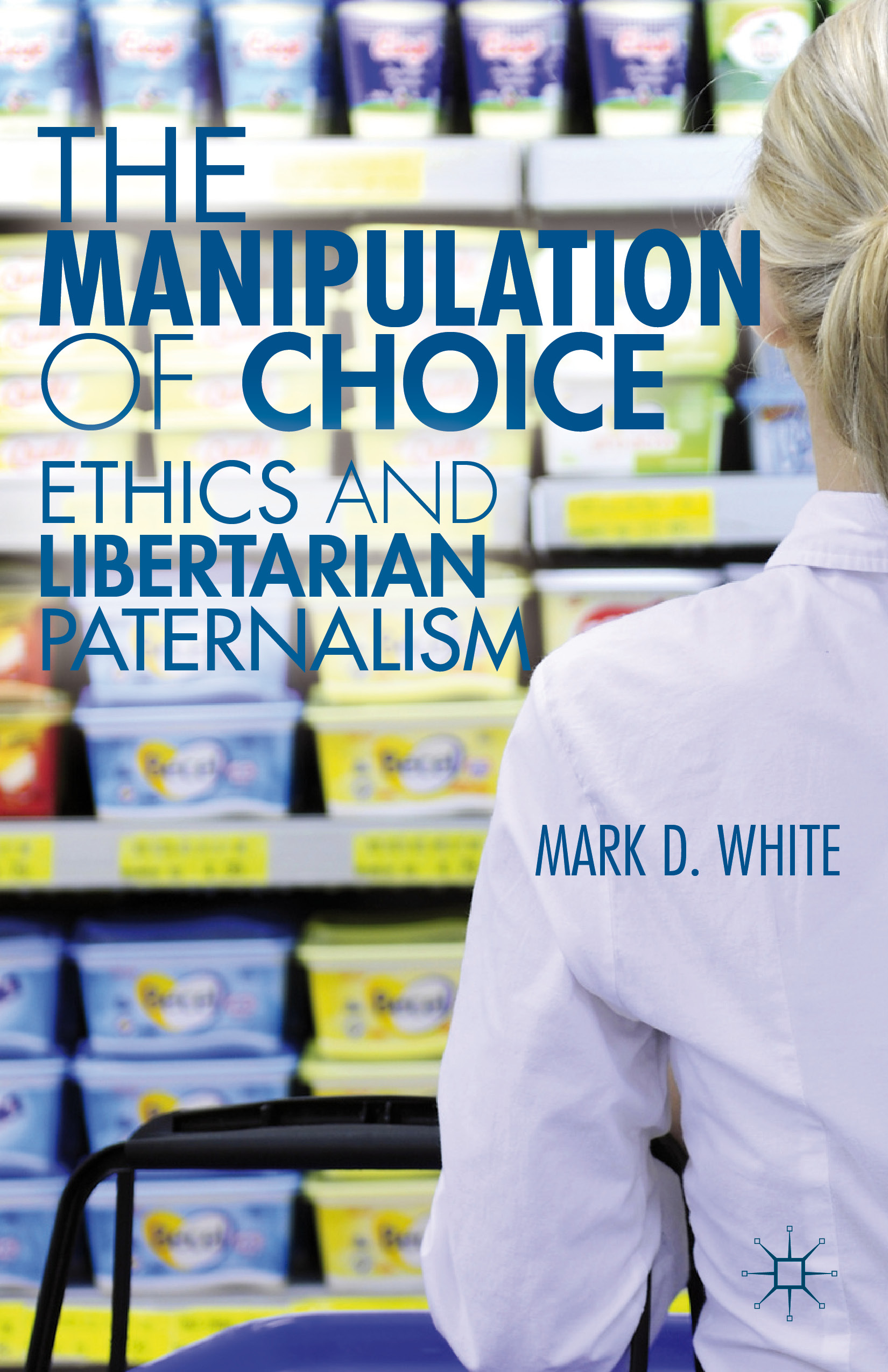
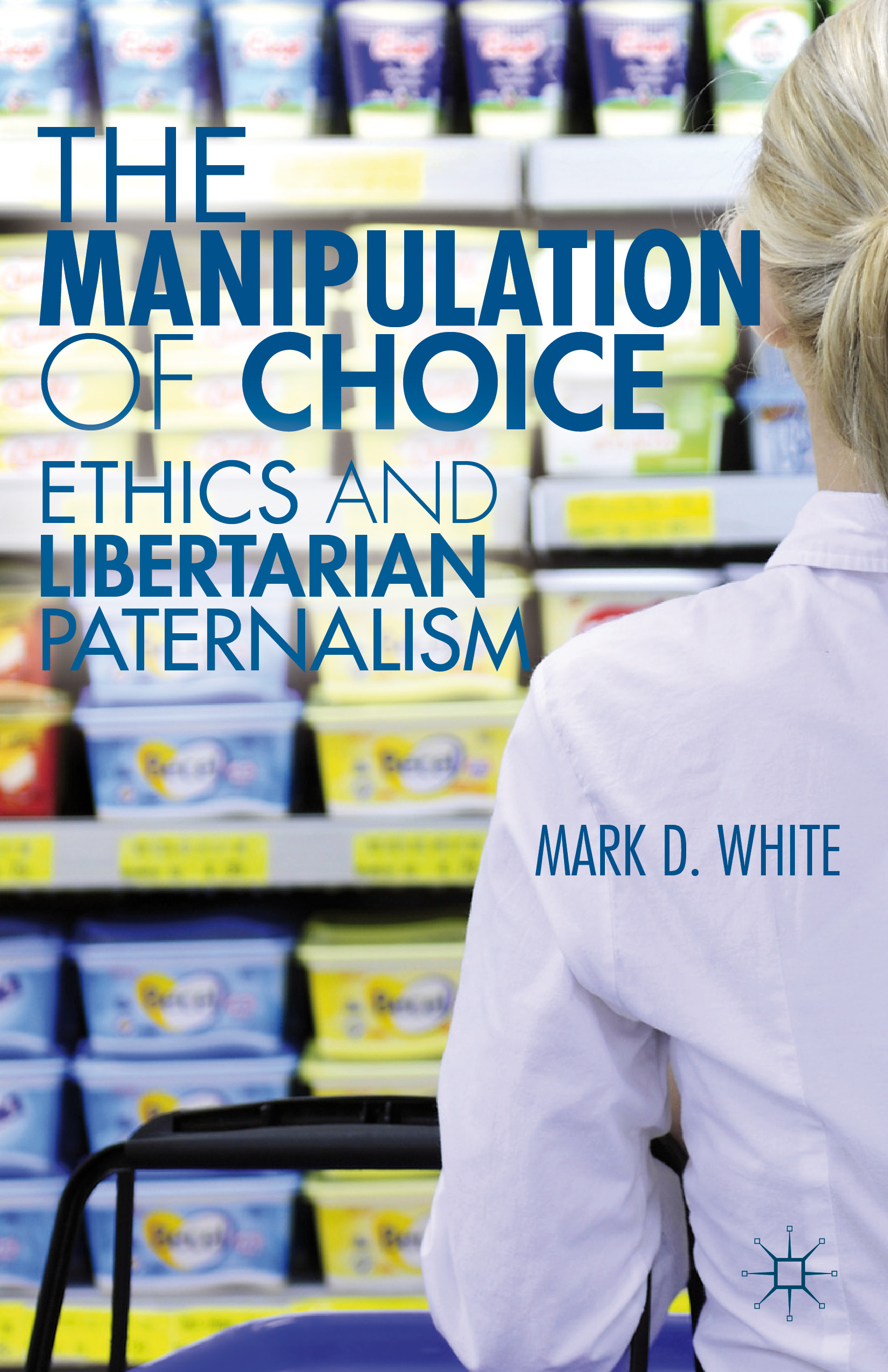
    Most of my time before and since the trip was been spent on The Manipulation of Choice: Ethics and Libertarian Paternalism, which is already available for preorder at Amazon and other sites and has a cover, which I am honored to present here for the first time anywhere. (Click on the image or link for a larger version.)

    In addition, I'm still working on Superman and Philosophy as well as arranging my writing plans once these projects are finished (including a few which I'm very excited to tell you about once they're finalized). In other book news, I was happily surprised to hear from the good folks at Routledge that Ethics and Economics: New Perspectives, the 2010 book I co-edited with Irene van Staveren–whom I finally had the pleasure of meeting at the World Congress last month–is now available in paperback. And I'm looking into the possibility of recording another audiobook; again, I'll give you more details when I know them!

    PT Aug 2012I haven't blogged much in the last month, but I did publish a new Psychology Today post yesterday, "Should I Tell My Partner about My Affair?", to complement my latest publication in the print magazine, "Is Adultery Every Justified?", in the August 2012 issue (p. 66), itself based on several blog posts. In the meantime, my Economics and Ethics co-blogger Jonathan Wight has been posting regularly–check out what he has to say! I merely contributed a couple posts (here and here, nothing very substantive) on the Supreme Court's Obamacare decision, but I'm sure you've read enough about that by now!

  • Mark D. White

    With respect to the dissent in the Obamacare decision from Justices Scalia, Kennedy, Thomas, and Alito (starting on page 127 of the PDF), I want to note several phrases that struck me as interesting, both in relation to Justice Ginsburg concurring opinion as well as Chief Justice Robert's majority opinion (discussed in a previous post here).

    With respect to the activity/inactivity distinction supported by Roberts but refuted by Ginsburg, the four dissenters had this to say:

    If all inactivity affecting commerce is commerce, commerce is everything. Ultimately the dissent is driven to saying that there is really no difference between action and inaction… a proposition that has never recommended itself, neither to the law nor to common sense. To say, for example, that the inaction here consists of activity in “the self-insurance market”… seems to us wordplay. By parity of reasoning the failure to buy a car can be called participation in the non-private-car-transportation market. Commerce becomes everything. (pp. 13-14)

    With respect to Justice Ginsburg's expansive reading of the Necessary and Proper Clause, they say simply:

    Article I contains no whatever-it-takes-to-solve-a-national-problem power. (p. 15)

    Finally, with respect to Chief Justice Roberts' reading of the ACA as imposing taxes rather than penalties, justifying his vote to uphold the individual mandate, they say:

    For all these reasons, to say that the Individual Mandate merely imposes a tax is not to interpret the statute but to rewrite it. (p. 24)

    As many have noted already, Scalia et al's dissent repeatedly refers to Justice Ginsburg's opinion as "the dissent" rather than a concurrence, with only the final part of the actual dissent (beginning of p. 64) reflecting the fact that they lost the case, making the timing of Roberts' decision-making process all the more intriguing. Oh, to be a fly on the wall…

  • Mark D. White

    Even though Jonathan beat me to it, let me put my two cents in regarding today's 5-4 Supreme Court decision affirming the individual mandate in the Affordable Care Act a.k.a. Obamacare.

    Pages 17-27 of Chief Justice Roberts' majority opinion contain a masterful counterargument to those who argued that the Commerce Clause justifies the individual mandate because a decision not to participate in the health insurance market affects that market.

    The individual mandate, however, does not regulate existing commercial activity. It instead compels individuals to become active in commerce by purchasing a product, on the ground that their failure to do so affects interstate commerce. Construing the Commerce Clause to permit Congress to regulate individuals precisely because they are doing nothing would open a new and potentially vast domain to congressional authority. Every day individuals do not do an infinite number of things. In some cases they decide not to do something; in others they simply fail to do it. Allowing Congress to justify federal regulation by pointing to the effect of inaction on commerce would bring countless decisions an individual could potentially make within the scope of federal regulation, and—under the Government’s theory—empower Congress to make those decisions for him. (pp. 20-21)

    He extends the argument, as many have done but even more have ridiculed, to other hypothethical mandates based on inactivity, such as not buying broccoli healthy foods:

    Indeed, the Government’s logic would justify a mandatory purchase to solve almost any problem. … To consider a different example in the health care market, many Americans do not eat a balanced diet. That group makes up a larger percentage of the total population than those without health insurance. … The failure of that group to have a healthy diet increases health care costs, to agreater extent than the failure of the uninsured to purchase insurance. … Those increased costs are borne in part by other Americans who must pay more, just as the uninsured shift costs to the insured. … Congress addressed the insurance problem by ordering everyone to buy insurance. Under the Government’s theory, Congress could address the diet problem by ordering everyone to buy vegetables. (pp. 22-23)

    He sums up his point nicely here:

    People, for reasons of their own, often fail to do thingsthat would be good for them or good for society. Those failures—joined with the similar failures of others—can readily have a substantial effect on interstate commerce. Under the Government’s logic, that authorizes Congress to use its commerce power to compel citizens to act as the Government would have them act. (p. 23)

    He goes on to argue against most of the specific arguments for the individual mandate based on the Commerce Clause, including that everyone will eventually be involved or "active" in the market for health care, and that health care is a "unique product." But my favorite part has to be his dismissal of the application of the Necessary and Proper Clause, which many commentators have confused with an "ends justify the means" clause, but is nonetheless subject to Constitutional constraints:

    Even if the individual mandate is "necessary" to the Act’s insurance reforms, such an expansion of federal power is not a "proper" means for making those reforms effective. … Just as the individual mandate cannot be sustained as a law regulating the substantial effects of the failure to purchase health insurance, neither can it be upheld as a “necessary and proper” component of the insurance reforms. The commerce power thus does not authorize the mandate. (p. 30)

    But while he wins the ideological war against the justification of the individual mandate based on the Commerce Clause  and the Necessary and Proper Clause, he affirms the mandate by reinterpreting it under Congrress' taxation power, which is exactly what the drafters of the legislation wanted to avoid.

    This just reaffirms the irony of the Obamacare: rather than simply propose universal health care financed by taxation, which would have been unquestionably Constitutional, the president and the Congress tried to square the circle, avoiding the "t" word by instead requiring a more personally intrusive and selective violation of individual rights, which was (of course) questionable. In a sense, Roberts did the other two branches' work for them, allowing them to avoid the taxation issue when writing, promoting, and passing the law, but ending up with a tax bill in the end.

    Former Speaker Nancy Pelosi famously said that we'd know what was in the bill after we passed it. It turns out we didn't see how to read it until Chief Justice Roberts told us how.

  • Later today I leave for Europe to speak at two events (in Glasgow and Rotterdam) and relax and sight-see (in Sweden). This is the first time I've ever flown overseas solo, as well as the first time I've ever gone on a multi-leg trip anywhere (as opposed to flying to one place and flying back).

    So here's how it goes (if you're interested):

    • I fly out of Newark this evening, get into Amsterdam Tuesday morning.
    • I spend Tuesday in Amsterdam and fly to Glasgow Wednesday morning.
    • I spend the next couple days at the World Congress for Social Economics, where I'll speak against the measurement of well-being.
    • Friday night I fly to London, where I'll spend the night and then fly to Stockholm Saturday morning.
    • After spending a couple days in Stockholm, I fly to Amsterdam Monday afternoon and then take a train into Rotterdam.
    • Tuesday I'm at the Regulating Bodies and Influencing Health workshop, where I'll speak against libertarian paternalist "nudges" in health care. (Yes, I'm very against things right now.)
    • Wednesday morning I take the train back to Amsterdam and fly home. (Whew.)

    Other than that, I've just been working on my Palgrave trade book against nudges, now titled The Manipulation of Choice: Ethics and Libertarian Paternalism, as well as making plans for the scholarly version, and dealing with departmental things that always come up. If I have a chance to post while I'm gone, I will!

  • Work continues on both my book about libertarian paternalism and nudges for Palgrave and Superman and Philosophy, but there has also been a surge in blogging over the last week, largely in response to controversies big and small:

    I also offered the post "Let's Be More Productive" at Economics and Ethics (May 29), which was reworked slightly for Psychology Today.

    In the meantime, I received the flyer for the "Regulating Bodies and Influencing Health" workshop in which I'm participating in Rotterdam near the end of the month–very appropriately, on the concept of health care nudges that lies behind Mayor Bloomberg's soda ban and, more generally, my Palgrave book. (I love it when things come together, don't you?)