Mark D. White

Writer, editor, teacher

  • Mark D. White

    In this morning's Wall Street Journal, James Bovard pokes a little fun at the US government's plans for measuring gross domesic happiness (of which Nicolas Sarkozy was a leading advocate), pointing to how well they currently measure the myriad economic statistics regarding things that aren't entirely subjective. Many economists take this very seriously, however; as it happens, I'm currently working on several projects that, to some extent, deal with this issue (as is Deirdre McCloskey, if I remember correctly). The literature is recent but already vast: a marvelous summary and critique can be found in Daniel Hausman's 2010 Economics and Philosophy article, "Hedonism and Welfare Economics."

    My take, in a nutshell, is that measuring happiness is neither feasible nor desirable. It is not feasible because happiness is irreconciliably multifaceted (along several dimensions) and inescapably subjective. It is not desirable because any official focus on happiness violates ideals of liberal neutrality and personal autonomy regarding persons' individual pursuit of the "good life," and the measurement of such can only lead to excessive government manipulation (if not paternalism) towards that imposed end (as Bovard describes). Rather, institutions should be established and maintained to ensure that person have the maximal capacity to make choices in pursuit of their own interests consistent with all others doing the same. Only such a system can ensure respect for persons' own interests and the choices they make towards them.

  • Earth 2OK, the title is a little melodramatic, but I think this book deserves it. Earth 2 #1, written by James Robinson and drawn by the incomparable Nicola Scott, has me wishing (with qualifications) that this new Earth 2 were the mainstream DC Earth. (Its companion book, Worlds' Finest, by Paul Levitz, George Pérez, and Kevin Maguire, was also excellent, but pales in comparison to the cinematic bombast of Earth 2.)

    I can't discuss this book without massive spoilers, so proceed with caution! More below the jump…

    (more…)

  • Last week's Green Lantern Corps #8, written Pete Tomasi and illustrated by Fernando Pasarin and Scott Hanna, featured an interesting discussion among the Alpha Lanterns regarding what to do about John Stewart in light of his killings of a fellow Green Lantern who seemed close to revealing Corps secrets under torture by the Keepers.

    Glc8

    This exchange raises terrific questions about the nature of criminal justice as well as the role of the Alpha Lanterns in particular. From Boodikka's comment that "our duty is to be impartial and render justice," it sounds like the Alphas are more than just police. As usually understood, police do not "render justice" but merely play a role in it by investigating and apprehending suspects–an important role, of course, but not quite "rendering justice." So let's assume Boodikka was getting ahead of herself, and continue to understand the Alphas as the internal affairs division of the Corps.

    The more interesting issue here is about the proper role of incidental consequences to the execution of justice, even at the level of arrest and arraignment. There seems to be no question among the Alphas regarding what Stewart did; the only question is whether to arrest him for it (and presumably transmit him to the Guardians for "trial," as they did with Laira before the relaunch). Boodikka and Relok Hag take the position that they must arrest Stewart no matter what the consequences, especially those due to "emotion," in order to serve justice. Green Man and Varix, on the other hand, urge consideration of the broader consequences, particularly those that impact their ability to enforce justice in the future.

    The first position has clear appeal: the Alphas have good reason to believe John Stewart committed a crime against the Corps, and he should be brought in for future questioning. Arresting him should imply nothing about his guilt (though the Alphas have grounds for reasonable suspicion), and the Guardians will pronounce judgment at trial. But the second position is more inclusive: it doesn't deny the importance of arresting suspected wrongdoers, but it admits other factors relevant to the decision whether and how to do it. Stewart is a leader in the Corps, widely admired and respected by his fellow Lanterns as a pillor of honor. Bursting into a crowded room to arrest Stewart (as they do at the end of the issue) is an extremely bold show of force, especially toward someone like Stewart who would likely submit himself willingly for trial. John's popularity, the moral ambiguity of his actions, and the Alphas' brashness in response make it likely that the Green Man's prediction of divisiveness will come true, and as Varix said, "the ability to enforce justice will be severely put to" the test.

    Green Man and Varix are not suggesting that they don't arrest John at all, but merely that they do so in a way that preserves the Alpha's authority and whatever respect the rest of the Corps has for them. By following Boodikka and Relok Hag's hardline position (especially in the way in which they did it), the Alphas will compromise their own standing and make the pursuit of justice more difficult in the future. In other words, justice viciously served is self-defeating. Once the arrest decision is made, the Alphas should consider how best to take John into custody to make sure that they are seen as fair and–yes, Boodikka–impartial in their "rendering" of justice. This is not a compromise in the pursuit of justice, but a way to make the pursuit of justice better. Arresting John the right way will serve justice in this particular case and ensure that they will enjoy the respect and authority necessary to continue to serve justice in the future.

    But what if Green Man and Varix had been suggesting that they not arrest John at all (at least not until the Guardians ordered them to)? Do the Alphas have that kind of discretion? In a sense they must–as far as we know, there have only ever been five of them at any given time! Unless the 7200 rank-and-file Lanterns are extremely well-behaved (or the potential violations that would attract the Alphas' attention are very few), the Alphas can't possibly investigate and apprehend every wrongdoer among the Corps.

    In the real world on Earth, police have tremendous discretion over which crimes to address, especially regarding misdemeanors like traffic violations and littering. Even in areas with a lot of officers per capita or square mile, they can't possibly go after every wrongdoer they see, and so they must use their judgment regarding which ones are most important to spend their time and resources investigating. Of course, people who double-park are one thing, but we wouldn't like to think of police letting murderers get away. Prosecutors, however, can certainly decide to drop a case against a suspected murderer if they think their limited resources can be better used somewhere else, either because of a weak case or even community pressure (though this is obviously a dangerous and inadvisable road to take). This is a tremendous amount of power, of course, and we trust our prosecutors to use it wisely and sparingly, but given the scarcity of their resources, they cannot possible prosecute every crime that comes across their desks, and must own judgment in choosing amongst them.

    The idea that the Alpha Lanterns "embody the independent thought process of a Green Lantern along with the efficient logic of the Manhunters" is extremely intriguing one to a philosopher, especially one who has interests in rationality and judgment. This issue was the first of the "Alpha War" arc, so let's hope there is more to talk about in future installments.

    —–

    GLFor more on justice and scarcity, see Michael Cahill paper's "Real World Retributivism" (Washington University Law Review 85, 2007, pp. 815-870), and my paper "Retributivism in a World of Scarcity" (from Theoretical Foundations of Law and Economics, edited by Mark D. White, Cambridge University Press, 2009, pp. 253-271). The Alpha Lanterns and the trial of Laira are discussed in two chapters in Green Lantern and Philosophy (edited by Jane Dryden and Mark D. White, Wiley, 2011): Andrew Terjesen's "Will They Let Just Anybody Join?: Testing for Moral Judgment in the Green Lantern Corps" (pp. 53-68) and my "Crying for Justice: Retributivism for Those Who Worship Evil's Might" (pp. 162-174).

  • Spring break is ending, and the last stretch of spring semester starts tomorrow. What have I been up to since my last update?

    Other than working on the same papers, chapters, and book proposals as last time, I was arranging my travel plans for my short European "tour" this summer–the organizer of the Rotterdam workshop generously covered my transatlantic travel, so I'm been busy booking all the short flights and hotel stays to get me around Europe. More on that later!

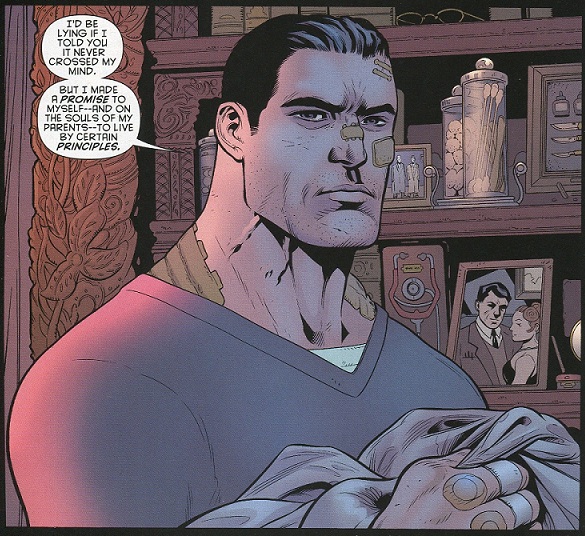
  • This week's Batman and Robin #8 (written by Peter Tomasi and illustrated by Patrick Gleason and Mick Gray) was a welcome denouement to the Morgan Ducard/Nobody storyline that culminated at the end of #7 when, as Bruce explains to Alfred, "Nobody's dead. Damian killed him." (Imagine parsing that statement if you hadn't been keeping up with the storyline!) As Bruce and Damian recover from their injuries (gee, good thing Bruce hasn't gotten thrashed lately in any other title), father and son talk about what happened. Bruce shares his oral diary, revealing his own desire to kill Ducard, to show Damian that the urge is natural but that he must never give into it.

    B&R8_1B&R8_2

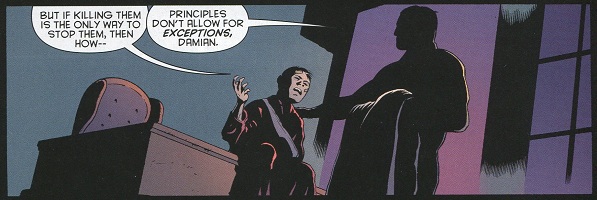
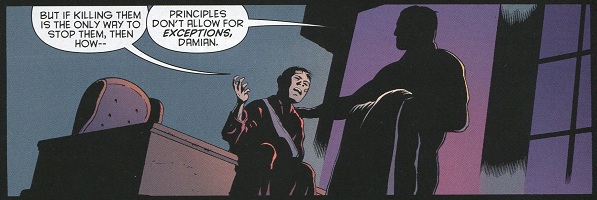
    Bruce argues that he adheres to a principle of not killing that doesn't "allow for exceptions." This sounds very much like a Kantian perfect duty, which is fantastic–to a degree. In an ideal world, it is easy to say "I will not kill" or "I will not lie," regardless of the circumstances, and it is an admirable person that tries his or her best to stick to them. But such a person must also recognize that there can be circumstances that will force him or her to question whether these duties or principles are truly absolute.

    Take Kant's infamous "murderer at the door" example: Your good friend shows up at your door one day, frantically trying to escape someone who's trying to kill him. You agree to hide your friend, and minutes later the would-be murderer shows up, asking if your friend is about. What do you do: lie to the murderer to save your friend, or tell the truth and help the murderer?

    Kant said you must not lie. According to  him, you have one concern and one concern alone: following your strict duty not to lie. If you tell the truth (or simply say nothing, which will save the same effect), your hands will be clean. If you do right, you're not responsible for anything that happens as a consequence, whereas if you were to lie, and the murderer went on to kill someone else (in mistake, perhaps), you would be responsible for that.

    But Kant was wrong, and he was wrong by his own standards. The murderer-at-the-door example appeared in the Berlin Press as a retort to Benjamin Constant, a French statesman, but in his more considered work, he wrote that no one can apply simple rules, including the duties one derives from the categorical imperative, to real-life situations without using judgment. For instance, even if you decided not to lie to the murderer at the door, you would need to use judgment to decide what to do instead: tell the truth, stay silent, or say "look–a squirrel!"

    More relevant is the need for judgment to settle conflicts between obligations, and this provides a more reasonable answer to the murderer-at-the-door example (and much-needed perspective on Bruce and Damian's discussion). Clearly there is more than one principle, duty, or obligation at play when the murderer comes to your door–specifically, you should also help save your friend's life, based on a moral principle to prevent wrongful harm to others. I think most morally reflective people would consider that to be a more important principle in this case than the principle that you shouldn't lie. Of course, this judgment is contingent on the context of the situation: the harm threatened is severe and the lie would be to a person intent on doing wrong. In a different situation, the judgment may be different, though the two principles are the same, because the context gives the principles different relative weight.

    In the second panel above, Damian essentially states the opposing principle to his father's: "But if killing them is the only way to stop them…" Bruce knows this principle well: while he says in this issue that he made a promise to himself ("and on the souls of my parents") not to kill criminals, he also made a promise that night (as seen in countless retellings of his origin) to make sure what happened to him doesn't happen to anyone else. Bruce and Damian recognize both a principle of preventing wrongful harm and a principle of not killing–but for Bruce, the latter principle always takes precedence, where I think Damian is more open to weighing the principles against each other in any given situation. (I realize this may be due to his early training by the League of Assassins, which leads him to minimize the importance of the no-killing principle. If nothing else, Bruce is helping him see the importance of this principle by adhering to it with no exceptions–the opposite extreme to Damian's dear mother and grandfather.)
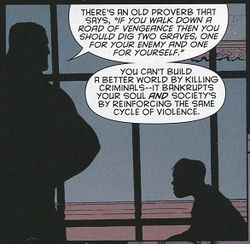
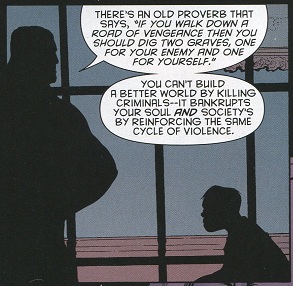
    B&R8_3Bruce does give other rationales, familiar from previous Batman stories in which killing has been discussed. He gives the virtue argument, that killing makes you a lesser person ("bankrupts your soul") and makes you no better than those you're sworn to fight. (His caution against indulging vengeance can be considered part of this, and is the clearest argument he makes; few would defend a principle based on vengeance.) He also presents the consequentialist argument ("reinforcing the same cycle of violence") that killing only leads to more killing. But note that neither of these escape the need for judgment: is your purity of character more important than saving lives, and does killing necessarily lead to more killing–or may judicious use of it lead to less deaths instead?

    Bruce's continued idealism on this issue is particularly welcome following Geoff Johns' flip comments about killing earlier this week. If we give him the benefit of the doubt, Johns may have been thinking much the same as I wrote here when he said, "there are heroes that, when they need to cross that line, they do it," citing Green Lantern, Aquaman, and Wonder Woman as examples. I would just like to see more discussions like the one in Batman and Robin #8, in which these heroes defend their decisions and explain why they "need to cross that line." I'm less interested in whether or not they kill than I am in how they justify it.

    —–

    Kant presented his murderer-at-the-door example in an essay titled "On a Supposed Right to Lie Because of Philanthropic Concerns," available in the Hackett edition of his Grounding for the Metaphysics of Morals. Philosophers have spilled much ink and killed many trees trying to reconcile the absolutist position given there with the rest of his philosophy; my favorite is Christine Korsgaard's "The Right to Lie: Kant on Dealing with Evil," available in her book Creating the Kingdom of Ends, which focuses on the difference between ideal and nonideal moral theory. Finally, I wrote about Batman and killing, relying chiefly on the Joker and the trolley problem (which can easily be framed as a conflict of principles as above), in my chapter "Why Doesn't Batman Kill the Joker?" in Batman and Philosophy: The Dark Knight of the Soul.

  • Mark D. White

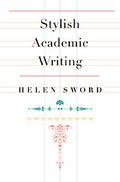
    SwordThis weekend's Wall Street Journal featured an article by Helen Sword entitled "Yes, Even Professors Can Write Stylishly," in which she criticized the quality of writing by most academics–and praised the exceptions, explaining some features that make good academic writing shine. (More can be found in her book, Stylish Academic Writing.) Having done my share of both writing and editing for various audiences, as well as lots of reading and refereeing, Sword's article got me to thinking about the challenges of academic writing and the pursuit of style in it.

    I would tend to think that scholars in the humanities (such as philosophy and law) have more latitude–and more responsibility–to write stylishly than those in the physical and social sciences. Scientific writing is often rigidly formatted (sometimes explicitly by journals): present the problem, explain the model, derive results (theoretically or empirically), and interpret the results. This should all be written well, of course, but I think style is of less concern when you're explaining a negative second derivative or a statistically significant coefficient.

    I remember writing my early economics articles (in theoretical industrial organization), in which it seemed all I was doing in the middle 80% of the paper was bridging the gaps between equations. The only "real" writing came at the beginning and the end, the parentheses that held the "stuff"–but ironically, the parentheses were the only part most people would read, so I learned quickly that careful attention to them was crucial.

    Writing in the humanities–a category in which I would include non-scientific economics–is less structured. This gives scholars more freedom to exercise their personal style, and at the same time provides less scaffolding under which to hide bad writing. Naturally, philosophers and legal scholars, who are trained at crafting arguments, often have the most polished prose, but many economists excel at this as well.

    Personally, I find much more stylistic freedom writing books (or contributions for edited volumes) than journal articles. While I agree with Sword that journal editors (and referees) value clear writing as much as anybody, I don't know if I'd agree that they appreciate stylish writing. Maybe it's just me, but I feel constrained to write very formally when I write for a journal; based on what I read in journals, it seems that is what most journal editors expect. (I say "most," because I know some journal editors that are exceptional in this way.)

    I tend to be a fairly good mimic when I write, so I've been able to adopt my writing style to whatever venue I'm writing for, whether it be journal, newspaper op-ed, popular magazine, academic book or popular trade. Out of those, the journal "style" is definitely my least favorite, and happily I'm at a stage in my career where I'm no longer dependant on journal publications for professional advancement. But while books may reach a wider audience (especially outside academia), there is a degree to which regular journal publications help keep your name in the thick of things in a particular academic community, so in that sense I miss writing for journals. (It's just not as enjoyable–and shouldn't writing be enjoyable?)

    Mimckry does not always pay off, though. For instance, Deirdre McCloskey is my favorite academic writer as far as style is concerned. I adore her tone–playful and gracious, yet firm and forceful–and I have to be very careful not to indulge my inner mimic and churn out third-rate McCloskeyisms when I write!

    I make no claims to any significant degree of craft or style in my writing, academic or popular. I am very grateful when friends or colleagues read my work and say they can "hear my voice" in it, and I am especially happy when they say this in reference to my academic writing, in which it is more challenging to be myself. (My natural voice comes out much more easily in my chapters in the Blackwell Philosopy and Pop Culture books and my Psychology Today posts.) Whatever academic style I have is most apparent in Kantian Ethics and Economics: Autonomy, Dignity, and Character, especially in the introduction (available here). I'll just keeping trying to improve and hone my style as I keep writing. (And writing. And writing. And…)

  • BaumeisterAt The Atlantic today, Hans Villarica interviews Dr. Roy Baumeister, one of the psychologists chiefly responsible for the ego-depletion or "muscle" theory of willpower. Under this conception, people have a limited amount of willpower at any given time; as they use it, it is depleted in the short term but strengthened in the long term (just like a muscle used in work or resistance training). In the interview, Baumeister describes one of his early experiments in which he tempted people with chocolate while asking them to eat radishes instead; this used some of their reserves of willpower, leaving less for other tasks, compared to the control group who got to eat the chocolate.

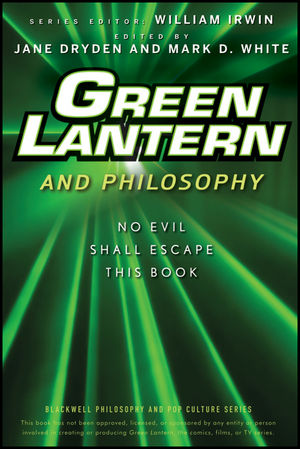
    In addition to informing my academic work on willpower and character, Baumeister's work was the basis for one of my chapters in Green Lantern and Philosophy: No Evil Shall Escape this Book. In chapter 2, "Flexing the Mental Muscle: Green Lanterns and the Nature of Willpower," I draw from years of stories to show that Lanterns' willpower has long been portrayed as a scarce resource. Below, I list some of the quotes I used in the chapter, showing that the version of willpower used in the Green Lantern stories corresponds with Baumeister's work–some even decades before Baumeister and his colleagues published it!

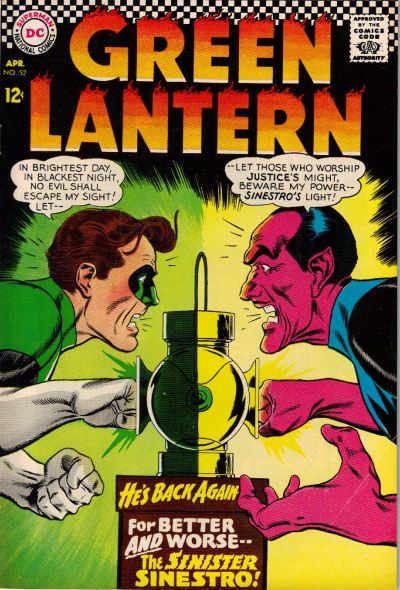
    Gl52On willpower as a muscle:

    "Your mind is like a muscle unused for years. You forgot how to use the power ring." (Sinestro to Hal Jordan, Green Lantern: Rebirth #5, April 2005)

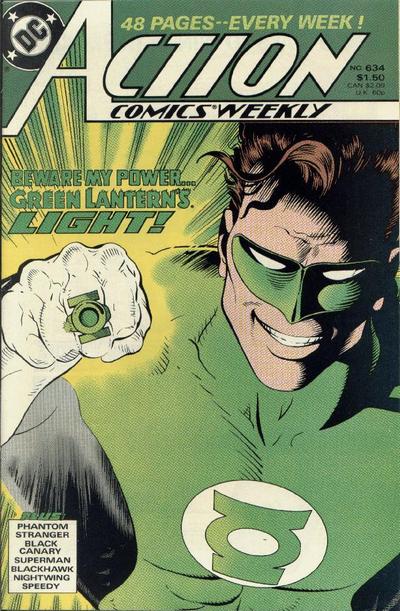
    "…the will is very like a muscle. In Abin Sur, that muscle was once extraordinarily strong—so strong that the Guardians of the Universe made him custodian of a battery of power, an amplifier of the will… and of a power ring, a device to focus that amplified will." (Action Comics Weekly #642, June 1989)

    On willpower as a scarce resource (which can be replenished):

    "[That] took lots of willpower. That—and escaping from the energy net—has left me exhausted. I need to regain my strength." (Action Comics Weekly #625, December 1988)

    "I know my ring’s got limitless power—but it is powered by my willpower. Have I got the strength necessary to make this work?" (Green Lantern, vol. 2, #149, February 1982)

    "Willpower’s like a muscle, and I’ve gotten better with it year after year!" (Green Lantern, vol. 2, #200, May 1986)

    Acw634On willpower, focus, and distraction:

    "Can’t take much more of this. I’ve been up all night trying to find the alien… . I’m exhausted… keeping this building together is taking all my concentration… all my will!" (Action Comics Weekly #628, January 1989)

    "Finding it hard to concentrate, aren’t you? With me hitting you, I mean! And unless you can focus your willpower, your ring can’t work!" (Hal to Sinestro, Green Lantern, vol. 2, #124, January 1980)

    For more on Baumeister's work, pick up his latest book (cowritten with John Tierney), cunningly titled Willpower: Rediscovering the Greatest Human Strength.

  • Fearless12The 12-part biweekly (semimonthly?) series Fear Itself: The Fearless, which focused on Sin's plan to reclaim the Serpent's Hammers after the end of Fear Itself and Valkyrie's attempts to stop her, came to its conclusion last week. I found the series much more enjoyable than it's predecessor, perhaps because it was not weighed down by the event status of Fear Itself, and the creators were more free simply to tell their story.

    Along with Chris Yost and Fear Itself scribe Matt Fraction, Cullen Bunn crafted a story of a strong female Asgardian warrior fulfilling her destiny, finding her lost love, and leading her fellow heroes in the fight. And as rendered by Mark Bagley and Paul Pelletier, the series was remarkably devoid of any of the blatantly sexist imagery that fills so much of comics these days. It's fairly safe to say that Bunn and his colleagues write Valkyrie the way I wish Wonder Woman would be written–fierce yet noble, compassionate yet uncompromising, and informed by a mythology that reinforces these ideals, rather than upends them for shock value.

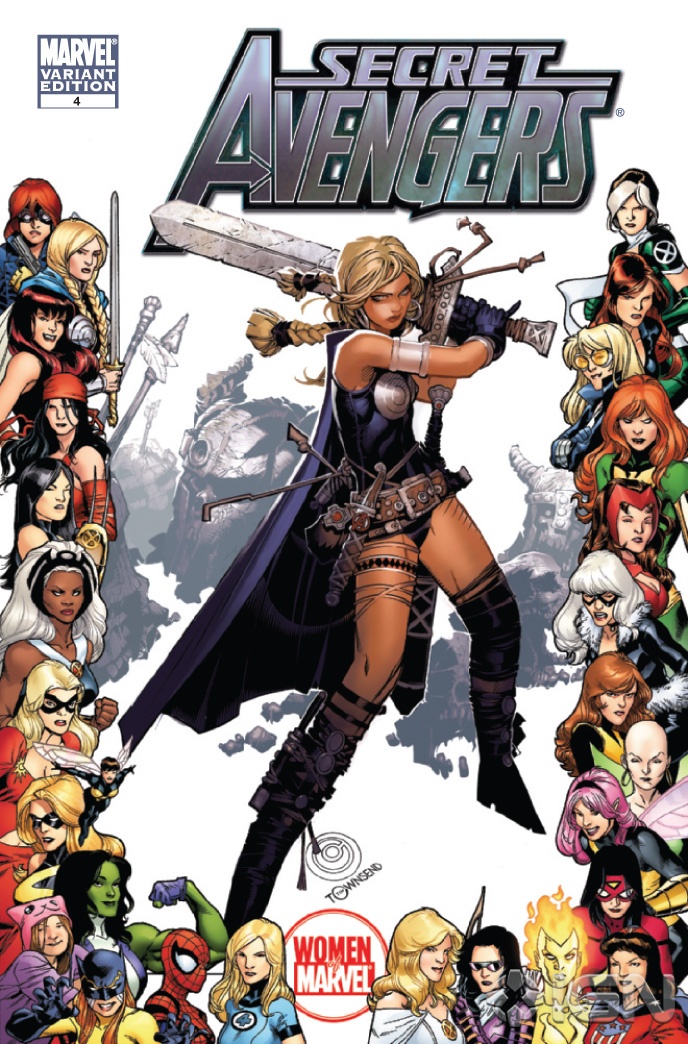
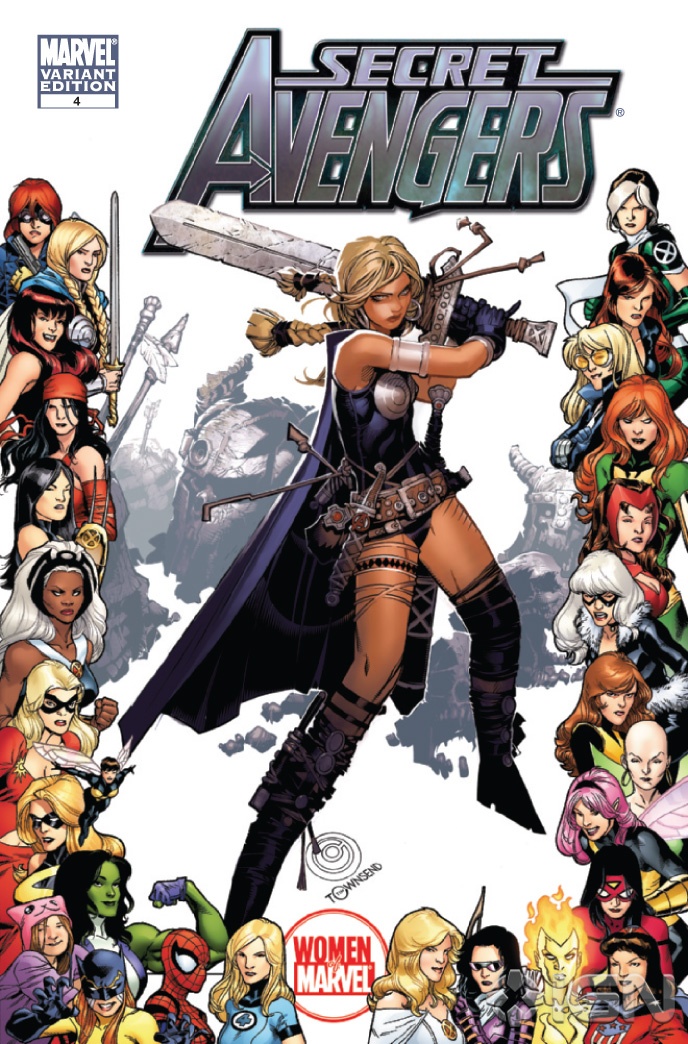
    Secretavengers4So I ask the powers-that-be at Marvel, why not try an ongoing series for Valkyrie? Let's admit it, you've struggled with female-led titles for years: after some success with She-Hulk and Ms. Marvel a few years ago, the most recent Black Widow series was short-lived, as was Green Arrow/Black Canary Hawkeye & Mockingbird. We all have the highest hopes for Kelly Sue DeConnick's Captain Marvel series featuring Carol Danvers, but you could certainly use another female-led ongoing. Along with Ed Brubaker in Secret Avengers, Bunn showed in The Fearless that Valkyrie can be a compelling character with ties to both Asgard and Midgard–and with The Mighty Thor and Journey into Mystery, it would give you a trilogy of Asgardian titles. (Can you say "crossover"? I knew you could.)

    And best of all, I have it on good authority that Bunn wants to do it!

    Cullen

    Yes we can, Mr. Bunn. Yes we can.

  • In the back-up feature to last week's Detective Comics #8, written by Tony S. Daniel and illsutrated by Szymon Kudranski, Harvey Dent, aka Two-Face, appropriately adopts both sides of the recent philosophical and psychological debate over character traits.

    First, Harvey shows us the situationist position:

    Detective8_1

    Situationists such as John M. Doris, author of Lack of Character: Personality and Moral Behavior, argue that people do not have general character traits like honesty and courage, but rather that their moral behavior depends very strongly on the circumstances of any particular situaiton. This work is based on psychological research showing that, for instance, people are much more likely to help a stranger after finding a coin in a phone booth (or other seemingly irrelevant and trivial cues).

    This is widely seen as a criticism of virtue ethics, which claims that people do have robust character traits or dispositions that correspond to the virtues. Luckily for us, Two-Face also represents this position:

    Detective8_2

    Virtue ethicists respond to the situationist critique in a number of ways. For instance, they argue that they never claimed that character traits and action were correlated precisely, so there is no problem with observing some situational variation in behavior. Also, they argue that the experiments don't show that circumstances change any particular person's behavior; they simply separate those with robust character traits from those without. (Showing his own professional virtue, Doris lists much of his critics' work here; Gopal Sreenivasan's "Errors about Errors: Virtue Theory and Trait Attribution" is particularly good.)

  • GL 49Hmm. Here's Geoff Johns, discussing the future of the Green Lantern book with Vaneta Rogers at Newsarama:

    Nrama: Going back and looking at the relaunch, I know everyone talked about it being a "soft" reboot and pointed quite often to Green Lantern and Batman as the places where not a lot of changes took place, but it's obvious this Hal Jordan is a little different. You're playing him a lot younger and a little more brash, especially in the Justice League title. But I think a lot of readers were surprised that Hal Jordan killed a Sinestro Corps member in a way that appeared light-hearted, as he made a funny comment. Did you want to show that he was a little different now?

    Johns: Yeah, because Dan [DiDio] and Jim [Lee] wanted the timeline rolled back to five years, there are differences with Green Lantern. He's a little bit younger, but also, all the stuff he's been through, I think he's a lot more sure of himself. I think he's a little less patient with the stuff he goes up against.

    With that Sinestro Corps member he killed, when Hal goes up against one of those guys, he's going to take him out if lives are at stake.

    There are certain heroes that kill. Among those are Green Lantern, who definitely has to, although he doesn't do it very often. But he does it when he has to. Aquaman sure does. And we've seen Wonder Woman do it too.

    So there are heroes that, when they need to cross that line, they do it.

    Does this herald a mjaor shift toward "heroic killing" in the DCU? The rest of the Marvel community tolerates the Punisher–and welcomes Wolverine onto every team–with little controversy (usually from Captain America), but I've always thought the DC heroes were more firmly against killing (hence the reaction to every iteration of the Vigilante that pops up). Of course, there have been exceptions, but they were always treated as such, like Superman's killing of the Kryptonian criminals that led to his "Exile," Wonder Woman's breaking Max Lord's neck during "Sacrifice," and most recently the Guardians' enabling the Green Lantern rings to kill members of Sinestro Corps during "The Sinestro Corps War."

    I'm no absolutist when it comes to moral prohibitions, but Johns' attitude strikes me as disturbingly lacksadaisical. Green Lantern "definitely has to, although he doesn't do it very often. But he does it when he has to"? Why does he "definitely" have to and not other heroes? And what defines when he "has to"? One has to presume some consequentialist calculation (the one life taken versus the many saved or perhaps threshold deontology (where the hero refuses to kill unless the cost becomes "too" high), but why does this apply to some heroes and not others? Is it a difference in ethical codes, character traits, or situations?

    These are interesting questions, to be sure, but Johns seems too glib about it all for my tastes, simply saying that "there are heroes that, when they need to cross that line, they do it." Let's just hope that when they consider crossing that line, we see them struggle with it–if they feel they "have to," at least let the readers know why, and let them judge if they agree or not.

    (As for Johns' statement about "all the stuff he's been through"–in his short five years, of course–and how this supposedly informs his character, see my recent post on history and character.)