Mark D. White

Writer, editor, teacher

  • Mark D. White

    In his column in this morning's New York Times, Mark Bittman reiterates his call for regulation of the amount of sugar Americans consume, such as taxing sugary foods and adding them to the list of items for which food stamps cannot be used–nothing new there. (I've discussed Bittman before here.)

    After presenting his case for sugar regulation, he asks,

    The question “Is this necessary?” is unavoidable. But as obesity and its consequences ravage our health care system, we struggle not only with our own diets but also with preventing our children from falling into the same traps. Last year a brigade of parents stood watch outside a corner store in North Philadelphia in an attempt to prevent their kids from buying junk food.

    They’ve been called foot soldiers, but you might call them vigilantes. Vigilantism occurs when people believe the government isn’t doing its job. We need the government on our side. It must acknowledge the dangers caused by the most unhealthy aspects of our diet and figure out how to help us cope with them, because this is the biggest public health challenge facing the developed world.

    Vigilantes? He casts parents as vigilantes for doing their job–parenting–and blames the government for not "doing its job"–which is parenting. Vigilantes usurp legitimate roles of the state, such as criminal justice–not taking care of our kids.

    For the record, I have no problem with schools limiting their own food offerings to healthy foods and eliminating junk food from school vending machines, but these parents were trying to stop their kids from eating junk outside of school–which, again, is their job, not the government's.

  • The Good Men Project, a website I'm honored to be affiliated with (as a frequent contributor and now an editor-at-large), is currently running a series of articles on heroes and heroism, two of which feature superheros in particular:

    • Dd7"The Man Without Fear: Heroism and Elementary School" is by my good friend Dr. Matt Finch (and originally appeared at another great site, Role/Reboot). Matt uses the story from Daredevil #7 (in which Matt has to lead a group of blind children through a raging snowstorm after their bus crashes) to explore the challenges he's encountered with teaching small children. (And he was kind enough to mention in the piece that I suggested that particular comic to him–he even immortalized the day in tumblr form.)
    • "Why I Read Superhero Comics" is my own contribution to the section, explaining how the best superhero comics can inspire by reminding us that everyone has the capacity to be a hero in some small way, and that my favorite superhero stories feature heroes confronting dilemmas similar to those we face in the real world, problems that must be solved using reason and judgment rather than powers or gadgets.
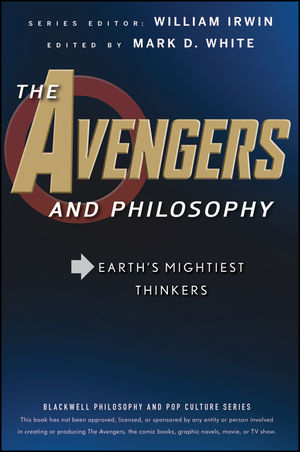
  • AvengersThanks to Mitters' tumblr, I discovered that there are three samples from The Avengers and Philosophy: Earth's Mightiest Thinkers available at Wiley's site for the book: the table of contents, the index (in case you're curious who's included in the book–I'm happy to say most everybody!), and best of all, the first chapter, written by yours truly.

    Titled "Superhuman Ethics Class with the Avengers Prime," it introduces the three basic schools of ethics–utilitarianism, deontology, and virtue ethics–using Iron Man, Captain America, and Thor (respectively), and the conflicts between them, as examples. (The title comes from Avengers Academy, as I discuss here and here.)

    Download it and let me know what you think, and don't forget to preorder the book, which comnes out in May!

  • Mark D. White

    BarryschwartzIn the New York Times, psychologist Barry Schwartz (author of The Paradox of Choice: Why More Is Less) warns us of "The Danger of Too Much Efficiency," in which he argues that, while efficiency is generally a good thing and enables increases in standards of living, more efficiency is not necessarily better. The first half of his piece is an excellent summary of the benefits of efficiency, which he illustrates using the concept of friction:

    …firms compete to become more efficient, and we as consumers, along with Bain and its like, benefit from this competition.

    What stands in the way of efficiency is friction. When automobile manufacturers struggle to squeeze as many miles per gallon as possible out of their car designs, friction is the enemy. Their aim is to design a vehicle that uses every ounce of fuel to move the car forward.

    And so it is in the world of finance. As the historian Niall Ferguson reminds us in his book The Ascent of Money, hard as it is to imagine, people didn’t always have money. The invention of money went a long way toward reducing the friction, the inefficiency, in financial transactions. No longer did the farmer have to bring sacks of potatoes to the marketplace to trade for eggs and milk. Money was a medium of exchange that greatly reduced what some have called the financial coefficient of drag.

    But Schwartz recognizes that increasing efficiency by reducing friction is not the only important concern to individuals or society. After summarizing the efficiency gains from securitizing mortgages and increased access to consumer credit, he turns to the downside:

    All these examples tell us that increased efficiency is good, and that removing friction increases efficiency. But the financial crisis, along with the activities of the Occupy movement and the criticism being leveled at Mr. Romney, suggests that maybe there can be too much of a good thing. If loans weren’t securitized, bankers might have taken the time to assess the creditworthiness of each applicant. If homeowners had to apply for loans to improve their houses or buy new cars, instead of writing checks against home equity, they might have thought harder before making weighty financial commitments. If people actually had to go into a bank and stand in line to withdraw cash, they might spend a little less and save a little more. If credit card companies weren’t allowed to charge outrageous interest, perhaps not everyone with a pulse would be offered credit cards. And if people had to pay with cash, rather than plastic, they might keep their hands in their pockets just a little bit longer.

    Rather than focus on his policy recommendations (with which I have much disagreement, as regular readers of this blog can easily imagine), I want to address his normative analysis of efficiency, which with I have much sympathy. I do think, however, that the particular way in which he criticies the emphasis of efficiency is strange, and obscures his greater point to some extent–a point with which, again, for the most part I agree.

    Using the Aristotelian language he adopted in his more recent book (written with Kenneth Sharpe), Practical Wisdom, Schwartz recommends finding the "golden mean" of efficiency rather than simply purusing its maximum level. While I don't disagree with this in principle, I do think it is an odd way to put the problem, since it suggests that we can find the optimal level of efficiency without consideration of other values. If there is a golden mean of efficiency, the only way to find it is to determine how much efficiency is consistent with other values we want to promote (such as justice, dignity, and equality). This is really no different from the Aristotelian determination of the golden mean of characteristics like courage, in which the extremes of foolhardiness and cowardice offend other values and ends, as opposed to being internally inconsistent.

    But I find the golden mean analysis to be misleading in a deeper sense when applied to efficiency. The reason we can't determine the optimal level of efficiency is because it is an empty value–it's a mean to an end, not an end in itself. And as such, it should be maximized in order to provide the means to pursue valuable ends, except insofar as it conflicts with those ends themselves. In other words, the pursuit of efficiency must be limited, but out of recognition that other values are more important, not that there is something inherently bad about a certain level of efficiency. The only "danger with too much efficiency" is that it implies that important values have been neglected in its name.

    To a large extent, this all cashes out the same way; my disgreement with Schwartz on this issue is largely rhetorical rather than substantive. He emphasizes the excessive attention given to efficiency, and then recommends that it be frustrated (by increasing frictions through regulation) in order to correct the resulting problems. But as I said above, the issue is not an excessive focus on efficiency, but on neglect on other values which should temper it. It is as if we said that, if people neglect their families to spend time at the gym, then we should discourage gym use by raising membership fees or reducing hours of operation. But exercise–also a good thing in general, though it can be taken too far in many ways–is not the problem here. The neglect of family is the problem, and it is that neglect that should be addressed. In general, our focus should be placed directly on the neglected values (justice, equality, and so forth) rather indirectly on limiting the threat to them (too much efficiency).

    Indeed, Schwartz does emphasize the importance of corrective norms, although he resorts to regulation to bolster them:

    Perhaps we can use the criticism of Bain Capital as an opportunity to bring a little friction back into our lives. One way to do this is to use regulation to rekindle certain social norms that serve to slow us down. For example, if people thought about their homes less as investments and more as places to live, full of the friction of kids, dogs, friends, neighbors and community organizations attached, there might be less speculation with an eye toward house-flipping. And if companies thought of themselves, at least partly, as caretakers of their communities, they might look differently at streamlining their operations.

    True, increased observance of these norms would increase friction and reduce efficiency, but that shouldn't be the goal–the goal should be increased observance of the norms themselves! Again, the result is the same, but I worry that focusing on efficiency as the "target variable" risks obscuring the more important issues behind it.

    I think Schwartz would agree with me that, in the end, the best way to conceptualize of efficiency is as a means to an end, in which the values we hold individually and collectively are promoted by it at the same time that they temper its pursuit.

  • Vday dogI realize I just posted yesterday, but I wanted to point out some special Valentine's Day activity, including two new pieces written and posted today:

  • Thor TMAIf you're like me, a comics fan who desperately needs a dose of romance on this Valentine's Day, then do what I just did: reread (because I sincerely hope you've read it already) Roger Langridge and Chris Samnee's Thor: The Mighty Avenger series (eight issues, collected in two digests, available here and here). Colyn deGraaff chose its depiction of Thor and Jane Foster as the #1 comic romance "you might have missed" today at his Canuck Goose blog, and last summer, Carol Borden of the Cultural Gutter called it "an unusual book—a superhero romance comic" that, as an all-ages book, "because it is limited in the kind of adult material that can be shown… ends up more adult in its focus on love and friendship."

    As Borden points out, it is yet another retelling of Thor's origin story, much closer to the version eventually portrayed in the feature film than in Journey into Mystery #83 from 1962 (also reprinted in the first digest). Thor is banished from Asgard, falls to Earth, and must find Mjolnir, which is hidden in a vase in the museum at which Jane Foster works. Jane, fresh out of a relationship with a once-idealistic young doctor who became more concerned with success and money, finds a virtuous and chivalrous alternative in a bewildered Thor, whom she helps acclimate to his new surroundings while he tries to find his way home.

    Jane is clearly taken by Thor from the beginning, Thor is ever the gentleman, and their romance builds slowly and sweetly over the eight issues of the series. I hesitate to spoil much, but the final page from issue #6 (in the second digest) is quite representative:

    Thor tma 6
    Chris Samnee's art perfectly complements Langridge's tender-hearted script, and both are utterly refreshing in their portrayal of Jane Foster. Together they show her to be smart, strong, and beautiful, a confident woman who can take command of Toothgnasher and Toothgrinder but at the same time a smitten girl who finds herself in love with a god.

    Thor: The Mighty Avenger was unfortunately short-lived, but I hope it stays in print in digest form for years to come–and it would make the perfect Valentine's Day gift for the comics fan in your life (or yourself!).

  • It's hard to believe that we're already a month and a half into 2012. Here's what I'm been up to in terms of writing since my last update:

    Alng with prepping for various academic projects, I also indulged in a bit of free writing a couple nights ago, just writing for its own sake rather than for the purpose of publication or promotion. it felt wonderful, and I will have to make time to do it some more–and hopefully regularly.

    I've also been trying to implement some of David Covey's time management techniques from his book The 7 Habits of Highly Effective People, which was highly recommended by a good friend who's both very productive and rather satisfied with his life (hmm). Briefly, it recommends listing your various roles and then setting goals for the next week for each role. That was, to put it mildly, an eye-opener; perhaps I'll write more about that in a future post. A worthy exercise in itself, even if I never implement it. (The scarier part is writing my "mission statement," which touches on all my issues about purpose and meaning–and lack thereof.) 

  • Mark D. White

    LynnemurphyI'm fascinated by the recent trend of academic bloggers reflecting on what it is they do, and the latest comes from linguist Lynne Murphy of the Separated by a Common Language blog, writing in the Impact of Social Sciences blog run by the London School of Economics. (Thanks to Andrea Doucet for the link.)

    Her post there is titled "I’m having a blogsistential crisis! I am a blogger. And I am an academic. But am I an academic blogger?", and in similar way to Doucet's examination of blogging versus academic research discussed earlier here, Murphy ponders the relationship between her blogging and her university position and responsibilities:

    This has been an issue for me since I started the blog while on research leave in 2006. It served me then as a limbering-up exercise before writing the “hard” stuff that would be subjected to peer review. At the start, I was meticulously careful about keeping blog and work separate. I acknowledged my qualifications and title, but only in order to give readers some reason to think I knew what I was talking about. I don’t blog at the office. And I still defensively refer to blogging as my ‘hobby’ on my Blogger profile. But when I became aware that my blogging was (being acknowledged as) a selling point for the University and the programmes I teach on, I started being less meticulous about separating blogging/tweeting activities from my academic life. A few months ago, I added mention of my employer to my Twitter profile and I’ve started asking media contacts to mention the University when the introduce me, because otherwise I can’t be listed among the staff ‘in the news’. But it is still a constant question for me: Am I working for the University when I blog? Should I be?

    To get her answer, read the rest of her post here.

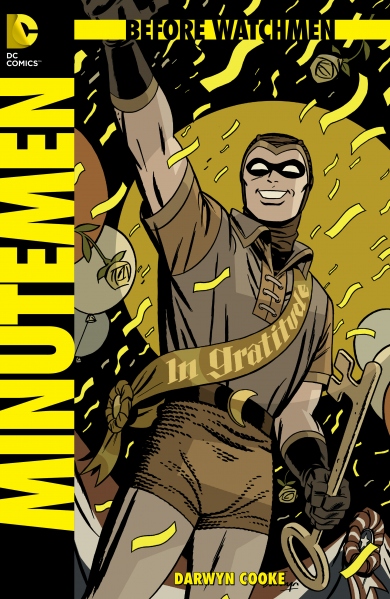
  • MinutemenHardly a secret at this point but finally officially confirmed, DC Comics unpeels its plan for seven prequel miniseries to Watchmen, the 25-year-old classic series by Alan Moore and Dave Gibbons. Creators for the new series include Darwyn Cooke, J. Michael Straczynski, Amanda Conner, Andy and Joe Kubert, and Len Wein.

    Get the complete details from the LA Times' Hero Complex or USA Today.

    Guess I should get working on a sequel prequel to this, then. (Does Before Watchmen and Philosophy sound good?)

  • Mark D. White

    As pointed out by Lynne Kiesling at Knowledge Problem, Nobel laureates Peter Diamond and Joe Stiglitz, along with (this year's ASE/ASSA keynote speaker) Robert Shiller and Brian Arthur, discussed "The Future of Economics," which moderator Martin Wolf summarizes at the Financial Times' The World blog. Kiesling condenses Wolf's summary (as reproduced below):

    1. First, orthodox economics had, in the years leading up to the crisis, become more a cult than a science, particularly with the assumption that what exists in competitive markets has to be the best possible outcome, since, if it were not, it could not exist.
    2. Second, let a thousand flowers of thought bloom.
    3. Third, the sociology of the profession – the need to define and defend a core discipline that can be taught to students and so determines what it means to be an economist – militates against such heterodoxy.
    4. Fourth, human beings are not rational calculating machines.
    5. Fifth, time matters in economic processes, which are, in general, not reversible and not characterised by any sort of equilibrium.
    6. Sixth, the world is not computable.
    7. Seventh, being a study of complex human behaviour, in which the world is created by human understand [sic] and motivations, economics is hard.
    8. Eighth, in theory it is right and proper to abstract in order to focus on a specific phenomenon. In addressing policy, this is irresponsible.
    9. Ninth, even though economists get much wrong, they still have much to offer to non-economists who tend to assume that economic problems are far more simple than they actually are.
    10. Tenth, there is a great danger that in rejected the most simplistic pro-market mantras, economists and policymakers will embrace even more dangerous and naïve statism.

    In my opinion, these are fantastic, especially 4, 6, 7, and 9 (concerning the complexity of economics as a social science and popular misunderstandings of that), 8 (about the responsible conduct of policy analysis), and 10 (cautioning against extreme reactions to the crisis). I just hope people are listening.