Mark D. White

Writer, editor, teacher

  • Mark D. White

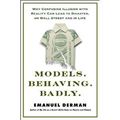
    Models-behaving-badlyIn today's Wall Street Journal, there is a book review by Burton Malkiel of Models. Behaving. Badly., a critique of excessive reliance of mathematical modeling in finance and economics, written by Emanuel Derman, a key player in developing the very techniques he now criticizes. Judging from Malkiel's review, Derman's book echoes themes which are familiar by now, but are no less welcome for that. Some excerpts from the review:

    Mr. Derman's particular thesis can be stated simply: Although financial models employ the mathematics and style of physics, they are fundamentally different from the models that science produces. Physical models can provide an accurate description of reality. Financial models, despite their mathematical sophistication, can at best provide a vast oversimplification of reality. In the universe of finance, the behavior of individuals determines value—and, as he says, "people change their minds." …

    "In crises," Mr. Derman writes, "the behavior of people changes and normal models fail. While quantum electrodynamics is a genuine theory of all reality, financial models are only mediocre metaphors for a part of it." …

    The basic problem, according to Mr. Derman, is that "in physics you're playing against God, and He doesn't change His laws very often. In finance, you're playing against God's creatures." And God's creatures use "their ephemeral opinions" to value assets. Moreover, most financial models "fail to reflect the complex reality of the world around them."

    And my favorite:

    He sums up his key points about how to keep models from going bad by quoting excerpts from his "Financial Modeler's Manifesto" (written with Paul Wilmott), a paper he published a couple of years ago. Among its admonitions: "I will always look over my shoulder and never forget that the model is not the world"; "I will not be overly impressed with mathematics"; "I will never sacrifice reality for elegance"; "I will not give the people who use my models false comfort about their accuracy"; "I understand that my work may have enormous effects on society and the economy, many beyond my apprehension."…

  • Avengers-disassembledComic Book Resources has announced, at the end of a lengthy interview with Avengers mastermind Brian Michael Bendis, that he will end his tenure with the franchise in 2012:

    "I'm going to wrap up 'Avengers' and 'New Avengers.' At the same time the first storyline of 'Avengers Assemble' will be done," Bendis told CBR. "It's a good time to move on to other things. Before I go, though, I'm ending things big. I'm in countdown mode. You know when you're watching a show like 'Breaking Bad,' and every episode feels like the second to last episode? That's where I'm at. I've been on the Avengers longer than anybody in the history of the book. When you take everything into account, I've written over 200 issues. I'm very, very proud of that, and what we have coming up this summer gives me the opportunity to go out on a high note. I know enough about showbiz to know that's a great time to go."

    I have been a huge fan on Bendis' work on Avengers since the team was first disassembled, and his influence appears throughout Avengers and Philosophy. I hope to have more to say on his epic run in future posts.

    Thank you, Mr. Bendis, for a groundbreaking run.

  • Iron man 510I know, I know–no post in over a month. But I've not been excited about comics for a while: the DCU relaunch left me cold, and Fear Itself was largely a disappointment, redeemed only by the fantastic epilogue issues 7.1, 7.2, and 7.3. (Try to explain to the Wiley copy-editors why some comics citations now have ".1" at the end of the issue number–it's a new world, folks.) Mark Waid's Daredevil and Kieron Gillen's Journey into Mystery are the highlights of my month, along with select DC titles such as Scott Snyder's Batman, Kyle Higgins' Nightwing, and Geoff John's Aquaman.

    But Ed Brubaker's relaunch of Captain America has gotten off to a slow start, forced to be an autonomous title parallel to but disconnected from the Cap-centric Fear Itself and therefore missing out on the post-Fear Itself "Shattered Heroes" theme. On the other hand, two titles closely linked to the aftermath of the Serpent War, both written by Matt Fraction, are forging ahead: The Invincible Iron Man and The Mighty Thor. (Maybe Cap needs an adjective?)

    Both titles continue directly from their respective Fear Itself 7.x issues, and while Fraction can certainly be criticized for the somewhat glacial pace of his previous arcs on these two titles, Iron Man #510 and Thor #8 (if I may dispense with the adjectives) both race ahead like Guy Ritchie films shown at double-speed.

    MILD SPOILERS AFTER THE JUMP…

    (more…)

  • Boy, talk about déjà vu–two weeks since my last update and things are very similar…

    • Another two new Psychology Today posts, both stemming from readers' comments: "Is Self-Loathing an "All-or-Nothing" Proposition?" (November 13) and "Does Self-Loathing Get Better or Worse in Certain Situations?" (November 20).
    • Another conference–going on as I write, in fact–this time the Southern Economic Association meetings in Washington, where I am giving two papers, one an overview of my book Kantian Ethics and Economics: Autonomy, Dignity, and Character, and the other an elaboration of some themes in it–specifically, whether it is true that "every man has his price," or, in other words, if financial or materials considerations can ever affect truly moral behavior. Against all expectations, I say yes, but only in very particular instances: namely, tragic dilemmas in which one has to compromise one obligation to perform another, the choice between which can be affected by material considerations since there are no hard and fast rules regarding these choices. I gave that talk yesterday (Saturday), and it went very well–I actually recount some of yesterday's experiences in today's Psychology Today post. Let's hope this afternoon's goes as well!
    • I also posted a number of things to Economics and Ethics, mostly pointing out interesting work without much comment ("if it ain't broke…"), but one piece had a little more oomp to it: "I may suck, but not as much as you" (November 10), which commented on the inauthenticity of people's focus on relative well-being.

    Reappointments are done at work, which frees up a lot of time for writing, which I hope to do much more of from this point on–watch this space!

  • Mark D. White

    Please excuse the flippant title, and get ready for a bit of a rant. (Listen–it's almost Friday, and it's been a rough couple of weeks.)

    I'll start with a old joke: Two campers are in the woods when they spot a bear heading toward them. One camper starts running while the other bends down to carefully tie his shoes. The first camper yells back to his friend, "do you really think that will help you outrun the bear?" The second camper yells back, "I don't need to outrun the bear–I just need to outrun you."

    I was reminded of that joke when reading a Real Time Economics blog post at The Wall Street Journal's site a couple weeks ago about a recent study on "last-place aversion." In the paper (available here), the authors report on experiments in which the participants were found more likely to take gambles that might boost their social ranking (rather than certain payoffs of equivalent expected value), and to forego costless action to help those worse off than themselves, the lower in the ranking they were to begin with. The authors use these results to support individuals' aversion to being at the bottom of the social ranking, preferring to have at least one person or group to look down upon.

    I don't doubt the findings or the interpretation, but they sadden me. In fact, the entire concept of relative preferences and well-being disturbs me and always has. The idea that many (perhaps most) people base their feelings of satisfaction and happiness on what the folks next door have rather than on their own needs and desires–assuming they even have their own needs and desires–is ironically and tragically counterproductive in the aggregate. (On this I agree with Robert Frank, though not on his policy recommendations based on it.)

    Maybe this unconscious desire to one-up our peers has an evolutionary basis–it would certainly seem to inspire a striving for material (and thereby reproductive) success–but it also seems to vary widely on cultural grounds (being much more pronounced in the U.S. than in Europe, for instance). (I thank Dr. Maryanne Fisher for her insights on this point.) But just because it's natural doesn't make it good or right–thank you, G.E. Moore–and just as we strive to counter other hardwired inclinations toward prejudice and oppression toward others, I would hope we would reject those which represent an attitude of disrepect toward ourselves.

    It strikes me as horribly inauthentic to subsume your own standards of well-being, happiness, and satisfaction for other people's, especially if it leads to a counterproductive "race to the top" in which no one's intrinsic preferences are satisfied. I said as much here about two years ago (focusing on status goods like Starbucks coffee, which I now drink regularly, thanks to the same Dr. Fisher), so I won't rehash those arguments. Nonetheless… argh.

    Don't get me wrong, researchers in psychology and economics do us a great service in highlighting these unconscious dispositions. But where are the voices crying out to restrain them, to orient our decision-making more towards activities that will satisfy our desires rather than simply make us feel good compared to our neighbors? Dr. Frank decries what Thorstein Veblen termed conspicuous consumption, certainly, but he focuses policy changes such as steeply progressive tax rates to "solve" the problem. This is to treat the symptoms rather than the disease (as behavioral economists are wont to do). Once we recognize our flaws we don't have to take them as given–but we have to make the effort.

    And we shouldn't want for the people next door to do it first.

  • Mark D. White

    A fascinating article in the latest issue of Utilitas (23/4, December 2011) by Toby Handfield (Monash University) titled "Absent Desires" takes up the issue of absent desire in relation to satisfied and frustrated desire, arguing that having absent desires is incommensurable with having satisfied desires:

    What difference does it make to matters of value, for a desire-satisfactionist, if a given desire is absent, rather than present? I argue that it is most plausible to hold that the state in which a given desire is satisfied is, other things being equal, incommensurate with the state in which that desire does not exist at all. In addition to illustrating the internal attractions of the view, I demonstrate that this idea has attractive implications for population ethics. Finally, I show that the view is not subject to John Broome’s ‘greedy neutrality’ worry.

    This has obvious relevance for Stoic ethics and normative population studies (as Handfield notes), but also Buddhist thought as well as standard welfare economics (for example, the measurement of well-being when demand is affected by advertising, creating a desire that was previously "absent").

  • Mark D. White

    Just a brief note to draw your attention to a terrific new article forthcoming in the European Journal of Philosophy that summarizes the literature on the ethics of imposing risk, an omnipresent problem with no easy solution but which is of critical concern to anyone dealing with issues of harm, whether from an economic, legal, or philosophical perspective.

    The Moral Problem of Risk Impositions: A Survey of the Literature

    Madeleine Hayenhjelm and Jonathan Wolff

    Abstract: This paper surveys the current philosophical discussion of the ethics of risk imposition, placing it in the context of relevant work in psychology, economics and social theory. The central philosophical problem starts from the observation that it is not practically possible to assign people individual rights not to be exposed to risk, as virtually all activity imposes some risk on others. This is the ‘problem of paralysis’. However, the obvious alternative theory that exposure to risk is justified when its total benefits exceed its total costs faces the standard distributional challenges of consequentialism. Forms of contractualism have been proposed as a solution, but how exactly such theories can be formulated remains problematic, especially when confronted with the difficult cases of mass, novel, risk such as climate change.

  • My weekly update of activity seems to have morphed into every 12 days–odd. Chairing my department continues to take up most of my attention, but things should calm down considerably this week, after which I should be able to re-dedicate myself to some academic writing (more below). In the meantime…

    After I get my last five untenured people reappointed this week, I'll finalize my new paper to be presented at the Southern Economic Association meetings in Washington in a couple weeks (where I also give a talk drawn from my book Kantian Ethics and Economics: Autonomy, Dignity, and Character). It will be nice to get back into a scholarly writing mode–it was difficult for a while, even when I had more time, but I'm starting to feel better about it, especially after the retributivism conference on Friday. There's nothing like being in the presence of great minds to inspire work!

    OK, back to grading exams!

  • I have five more untenured colleagues–the last bunch out of eleven–to get reappointed in a couple weeks, and that has been (and will continue to be) my life for a while. But in the meantime, I did manage to get two new posts up at Psychology Today over the last couple weeks: "Does a Failed Relationship Mean That You're a Failure Too?" and "The Single Self-Loather: Caught Between Loneliness and Guilt."

    More soon, I hope…

  • So much for weekly updates… fall semesters for chairs at my college are dominated by personnel matters (i.e., making sure my yet-untenured faculty are reappointed for another year), which leaves little time or energy for writing. But a convenient break comes this afternoon (and continues throughout the weekend) in the form of New York Comic Con, which I am attending for the first time.

    But I did manage to get some things online, including a new Psychology Today post, "Self-Loathing and Relationships: Believe in Others Who Believe in You"; a long-overdue post on the DC relaunch at The Comics Professor; and my second article for Complete Wellbeing, "The Ultimate Dating Advice," which saw both print and online publication. I also read most of Jeffrey Sachs' new book, The Price of Civilization: Reawakening American Virtue and Prosperity, with hopes of commenting on it at Economics and Ethics soon.

    And in minor book news (minor news, not minor books, of course), Theoretical Foundations of Law and Economics is now available in paperback and The Avengers and Philosophy: Earth's Mightiest Thinkers is now available for preorder. Perfect for trick-or-treaters!