Mark D. White

Writer, editor, teacher

  • Answer: lotsa blogging and popular writing, and dealing with departmental stuff as chair, but alas no progress on book projects…

    A disappointing week in terms of scholarly writing, but very satisfying in terms of popular writing; it's becoming harder not to think this might be the way I should go, but it's early yet…

    (And I did discover I rather like the South Orange, NJ, Starbucks early in the morning; I might make that a regular thing, at least until the semester starts.)

  • This is great: Saturday Morning Breakfast Cereal takes an extremely practical approach to the life of Superman, part of it resembling Mahesh Ananth and Ben Dixon's chapter titled "Should Bruce Wayne Have Become Batman?" from Batman and Philosophy: The Dark Knight of the Soul (questioning whether superheroics are the morally best use of Bruce Wayne's wealth and time). 

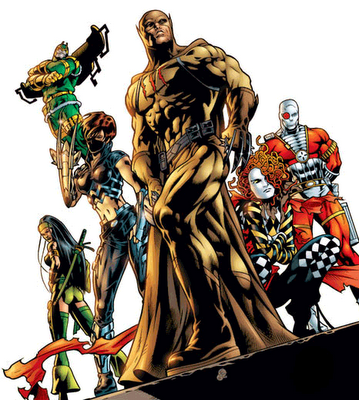
  • Huntress-01 Thanks to Newsarama for bringing us news of the new Huntress mini-series starting in October:

    DC has also exclusively revealed the Levitz-written, Marcus To and John Dell-drawn The Huntress five-issue series that also debuts in Month 2 of the DCnU…

    Paul Levitz has something of a history with the character, as he's credited with Joe Staton and Bob Layton for co-creating (in 1977) the Helena Wayne version of the Gotham City-based vigilante (daughter of the pre-Crisis Earth Two Batman and Catwoman). That version was killed during 1985's Crisis on Infinite Earths, her existence erased from the new post-Crisis unified timeline, and she was replaced with the similarly-looking Helena Bertinelli version, now the daughter of a Gotham crime boss.

    This 2011 revamp Huntress apparently has Italian roots, as DC reports she heads "home" to Italy to embark on a life-defining mission in this series, suggesting the DCnU version of the Huntress will likely remain Helena Bertinelli. It appears she will also continue to have ties with the Birds of Prey in the upcoming months.

    A great character with tremendous potential–hopefully they don't erase or "revamp" much of her rich backstory, especially her recent Year One mini.

  • I thought it might be nice to post here every Friday on what I did the previous week, both for my readers (reader, maybe) and for myself…

    Well, for a week that didn't seem very productive–I certainly made no progress on any of my current book projects–I guess it wasn't that bad. Hope to have some book progress to report next week…

  • Mark D. White

    At the New York Times' Economix blog this morning, David Leonhardt reports on a recent NBER study that studied the health outcomes of low-income people who either were or were not granted access to Medicare through a lottery, and good golly gosh, guess what they found: those with health insurance had better health, both because of better care and lower financial burden.

    I eagerly await the next study that finds out that giving people free shoes prevents food injury and frees up people's own resources for other things (perhaps more shoes).

    Well of course giving people health insurance will in the most cases improve their health and financial situation. But there are other forms of health insurance, and other ways to reform the health care system, including the financial aspects of it, than the Affordable Care Act, which Mr. Leonhardt uses the paper to support. It is as if the only choice were between Obamacare and no care at all, hardly a fair or inclusive comparison. (Hell, listening to Justin Bieber may be preferable to no music at all, but I'll wait for the study results to confirm that.)

    The paper itself seems more neutral, at least judging by the abstract:

    In 2008, a group of uninsured low-income adults in Oregon was selected by lottery to be given the chance to apply for Medicaid. This lottery provides a unique opportunity to gauge the effects of expanding access to public health insurance on the health care use, financial strain, and health of low-income adults using a randomized controlled design. In the year after random assignment, the treatment group selected by the lottery was about 25 percentage points more likely to have insurance than the control group that was not selected. We find that in this first year, the treatment group had substantively and statistically significantly higher health care utilization (including primary and preventive care as well as hospitalizations), lower out-of-pocket medical expenditures and medical debt (including fewer bills sent to collection), and better self-reported physical and mental health than the control group.

    Again, the results seems obvious, but not necessarily politically motivated–I trust they acknowledge the shortcoming in the available data that limit the interpretation of their results.

    I would ask Mr. Leonhardt, given that he supports the expansion of health insurance, if he also supports measures that would make private insurance cheaper and easier to maintain, such as allowing interstate competition (which would likely lower prices) and severing the link between employment and health insurance (that prevents many people from changing jobs for fear of losing their insurance).

  • Catman I came across this terrific blog post by Carol Borden at The Cultural Gutter, comparing Catman (from Gail Simone's tragically cancelled Secret Six series) to Batman, as well as to Dexter from the Showtime series. Not having watched Dexter (but intrigued after reading her post), I was more interested in what she had to say about Catman and Batman. Here's just a sampling:

    Thomas Blake plays with the idea of being Batman. … Blake seems to believe being a hero requires physical skill and being a good person, and he is a good person. … Like Dexter, Blake recognizes a code’s importance. Heroes have codes. But where Dexter—like Batman—actually has one, Blake is enamored again by the idea rather than the content. He believes in loyalty to the Six, until he betrays them in favor of his own needs.

    She explains how Catman is disappointed when he realizes Batman is truly just a man, because he needs him to be more, perhaps to justify why Catman isn't the hero he really wants to be.

    He believes it is easy for heroes like Batman to do the right thing, making Bake’s intentions—his desire to do good, his belief that he is a good person despite being a victim of circumstance—paramount to him. If things had been different, Catman would be like Batman, too, because Blake believes he really wants to be.

    Except when he doesn’t.

    A fascinating read, and definitely a blog to watch!

  • Mark D. White

    In a recent "The Shrink and the Sage" piece in the Financial Times Magazine, Julian Baggini (prolific popularizer of philosophy) and Antonia Macaro discuss the pursuit of happiness, which is very interesting in itself, but I was particularly amused by how Baggini started his half of the discussion:

    When psychology and philosophy filed for divorce about 100 years ago, they faced the common dilemma of how to divide the book collection. In the end, psychology left most of the volumes on happiness and the good life with philosophy, which dutifully left them to gather dust. Now that psychology has returned to the subject with gusto, there is an urgent need to dig them out again.

    Of course, economics and philosophy had their own break-up, perhaps a little earlier, so it may be fun to ask: how did they divide their book collection? Some speculation…

    • Economics only took one Adam Smith book–but didn't read it–and philosophy lost the rest for years.
    • Economics was more than happy to take the Bentham, but forgot the Mill (both the philosophy and economics).
    • Most tragically, economics chose to take the calculus books rather than Kant–and we all know how that turned out.

    Any others?

  • Mark D. White

    From today's Albany TImes Union:

    CONCORD, N.H. (AP) — More than 1,500 married, New Hampshire gay couples could be placed into a classification all their own if lawmakers succeed next year in repealing the state's two-year-old law legalizing same-sex unions.

    Legislation to repeal gay marriage is one of the highly charged issues left over from the just-completed legislative session that must be acted on early next year. The two proposed repeal bills would not affect gay marriages before repeal, but would stop new same-sex marriages.

    This absurd legislative ping-pong game is what happens when basic human rights are left up to the legislative process, as I argued here.

  • Mark D. White

    A question occurred to me this morning as I did some basic research on alimony after reading Alexandria Harwin's New York Times op-ed "Ending the Alimony Guessing Game": why don't social economists focus more on the family? Ms. Harwin's article interested me more at first due to her discussion of judicial discretion and formulae with respect to alimony determination, but then I dipped my toe into the literature on alimony on JSTOR, and found two primary recent resources: Elisabeth Landes' "The Economics of Alimony" (Journal of Legal Studies, 7/1, 1978) and Ira Mark Ellman's "The Theory of Alimony" (California Law Review, 77/1, 1989). Both take what can be fairly called a neoclassical economic approach to marriage, divorce, and alimony, Landes' paper more obviously than Ellman's (which linked the shifting interpretation of alimony to other trends in family law, especially no-fault divorce–very interesting).

    To be fair, a neoclassical approach to alimony is not necessarily inappropriate: upon divorce the former partners do become independent bargaining agents (at least with respect to each other), and alimony is, after all, essentially monetary. Nonetheless, this made me think of all the aspects of the standard economics of the family that, in the interest of facilitating mathematical modelling and scientism, leave out important ethical and social elements–elements which are important in most if not all areas of economic analysis, but surely none more so than the family (understood very broadly as any small and close relationship between persons based on care).

    There is some social economics research of the family–for instance, Deb Figart and John Marangos' special issue of Review of Social Economy in 2008 on living standards and social well-being contained some great work on the family–but it just seems there should be more. As I said with respect to law and economics in the past, I can understand social economists' disdain for neoclassical analysis of the family, but why aren't we showing the world that we can offer better insights on what is, at its core, a social issue?

    There oughta be a book…  😉

  • Well, it's been a while since I established this site–feels like I'm still moving in!

    Setting up this site to replace my college site has taken longer than I thought, but some of the book pages are up, the bio is up (but will be revised), the articles/chapters page still needs to include op-eds and popular chapters (which may merit their own page), and I've started the pages indexing my Psychology Today blog and other blogs.

    I'm not sure what I'll blog about here–I thought perhaps to summarize my other online activities here, or keep blatant self-promotion here (as opposed to the other more topical blogs). I also thought of maintaining some sort of online journal here, for anyone who may be interested (though I can't imagine who). Honestly, I don't know yet… this site is really meant to collect all my activities as an academic, writer, editor and blogger, and the blog was originally meant to provide a forum that's all my own (as opposed to the Economics and Ethics blog, which I share with three other people), and not necessarily academic in nature (reviews of movies and music, for instance, or the occasional incoherent rant).

    So we'll see… hope you stop by and let me know what you think!