Mark D. White

Writer, editor, teacher

  • Mark D. White

    Last nigt New York Governor Andrew Cuomo signed a bill allowing same-sex marriage after a lengthy process of legislative tomfoolery. Those who have read my previous posts and work on the issue will not be surprised to hear that I am very happy about the result and less than pleased with the process.

    Unlike most, I think issues such as same-sex marriage, which at their core are issues of human rights and dignity, are matters best dealt with by the courts, not the legislature–a small quibble, perhaps, seeing that the just result was achieved, but an important one nonetheless. Just in pragmatic terms, legislation can be overturned much more easily than court decisions. But on principled terms, human rights should never be put to a vote–they should be affirmed by the courts, our designed guardians of principle, rather than a deliberative political body.

    One quote from the news report above (from The New York Times) may help make my point:

    With his position still undeclared, Senator Mark J. Grisanti, a Republican from Buffalo who had sought office promising to oppose same-sex marriage, told his colleagues he had agonized for months before concluding he had been wrong.

    “I apologize for those who feel offended,” Mr. Grisanti said, adding, “I cannot deny a person, a human being, a taxpayer, a worker, the people of my district and across this state, the State of New York, and those people who make this the great state that it is the same rights that I have with my wife.”

    Very inspiring, and it helps make a case that popular affirmation of same-sex marriage may be more satisfying symbolically (especially when it involves people changing their minds and supporting it). But it also points out that the people of New York state left it to its state legislature to decide whether gays and lesbians have the same rights that straights have with their spouses. And as we have seen over the weeks this has played out, the successful vote was never assured until last night–a dreadfully uncertain and contingent method for asserting equal human rights and dignity for all.
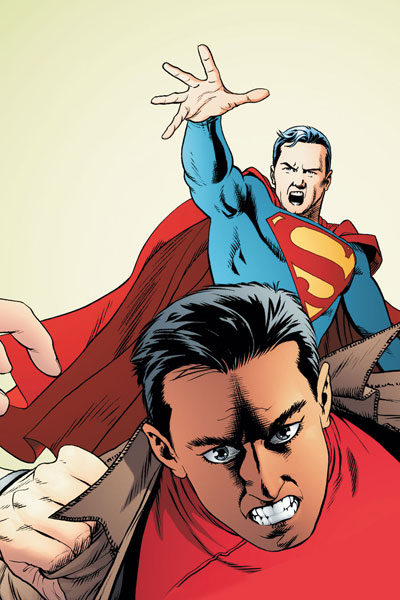

  • Superman712 This morning at Newsarama, Jill Pantozzi points out that DC sent out a press release at the last minute announcing that today's Superman #712, which was supposed to contain a Roberson/Straczynski story about social prejudice in the context of the "Grounded" storyline, has been replaced by what fans have come to know as the "lost" Krypto story, written by Kurt Busiek during his lengthy "One Year Later" run on the Superman books, but was shunted aside for continuity reasons. Now that DC has much less regard for continuity, especially current (pre-September) continuity, they like that story again, but that could have gone in a special one-shot–and doesn't Krypto deserve his own book?

    But back to the original story, which was solicited like this:

    Meet Los Angeles’s newest super hero in the latest Chapter of “Grounded”: Sharif! But Sharif discovers that in today’s current cultural climate, some people don’t want his help – they just want him gone. Can Superman aid Sharif and quell a prejudiced public, or are there some problems too big even for the Man of Steel to solve?

    Sounds perfect for the "Grounded" storyline, which was ostensibly meant to allow Superman to be a modern Hard Traveling Hero (without a pick-up truck and a plainclothes Guardian of the Universe) and encounters firsthand the ills of contemporary America. But DC apparently didn't see things the same way:

    DC Comics determined that the previously solicited story did not work within the “Grounded” storyline.

    Ominous, Orwellian… oh well.

    As Roberson explained to Newsarama in an earlier interview (quoted by Pantozzi):

    Like Superman, Sharif is a character with powers and abilities far beyond those of normal folks, who came to this country as a child and grew up dedicating himself to Truth, Justice, and the American Way. But the fact that he comes not from an alien world but from another country here on Earth complicates matters for him, and he quickly learns that some people have a different idea of what “The American Way” is all about.

    Sounds like a terrific story, and one that I'm sure Roberson told with his customary insight, balance, and humor. Maybe in the run-up to the next reboot/relaunch, we'll have a chance to see it.

    (For more on Superman and the American Way, see this post, as well as Andrew Terjesen's chapter "Is Superman an American Icon?" in Superheroes: The Best of Philosophy and Pop Culture, a promotional e-book coming from Wiley soon.)

    UPDATE: And if the story change weren't enough, they also messed with George Perez's gorgeous cover–Bleeding Cool has the story here.

    UPDATE 2: See Chris Sims' excellent and lengthy treatment, including Sharif's original appearance as Sinbad and incorporation of the Nightrunner controversy, at Comics Alliance.

    UPDATE 3: Wow, this story gets better and better… Bleeding Cool gives the real reason behind the switch, and it has nothing to do with Sharif…

  • June 21, 2011

    ASSOCIABLE PRESS–In a surpise move, DC Comics discovered that longtime head honcho Dan DiDio is actually a woman, then abruptly fired him her.

    Fellow employees' reactions were mixed. A Mr. Lee, who asked that his first name (Jim) be withheld, said, "I can't believe I didn't see it before–I mean, the dude's just so damn pretty." Another DC employee, a Mr. Johns whose first name isn't Jeff but oddly sounds just like it, said, "That would explain all the sexual tension in our meetings, which I always thought was strange since it's always been all guys."

    When asked if DiDio's dismissal was due to the shocking revelation, DC higher-ups scoffed, one asserting:

    What do you mean, of course not–I mean, look at our new 52 books coming in September. We have a female writer. We also have a female artist. One of each! I think there may even be a female assistant editor, maybe two–wait, do we need two? Hmm… we'll have to think about that… [trails off, pulling out a book of pink slips]

  • June 21, 2014

    ASSOCIABLE PRESS: After the highly publicized "Really Final Death of the Fourth Spider-Man This Year" storyline, Marvel Comics has publically admitted that they inadvertently killed their last remaining superhero, and must scramble to find new story ideas. "We relied for so long on 'Death of' stories, which seemed the most natural way to drive kids in the comics shops, that we didn't realize that we accidentally killed all of the heroes that our fans love. We even killed Wolverine, and that dude's freakin' hard to kill!"

    In the interim, Marvel will continue to publish Greatest Deaths and Amazing Funerals, containing reprints of the highlights of the previous decade of Marvel Comics.

  • Batgirl-babs The issue of Barbara Gordon regaining mobility and once again adopting the mantle of Batgirl has been the cause of much discussion on the interwebs since it was announced by DC recently. Earlier I highlighted longtime Gordon scribe Gail Simone's conversation with Oracle-advocate Jill Pantozzi, during which Simone said (in the context of explaining why the relaunch finally made her comfortable with "curing" Barbara):

    The most persuasive argument to put Babs back in the boots has always been one that I would argue against vehemently for story reasons, but that was impossible to argue with ethically. And I have heard this question a million times…why is it that virtually every single hero with a grievous injury, or even a death, gets to come back whole, except Barbara Gordon? Why? Why was Batman's back broken, and he was barely in the chair long enough to keep the seat warm, and now it's never even mentioned?

    Arms and legs get ripped off, and they grow back, somehow. Graves don't stay filled. But the one constant is that Barbara stays in that chair.

    Role model or not, that is problematic and uncomfortable, and the excuses to not cure her, in a world of purple rays and magic and super-science, are often unconvincing or wholly meta-textual. And the longer it goes on, the more it has stretched credibility.

    Simone's logic is compelling–why does everyone else in comics come back to life or have life-threatening injuries miraculously resolved, but Barbara Gordon doesn't. But it's her unspoken premise that I want to look into, because I think it's a fascinating area for discussion: in what sense can Barbara Gordon–a fictional character–be understood to "deserve" anything? And if there is such an understanding of having duties toward a fictional character, how do those duties compare with duties to fans (like Pantozzi) who derived tremendous satisfaction from having a character like Oracle in comics (not to mention the other fans, disabled or not, that will enjoy seeing Babs walk again)?

    (more…)

  • Mark D. White

    In today's installment of The Stone in The New York Times, UCLA's John McCumber presents a very critical view of "rational choice philosophy," by which he seems to mean the narrow version promulgated by most mainstream economists. In discussing the ethical problem with rational choice theory, he writes:

    Rational choice theory, being a branch of economics, does not question people’s preferences; it simply studies how they seek to maximize them. Rational choice philosophy seems to maintain this ethical neutrality (see Hans Reichenbach’s 1951 “The Rise of Scientific Philosophy,” an unwitting masterpiece of the genre); but it does not. Whatever my preferences are, I have a better chance of realizing them if I possess wealth and power. Rational choice philosophy thus promulgates a clear and compelling moral imperative: increase your wealth and power!

    Of course, in its simplest form, yes; but readers of this blog know that rational choice does not imply singleminded pursuit of one's own narrow self-interest. McCumber may be correct that more elaborate and ethically rich version of choice theory are presented and promoted too rarely, but I think he is too hasty in dismissing it altogether.

    He also conflates rational choice with individualism, and concludes that we need an alternative to "rational choice individualism" that is "quite a bit like Hegel in its view that individual freedom is of value only when communally guided." But flipping from one extreme to the other is not necessary, especially when one begins with a straw man.

    For instance, in chapter 3 of Kantian Ethics and Economics: Autonomy, Dignity, and Character, I argue that the economic agent should be considered "individual in essence, social in orientation." Kantian autonomy implies that persons are independent and individual decision-makers, but Kantian ethics demands that those decisions be made in explicitly ethical ways, based on the recognition of the autonomy and dignity of other persons. Individuals' choices don't have to be "communally guided," as McCumber says in his conclusion, because real people already incorporate ethical factors into their decision-making, whether they do so in way that would be recognized as Kantian, virtue-oriented, or utilitarian–and they do so autonomously and independently. As I wrote,

    the Kantian-economic approach maintains that agents are essentially individual, but at the same time they can be—and, ethically speaking, must be—social in orientation. I hope to have reassured those with concerns about sociality or community that individualism need not be threatening. In fact, if we treat persons as individuals imbued with autonomy and dignity, social harmony takes on much more meaning because it will be the result of free, individual choices, rather than coercively enforced order. (Kantian Ethics and Economics, p. 105).

    Just because rational choice and individualism have not presented well doesn't mean they should be abandoned. We simply need a better understand of them (which is one of the things we try to do on this blog).

  • From Bleeding Cool's report from the recent DC Retailer Roadshow in Burbank:

    Action Comics and Justice League are set in the past, the Green Lantern, Batman and LSH books are all continuing without a reboot.  DCU Presents, Green Arrow and Hawkman are picking up where Brightest Day left off.  But for everything else, yes, it will be more of a reboot/restart.  They are basically keeping the books going that were financially successful for them and restarting everything else.

    Wow–that's very upfront, and certainly quite a different picture from the May 31 announcement that implies a complete reboot.

    Several questions remain, though:

    1. Was Aquaman inadvertently left out of the Brightest Day group? Or did they say Hawkman by mistake, since the solicitation copy certainly makes Carter seem rebooted. (The same goes for Ollie, come to think of it.)
    2. Superman–the current-day title–is not mentioned, nor is Wonder Woman, so we have to assume they're complete reboots, which has precedent given the John Byrne and George Perez reboots after Crisis on Infinite Earths (respectively).
    3. It confirms whatever creators like Scott Snyder have been saying that changes in the Batman world will be organic and explained in story, rather than by deus ex machina (Latin for Superboy-punch or timestream manipulation).
  • Mark D. White

    Thomas L. Friedman had an interesting piece in The New York Times last week describing the rock star reception given in Asia recently to Harvard political philosopher Michael J. Sandel, author of Justice: What's the Right Thing to Do? and lecturer in the accompanying PBS series (available here). In the piece, Friedman writes (emphasis mine):

    Sandel’s popularity in Asia reflects the intersection of three trends. One is the growth of online education, where students anywhere now can gain access to the best professors from everywhere. Another is the craving in Asia for a more creative, discussion-based style of teaching in order to produce more creative, innovative students. And the last is the hunger of young people to engage in moral reasoning and debates, rather than having their education confined to the dry technical aspects of economics, business or engineering.

    This characterization of economics education may be true in some cases, but certainly not all–there are many economics professors who can bring economics alive in much the same way that Sandel presents philosophy. And to be fair, philosophy (especially analytical philosophy) can often seem dry and technical to students as well if not taught extraordinarily well.

    But if economics seems dry to many students, even when presented by a talented professor, then perhaps it could use some philosophy to enliven it, whether that means highlighting the philosophy that is embedded in economics already, or bringing fresh concepts from philosophy to bear on economic thinking and teaching. Any way we can, we should remind students that economics was once much more closely tied to economics than it is commonly thought of now, and that economists were once heralded as The Worldly Philosophers, not purveyors of "dry" and "technical" analysis.

  • My Green Lantern and Philosophy co-editor Jane Dryden and I have a blog post at my Psychology Today blog about what the Green Lantern Corps can teach us about cooperation and tolerance, especially in light of conflicts over values. Check it out!

    UPDATE: The Globe and the Mail also picked up the piece, under a different title.

  • Mark D. White

    Regardless of where you stand on the law, economics, or politics of the Affordable Care Act, I highly recommend Ilya Shapiro's new paper "A Long, Strange Trip: My First Year Challenging the Constitutionality of Obamacare" (forthcoming in Florida International Law Review), in which the CATO scholar details his year of writing, speaking, and debating various legal issues involving the health care reform legislation.

    For those of us in academia, the paper provides a wonderful view into the world of think tanks and advocacy–and may even spur some thoughts on the meaning and purpose of the academic life, as it certainly did for me.