Mark D. White

Writer, editor, teacher

  • Pink clouds dec 2021At the end of this dizzying year, and on the occasion of my fiftieth birthday, I offer my reflections on the last twelve months in terms of work—reflections that, to quote Rick Blaine, "don’t amount to a hill of beans in this crazy world," where matters of much greater importance are going on. <gestures wildly at everything> Nevertheless…

    I went into my work frustrations in my update last month, so I won't belabor the point here. Suffice it to say that this is my eleventh and final year as department chair, and I'm very much looking forward to returning to full-time teaching and writing as of next July 1. This year I designed a new introductory/survey course in legal philosophy, and I hope that it, together with the upper-level legal philosophy course I regularly teach—retitled "Jurisprudence" to reflect how I've been teaching it for years—will become part of my regular teaching rotation, along with other courses in philosophy and economics. (I taught law-and-economics this semester for the first time in years and enjoyed it, despite the Zoom setting, and I'm hoping to continue teaching that, and resume the economics-and-philosophy course I introduced 20+ years ago, more regularly going forward.)

    Although everything that happened in 2021 made it very difficult to write, I did manage to get more done than last year; what's more, I became more productive as the year progressed, which leaves me cautiously optimistic heading into 2022.

    1. I wrote two chapters for edited volumes coming out next year and welcomed the publication of one written last year, for which I thank all the editors who invited me to contribute.

    • I wrote "Panther Virtue: The Many Roles of T’Challa” for Black Panther and Philosophy, edited by Edwardo Pérez and Timothy E. Brown, coming out in February 2022 from Wiley-Blackwell.
    • I also wrote "A Kantian Perspective on Teaching Ethics to Economists" for Handbook of Teaching Ethics to Economists: A Plurality of Perspectives, edited by Craig Duckworth, Ioana Negru, and Imko Meyenburg, coming out from Edward Elgar later in 2022 (I believe).
    • My chapter "Reflections on the State of Economics and Ethics" was published last month in The Routledge Handbook of the Philosophy of Economics, edited by Conrad Heinmann and Julian Reiss.

    2. I was much more active in what we olds used to call "the blogosphere," especially in the second half of the year:

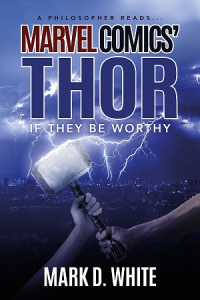
    Thor cover3. My signal achievement this year was finishing A Philosopher Reads Marvel Comics' Thor: If They Be Worthy, which will be released in 2022 ahead of next summer's Thor: Love and Thunder film. (UPDATE: It's now available.) It's an exploration of the seven years of Thor comics written by Jason Aaron and drawn by Esad Ribić, Russell Dauterman, and others, in which the original Thor suddenly finds himself unworthy of wielding his mighty hammer Mjolnir, only to see a new Thor emerge, eventually revealed to be Jane Foster, who must struggle with her own unique issues while saving the universe (and dealing with Odin). In this short volume, I use this fascinating tale to discuss the various meanings of worthiness, how it feels to lose it, and how one can reclaim it—which requires a more nuanced and somewhat paradoxical understanding of worthiness, suggested by the comics themselves. (See more about this book here.)

    —–

    Thinking ahead to 2022: I look forward to finishing my current book project—an introductory ethics textbook using superhero examples—as well as a handbook chapter on the philosophy of punishment. Then I will pick up work on two other book projects: a long-delayed discussion of antitrust, which is even more relevant these days than when I started it, and a deep dive into the Fant… well, perhaps I should hold off on talking about that for a while.
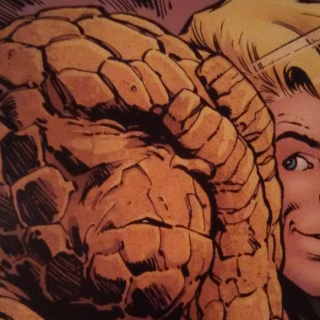
    Thing davis 3(Sorry, Ben—got carried away.)

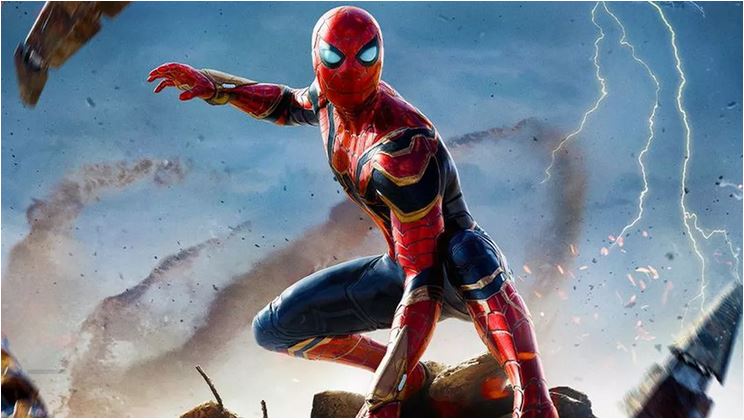
  • NowayhomeSPOILERS FOR SPIDER-MAN: NO WAY HOME BELOW! SO MANY SPOILERS!

    My son and I saw the new Spider-Man film yesterday afternoon in a large theater with about twenty other people—which was a Christmas miracle, given how most showings sold out over opening weekend and our hesitation to see it amongst a large crowd in the current environment. In anticipation of this event, we rewatched all the earlier Spidey flicks over the last couple months, which really paid off, given how well No Way Home wrapped up the entire franchise to date, while setting an interesting direction for future installments.

    Below I share a few of my thoughts about the movie. Before I start, I should warn you: I haven't read any other commentary or reviews yet, so it's quite likely that everything I have to say has already been said. (Still, no refunds!)

    1. Generally, everyone involved with this film pulled off an incredible juggling act, balancing the core story of Spider-Man and his amazing friends MJ and Ned with the multiversal spectacle of numerous guest-stars from the pre-MCU films. I had heard the rumors and had seen the set pictures, but I successfully avoided getting confirmation of who showed up in the movie before I saw it. Perhaps the most impressive aspect of this was that, with one notable exception (see #5-7 below), none of the invited guests were mere cameos; all of them had meaningful character beats and important roles to play in the story. Specifically, I was expecting the earlier Spideys to show up at the last minute to help out with the final fight, and was pleasantly surprised that they arrived early enough for some great character work between them.
    2. Continuing with that thought: The casual interactions between Tobey Maguire, Andrew Garfield, and Tom Holland, some touching and others funny, were some of my favorite moments of the movie. Tobey was the chill, elder statesman of the three, a more confident and competent version of Jake Johnson's Spidey from Into the Multiverse. In contrast, Andrew was still tormented by the death of Gwen Stacy in his second movie, now living a self-imposed life of solitude and self-loathing. Tobey sweetly tried to counter this ("You're amazing! Say it! Say you're amazing!"), but it takes the opportunity to save MJ from a similar fall that allows Andrew to start to move past his grief and guilt. And Tom took the leadership role while casually throwing out references to going into space and being an Avenger, which the others hilariously did not understand—but even better was seeing Andrew and Tom marvel at Toby being able to shoot webs out of his wrists instead of relying on homemade webshooters and webbing. (Now that's what I call fan service, given the endless debates about organic vs. mechanical webshooters on message boards.)
    3. I was relieved to see that Doctor Strange was not the co-star of the movie, as the trailer suggested. (I get it: After all, they couldn't show much else). I was afraid he'd play the father figure that Tony Stark and Quentin Beck did in Holland's first two movies; instead, there was a great older hero/younger hero dynamic between them that thankfully stopped short of mentor/mentee. (And hey, was that Zelma, from the Jason Aaron and Chris Bachalo run of the comics, cleaning up the snow in the Sanctum Sanctorum?)
    4. Holland's dedication to trying to save.help/cure the assorted villains, as opposed to Doctor Strange's plan to return them to their home universes to face their deaths, was perhaps the most positively surprising aspect of the story. This reflected the traditional Spider-Man idealism (especially during the Dan Slott "no one dies" period) and exemplified the less reactive or defensive approach to superheroing we often see these days among the younger set, such as Ms. Marvel or Squirrel Girl. (Although, to be fair, one of Batman's greatest regrets is not being able to help or redeem his worst villains, especially those like Two-Face who were once on the side of good, as I discuss in Batman and Ethics.) It was also nice to see that, other than Norman Osborn, the villains weren't truly evil; rather, each had been "turned" in his own way, which the Spideys were able to reverse, setting them back on the righteous path.
    5. MATT MURDOCK!
    6. CHARLIE COX AS MATT MURDOCK!
    7. "I'm a very good lawyer." Fantastic line at the perfect time. (But I'm sad they missed the chance to have Matt turn in Happy's direction, take a sniff or listen intently for a second, and say "Foggy?")
    8. Most important, this movie fixed what I've regarded as the biggest flaw of the first two MCU Spider-Man films: the absence of a motivating tragedy that serves to convince Peter to dedicate himself to helping people and doing what's right, regardless of the personal cost (which is consistently high). In the comics and the last two iterations in the movies, this crucial event has always been the death of Uncle Ben, which Tobey references as his greatest loss, while Andrew understandably focuses on Gwen. But the MCU movies chose for some reason to neglect Uncle Ben altogether (other than occasional suggestions of his past existence in this universe), leaving Peter to be a more carefree, happy-go-lucky wallcrawler, reveling in playing dress-up with Iron Man and the Avengers but not really motivated to be a hero for its own sake. But with this movie, Aunt May takes Uncle Ben's place, and her death becomes the horrible tragedy that Peter feels responsible for and will spend the rest of his life trying to rise up from. To paraphrase a popular political saying, with this movie Peter Parker became Spider-Man…
    9. …and he proves this by making a tremendous sacrifice at the end to save the multiverse, asking Doctor Strange to erase all memory of Peter Parker's existence, including MJ and Ned, the two closest people to him left in the world. (It will be very interesting to see how Peter goes about rebuilding these relationships in the upcoming "college trilogy.") The fact that he did so without hesitation and with full awareness of the incredible personal cost shows that this Peter Parker has become the Spider-Man we know and love.

    All in all, Spider-Man: No Way Home was a stunning achievement by all involved, and it only heighten my excitement for what director Jon Watts does with the upcoming Fantastic Four film.

  • Devils reign 1 coverSPOILERS FOR DEVIL'S REIGN #1 BELOW!

    In last week's Devil's Reign #1, the first installment in the Daredevil-centered Marvel Comics event by writer Chip Zdarsky, artist Marco Checchetto, and colorist Marcio Menyz, Wilson Fisk—better known as the Kingpin, and currently the Mayor of New York—has enacted a citywide ban on superheroes to get revenge on Daredevil for erasing his secret identity from Fisk's files (as explained in Daredevil, vol. 5, #20, July 2017).

    In effect, it's Civil War and the Superhero Registration Act (SHRA) all over again, but with less nuance. There's no pretense this time toward registering heroes and holding them accountable, although Fisk does argue for his law on the basis of public safety and respecting public servants. Also, no heroes are supporting it this time around (otherwise than a few, such as USAgent, who are working for him as an enforcer). Hence, there's no juicy ideological conflict here—just an example of the nakedly corrupt exercise of power and the imperative of good people to stand up and resist it.

    And, knowing Fisk as they do, the (real) heroes are resisting. As detailed in my books on him as well as Civil War, Captain America opposed the SHRA, even though it was legitimately passed by Congress in response to a series of disasters related to superhero activity, because he felt it violated the liberty and privacy of people trying to save lives. So naturally, he finds the current law, with the same effects, even less acceptable, given the source.

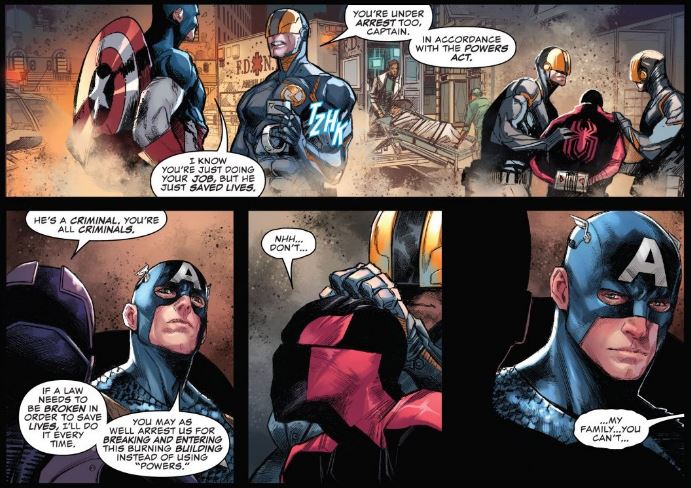
    We see just how unacceptable he finds it after Spider-Man (Miles Morales) saves a child from a burning building and Fisk's shock troops try to arrest him… until a higher authority steps in (while also saving lives).

    Dr1b

    When Fisk's officer asserts that the heroes are actually criminals now, Cap explains (with undue respect) that if he has to make a choice between following the law and saving lives, he will always choose the latter.

    Dr1c

    This doesn't mean that Cap is dismissing the importance of law in general, much less placing himself above it. He's merely recognizing that law is not an intrinsic good in and of itself, but rather a means to the end of ensuring social order, at the least, as well as protecting lives and promoting broader well-being. Heroes pursue those same ends, as do public servants and first responders, all of whom are justified in making judgment calls in emergency situations to set the law aside for the greater good (such as saving lives). Ideally, they will be held accountable for those choices after the fact if there is any doubt to their propriety, and sometimes those choices will be found improper (if not egregiously wrong). But it does not serve society's interest to set the law above the goals the law is meant to promote.

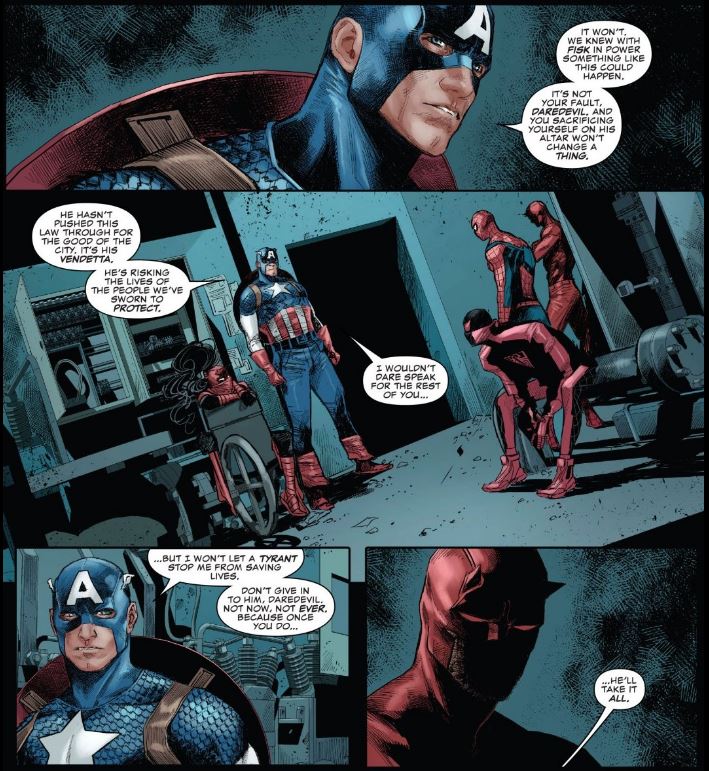
    Of course, this is all the more apparent when a particular law is the expression of the vendetta of a corrupt public official rather than a response to valid democratic concerns. Cap makes this clear to several fellow heroes afterwards when Daredevil claims responsibility for Fisk's actions, explaining how Fisk lost the knowledge of his secret identity. Knowing all too well what it means to take on too much responsibility, Cap tries to tell Matt that it's not his fault, and then reasserts his commitment to doing what's right, regardless of any counterproductive law that Fisk chooses to put in his way.

    Dr1e

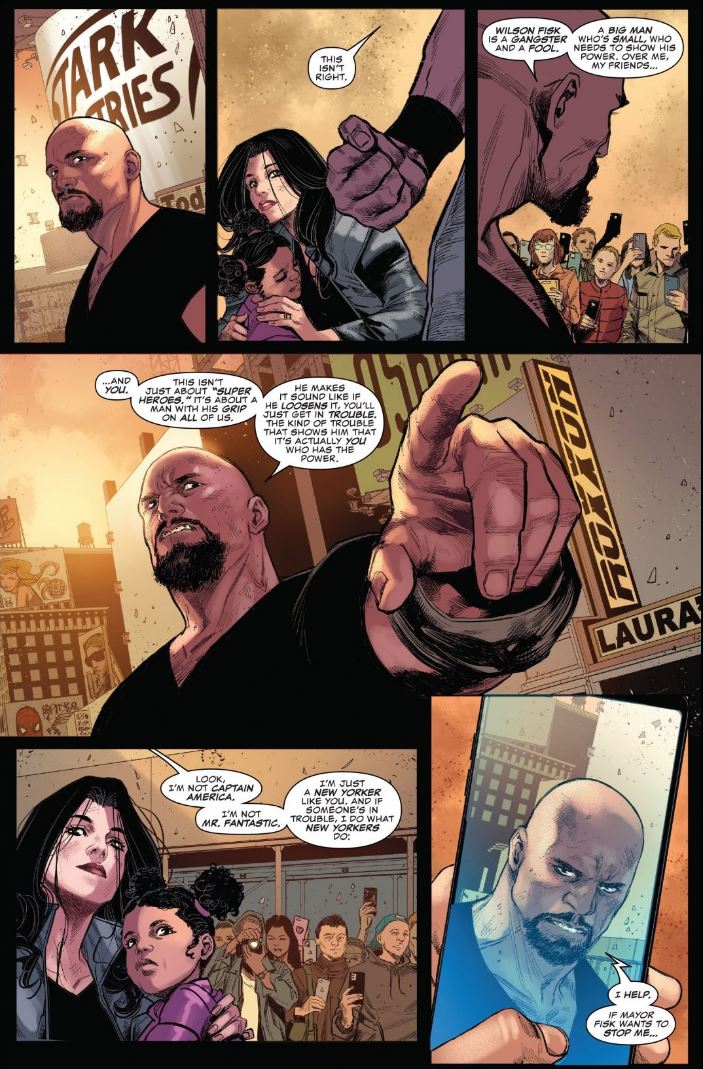
    In the end, though, it's Luke Cage who gets to the heart of Fisk's actions, as he explains to a group of gawking New Yorkers assembled around him and his family what the mayor's true plan is: to manufacture a crisis and then claim to be the only one who can prevent it from getting worse (like a mobster selling "protection" against his own threats of violence).

    Dr1i

    Even Tony Stark, poster boy and point man for the SHRA during the Civil War, sees through Fisk, suggesting a novel way to work the system against him: He's running for mayor. (Can Luke run instead?)

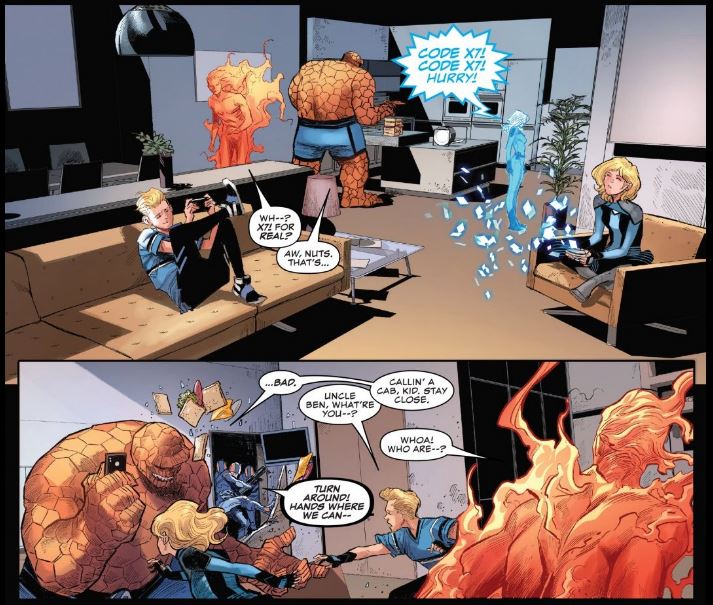
    Before I sign off, I have to share this fantastic scene (sorry) featuring the ever-lovin' Thing as Fisk's stormtroopers break into the Fantastic Four's home:

    Dr1f

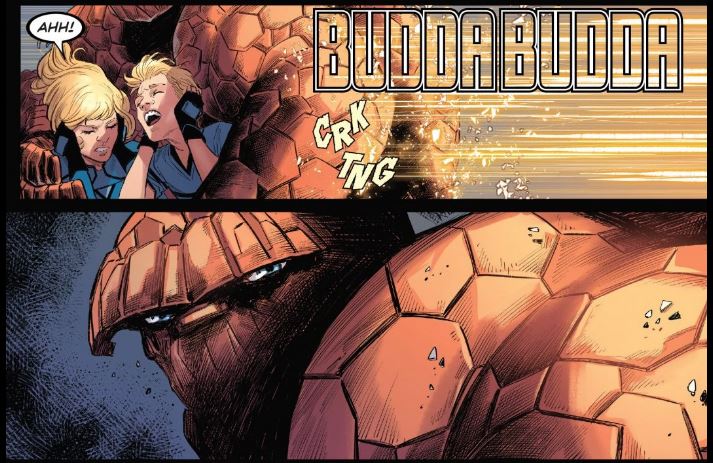
    If there's one thing that will get gentle Ben mad, it's someone threatening children, especially his family—just look at his face in the bottom panel.

    Dr1g

    Needless to say, it is clobberin' time indeed.

  • Dd 36 coverSPOILERS FOR THE CURRENT RUN OF DAREDEVIL BELOW!

    For the last year, Daredevil has been in prison, where he was sentenced in Daredevil #24 for second-degree manslaughter, resulting from the eventual death of a burglar he beat up in the first issue of the current run. Since he's been incarcerated—as Daredevil, mind you, avec mask but sans costume—Elektra has been protecting Hell's Kitchen as the new Daredevil (as seen on the cover to the right), and his twin brother Mike has been posing as Matt Murdock to preserve his secret identity. (If you think Mike Murdock was simply a farcical disguise Matt used in the past to do this, you obviously haven't read 2020's Daredevil Annual #1.)

    In Daredevil #36 (released December 1, 2021), by writer Chip Zdarsky, penciller Manuel Garcia, inkers Cam Smith, Scott Hanna, and Victor Nava, and colorists Marcio Menyz and Bryan Valenza, the Man without Fear is once again a free man, although he was preoccupied the last few weeks of his sentence with battling against both corruption inside the prison and clones of Bullseye outside of it. After wrapping up both matters in the previous issue, the authorities tried to arrest Daredevil for being a fugitive from justice; several of his fellow superheroes argued the necessity of his breakout and the good he did, and a video recording of their argument with the police soon went viral. In the end, Matt turned himself in, presumably to show, as he did when he submitted to his initial trial and accepted the prosecution's plea offer, that superheroes must be accountable to the same laws they help enforce—although, over Zdarsky's run of the book, he has become more and more skeptical of the criminal justice system that ultimately carries that responsibility.

    After reconnecting with both his brother and Elektra, Matt—now very furry of face, which I hope is not a permanent state of affairs—returns to patrolling Hell's Kitchen, and comes across two young men who had just knocked over a bodega. More concerned with helping them turn their lives around then sending them to prison, especially given his recent experiences, Matt lets them go and gives the bag of stolen loot back to the store owner… which comes as a surprise to Reed Richards, who by then had also arrived on the scene.

    Dd36 1

    Reed shares Matt's concerns about reassuring a worried public that they can trust superheroes, but they differ on how much deference they should show "the system" in order to do this. As he did during the fight over superhuman registration that he references—and despite the fact that his support of registration almost ended his marriage—Reed stands by the legal system, despite its flaws, and wants to devise an optimal strategy in accordance with it, as well as optics of the current situation.

    Dd36 2

    In contrast, Matt asks a simple question—"What's right?"—and then draws out the difference between what philosopher W.D. Ross characterized as "the right and the good" (in his book of the same title). Effectively, Matt is contrasting Reed's utilitarianism, in which he calculates the myriad contributing factors to an issue to arrive at a conclusion regarding the best course of action to take, with Matt's own deontological approach, which dismisses empirical contingencies in favor of using principle to determine the right thing to do.

    Matt drives the point home when he acknowledges Reed's brilliance, but suggests that it's distracting him from the simple moral truth.

    Dd36 3

    To be fair, determining what's right is not necessarily simpler than determining what's good or best; both require the use of judgment to weigh the various moral factors that are relevant to a problematic situation. (I discuss this reference to Captain America and Iron Man's conflicting moral perspectives, very similar to Matt's and Reed's, and the different use of judgment they each require, in my book A Philosopher Reads Marvel Comics' Civil War.) But Matt obviously feels, at least in this case, that he has identified the right thing to do—showing mercy to the two young men and sparing them the "justice" of the system that Matt feels is broken—and he has decided that no other factors, including the effect of his actions on public opinion, are relevant to that decision, amounting to mere "noise" that's "drowning out what's right."

    This is not to say Reed doesn't have a point as well. As we saw above, Reed recognizes the flaws in the system, which we can safely assume he has included in his determination of what is the best thing to do overall; it simply wasn't the conclusive factor in the end. For his part, Matt also showed he realizes the importance of optics when he turned himself in again after putting down the prison riot and helping to defeat the Bullseyes; nonetheless, he didn't find it relevant to his conclusion (which is a different moral logic than Reed's considering the flaws of the system but finding other factors more significant). Both heroes weighed the same options, but in different ways and with different conclusions, which shows how equally moral persons can nonetheless disagree, in good faith, on ethical problems based on their unique ethical perspectives.

    Don't believe for a minute that this issue is settled, especially for Matt Murdock. After all, he has seen the criminal justice system from many sides—defense attorney, prosecutor, defendant, and incarcerated felon—and he has long had to deal with the conflict between the law he is dedicated to upholding and the ideal of justice to which the law is only an approximation, as well the conflict between the law, ideally based on justice, and the imperfections of the criminal justice system, designed and implemented by human beings to enforce that law in the real world. (And we didn't even mention the conflict presented by the dual roles he has chosen to play in this drama!)

  • Sunset clouds 2021-11-28I know, it's been six months since my last post, but this is the first day in a long time I've felt upbeat about things in my life. (So I thought I'd better post while it lasts, right?)

    Like many people, I've been very overwhelmed the last few months, especially since the fall semester started. (I don't want to get into it, but I nearly quit my job several times the last couple months.) With only a few weeks left in the semester, as meetings become less frequent and classes begin to wrap up, I think I've finally got a handle on things.

    In particular, this past weekend—yes, Thanksgiving weekend—I was very productive, getting a lot of things done and off my plate. As a result, everything is finished for my course through the end of the semester; I finally completed a long overdue handbook chapter; and all my outstanding referee reports are in. Now I can look forward to receiving the page proofs of my upcoming book—the one I finished this summer—and to getting back to work on my current book-in-progress, as well as the next handbook chapter (and the books after that). More on these things as they approach completion.

    I've also managed to keep up with twice-weekly posts at the Virtues of Captain America blog, as well as returning to semi-regular blogging at Psychology Today as of August and relaunching the Economics and Ethics blog as of September, where I try (not always successfully) to post several times a week about new papers, books, and events relevant to economics and ethics.

    The next you'll hear from me (aside from the other blogs and Twitter) should be at the end of the year, after I've turned <gasp> fifty and my second half-century begins. Who knows what's coming on the other side?

  • Park 2021Wow, the first post of 2021—I didn't realize I hadn't posted here yet this year. In some ways, it seems like a different world since my last update/annual wrap-up, with the coronavirus situation slowly improving (at least in the US) and the political situation having changed in some obvious ways, while stubbornly resistant to change in others. Work at the college continues to be "challenging," for some reasons all too familiar and some new ones introduced this past semester just for fun. (At least, someone's twisted idea of "fun.") But summer promises to be at least a partial respite from that, which gives me a chance to update and retool an old course to teach it online in the fall. (My college is cautiously returning to in-person classes, starting with courses that need it, such as labs and art classes, so philosophy will remain online until the spring.)

    In terms of writing, I have made some improvements to routine and lifestyle, and I'm pleased to report that my productivity (oops, dirty word) has increased somewhat. I just finished a chapter for the upcoming Black Panther and Philosophy, edited by Edwardo Pérez and Timothy E. Brown, and I hope to complete my current superheroes-and-philosophy book project before the middle of summer. After that's done, I begin work on one of two scholarly handbook chapters I've agreed to write in economics and philosophy, and then I start my next book project, also on superheroes and philosophy but quite different in format and approach. (There are also plans afoot to revive the Economics and Ethics blog, which has languished for several years, and it only lasted that long because of the valiant efforts of the blog's co-founder, Jonathan Wight.)

    In all this time, the one constant is my working life is The Virtues of Captain America Blog, which reached its 300th at the end of April with the pivotal issue Captain America #321 (September 1986), and is now well into 1987. Earlier this month, I had the pleasure and honor of appearing on the Captain America Comic Book Fans podcast, discussing both my book and blog with two experts in everything Cap, and I hope to make a return visit in a few months.

    I'll try to check in at the end of summer or sooner—perhaps when the current book is finished and I'm more comfortable talking about it! I wish everybody a safe and relaxing summer, and you can always check in on me on Twitter for sardonic updates, lame jokes,and retweets of more interesting people, as well as Instagram, where I mainly post pictures of my local park, like the one at the top of this post.

  • 2020 maskWarning: This is gonna be short.

    If you read my last two posts (here and here), both titled "Work in a pandemic," there won't be any surprises here. It was more than enough to keep up with teaching* and my duties as department chair during a constant panic mode at my college, while trying to cope emotionally during a worldwide pandemic and national political crisis. Both of these are, I hope, winding down, and we'll see a gradual return to some sense of normalcy in which the number of new cases and lives lost each day start to decline and heart-stopping political news doesn't break around the clock.

    * Let me just say here that my students were incredible this semester, despite many of them enduring devastating personal losses and hardships that would test the strongest of us.

    Like last year, this year I continued to work on several projects, at various stages of development, without making significant progress on most of them. I am thankful to my patient editors for tolerating this, and I hope to get back on track in the new year. As it happens, this year will be my 50th, having turned 49 yesterday, and it would be welcome for that to provide some motivation to make it a better year than the last two. (Who does anything in their 48th and 49th years anyway, right?)

    Through it all, at least I managed to keep up with twice-weekly posts at my Virtues of Captain America blog, which this week covered the last issue of 1984, and will start 1985 issues on New Year's Day. On the other hand, however, I took a break from regular blogging at Psychology Today, at which I last posted in late March (excerpted in the October 2020 issue of the print magazine). Until I have new ideas worthy of posting there, I'm giving it a rest, but hopefully not for long.

    So here's to a better, brighter, and calmer year ahead, when we can move ahead with our lives, while remembering those we've lost—and what we've lost—as well as reflecting long and hard on how we got here so it never happens again.

  • Baltic for blogI had little reason to write this other than that it has been three months since my last post… three dreadfully long and eventful months in the real world, while little seems to have changed in my tiny corner of it (other than my hair). All the things I wrote last time about difficulties focusing on anything when the coronavirus continues to spread around the world—increasingly so in parts of the U.S. the last month—still hold true, but have been magnified since the #BlackLivesMatter protests against police brutality began after the tragic death of George Floyd.

    You know all this, of course… but what else to say?

    I'll be brief: My productivity is of a pace with that reported in the last post (along with the corresponding malaise for that and many other reasons). I finished or abandoned all of the smaller or shorter things to my to-do list, and am now focused on keeping my Captain America blog current and working on my next superhero-and-ethics book, which ideally will be finished (or close to it) by the end of summer. This one will be a bit different than my Captain America or Batman books: Rather than looking at a character's overall approach to ethics, it will be focused on one particular idea connected with them (and which happens to be very meaningful to me as well). Also, one of the book proposals I mentioned in my last post led to a contract, and I've started planning for that project, with work in earnest to start in the fall. (And I'm awaiting word on the other proposal, the first draft of which I just sent to my editor a week ago.)

    Other than that, I'm managing affairs for my college department over the summer, adapting to a constantly changing budget outlook ahead of a precarious fall semester, and updating my course while adapting it for the online format. I did find time to guest on a podcast, Good Is in the Details, hosted by my good friend Gwendolyn Dolske, discussing Batman and ethics, with a follow-up on Captain America coming soon. As always, I'm trying to stay offline more, even though my sense of FOMO is heightened and rationalized by the crucial, historical nature of everything happening at the moment.

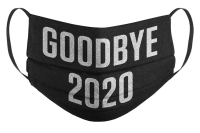
    I hope you have whatever kind of summer you can manage; try to stay positive and focus on the good; and please, please take care of yourselves and others by wearing a mask when you're out and about. Not all heroes wear masks, but everyone who wears a mask is a hero.

  • BalticWell.

    I wish I had written one of these a month ago. By the middle of March, my university went online, and now, at the end of March, 75% of Americans are living in some state of lockdown as the numbers of people infected and lost around the world continue to climb. We are all, adults and children alike, expected to continue "work as normal" under conditions that are anything but normal. Although I join those who push back again the emphasis on productivity during a pandemic and emphasize the importance of self-care and compassion… I do nonetheless worry about my own productivity.

    Not that I was getting a lot done before all this happened—my malaise from last year had not abated—but I think the constant state of urgency, with more to do as a department chair and more to think about as a human being, has strangely made me more alert to what I need to do as a writer and scholar. Of course, it's much harder to focus when you're trying to absorb the constantly updating news around the world (and here we thought there was a lot of news before the pandemic, ha). But the current crisis also makes it more imperative to unplug and refresh our minds, to focus on something else for at least a short while. (Not all of us can do this, of course, especially the heroes of the day: health care workers, first responders, and grocery store and restaurant employees, among others.)

    It seems that, very recently, I have managed to avoid the news cycle—and commentary on the news, and commentary on the commentary, ad infinitum and ad nauseam—which enabled me to recover a bit of my focus and motivation and move some projects forward. Today I sent off a book proposal to an editor who's been patiently waiting for it, and I will continue work on a handbook chapter for another editor who's been even more patient, which I hope will lead to finally completing a related book proposal for yet another editor, whose patience is off the charts. When those things are done, and I get a few review assignments off my desk, I can get back to the superhero-and-ethics book for which I did the reading and note-taking at the end of last year.

    In lighter activity, I have managed to keep up with blogging at Psychology Today and The Virtues of Captain America, as well as start an Instagram account, which I've found to be a comforting escape from Twitter (at which I just "celebrated" my tenth anniversary).

    – — — —- —– —- — — –

    I've found some solace this past month in journaling, which I do off and on and off again (and intermittently at that). But this time around, I've been using it to try to figure out what I want to do, as in "with my life," a nut I've been trying to crack for going on a decade now. Much of it has to do with determining with who I want to be, who I want to think of myself as, and who I want others to think of me as, all of which come back in one way or another to the word worthy (which just happens to be the focus of the book I'm current working on, so that's kind of weird).

    I also realized I had came to no longer think of myself of a writer, which was a striking revelation. I've written about why that particular mode of self-identification is problematic for me, but it did serve as an existential anchor of sorts, grounding me in an understanding of what I did with my days. Without it, I just drifted, but I think I've found my footing again, as shown by the reignited embers of work detailed above, and hopefully I'll have more progress to report the next time I check in.

    – — — —- —– —- — — –

    Until I see you again, please be well and safe, practice social distancing, and do wot the man says…