Mark D. White

Writer, editor, teacher

  • Mark D. White

    Last night I read a wonderful and concise article by Jillian Craigie (King's College London) from the latest issue of Bioethics (25/6, July 2011) titled "Competence, Practical Rationality and What a Patient Values." The abstract follows:

    According to the principle of patient autonomy, patients have the right to be self-determining in decisions about their own medical care, which includes the right to refuse treatment. However, a treatment refusal may legitimately be overridden in cases where the decision is judged to be incompetent. It has recently been proposed that in assessments of competence, attention should be paid to the evaluative judgments that guide patients' treatment decisions.

    In this paper I examine this claim in light of theories of practical rationality, focusing on the difficult case of an anorexic person who is judged to be competent and refuses treatment, thereby putting themselves at risk of serious harm. I argue that the standard criteria for competence assess whether a treatment decision satisfies the goals of practical decision-making, and that this same criterion can be applied to a patient's decision-guiding commitments. As a consequence I propose that a particular understanding of practical rationality offers a theoretical framework for justifying involuntary treatment in the anorexia case.

    Craigie argues for assessing the procedure–in this case, practical judgment–by which a person comesto the decision whether to refuse treatment, rather than applying external standards to the decision itself or the reasons that led to it. She emphasizes that in the past, simply exhibiting a behavior and expressing a preference that was characterized as or associated with a mental disorder was taken as evidence that the patient was "irrational." In the case of anorexia nervosa (on which she focuses in the article), if the patient expressed an overwhelming desire to be thin, this was judged to be irrational simply because that was one of the hallmarks of the disorder. Craigie correctly identifies this as circular reasoning, akin to listing homosexuality as a disorder and then "concluding" that homosexual desires are "pathological" (or interpreting denial of a problem as evidence of the problem–for one of the most disturbing instances of this that I've read, see Deirdre McCloskey's Crossing: A Memoir).

    Instead, Craigie recommends looking into the quality of the reasoning by which the patient forms the value or preference that leads to the treatment refusal. She considers several approaches of evaluating the process by which the patient comes to a particular conclusion rather than simply judging the decision itself, or the value or preference that led to it. I was gratified to see this approach, because that is what I argue in much of my work on paternalism and welfarism: assuming that paternalism is justified in cases of involuntary behavior, involuntariness must be assessed procedurally–based on how the individual came to "act" in a certain way–rather than judging the value, prudence, or wisdom of the act itself. Whatever external evalutors think of an action is irrelevant–all that matters is how she came to that decision, and if she acted voluntarily.

    Craigie argues that there is some evidence–though perhaps not enough at this point–to suggest that anorexics form their overwhelming desires for thinness in ways that compromise their true autonomy, and compares this case to Jehovah's Witness who refuses blood transfusions, in which case she recognizes that the religious value leading to that decision may be a core value of the individual, and is therefore less questionable. This is in line with what I have argued elsewhere (including chapter 5 of Kantian Ethics and Economics), we should assume that individuals make decisions in their own interests, as complex and multifaceted as they are, and interference with them is only justified if there is evidence that a decision (or action) was not made (or taken) voluntarily. (And yes, I realize that voluntariness is a topic of discussion all in itself, but I think the point stands even without specifying it further.) Refusal of medical treatment is  fantastic application of this, and I am very happy Craigie raised these issues.
  • Schism Wow, I guess Marvel wants part of the "shooting ourselves in the foot" action–the Associated Press (what, no love for comics blogs, Marvel?) just announced that Uncanny X-Men, the premier X-book among approximately 106 (give or take), will end in October with issue 544, as a result of the Schism event starting soon. (Or perhaps Flashpoint has further reaching ramifications than anyone thought…)

    On Twitter, current Uncanny writer Kieron Gillen said, "When I joined Uncanny after S.W.O.R.D. I thought "There's no way I can get THIS cancelled". But there are no limits to my power." (He kids–Journey to Mystery, featuring Li'l Loki, is fantastic.)

  • Oops–in his interview on Newsarama about his coming Red Hood title, writer Scott Lobdell says:

    Nrama: What do you think of the chance to launch a new #1 with the other titles in this relaunch?

    Lobdell: Well, without slighting Teen Titans and Superboy, I think Red Hood and the Outlaws is the perfect book to relaunch in September…

    Thanks, Scott! That's one more #1 confirmed, I guess…

  • GL The interview I did with my co-editor Jane Dryden about Green Lantern and Philosophy: No Evil Shall Escape this Book just appeared at the Los Angeles Times' Hero Complex blog. (It also includes a shameless plug for another new book of mine, Kantian Ethics and Economics: Autonomy, Dignity, and Character.) Thanks to Jevon Phillips for the great questions, and be sure to let me know what you think!
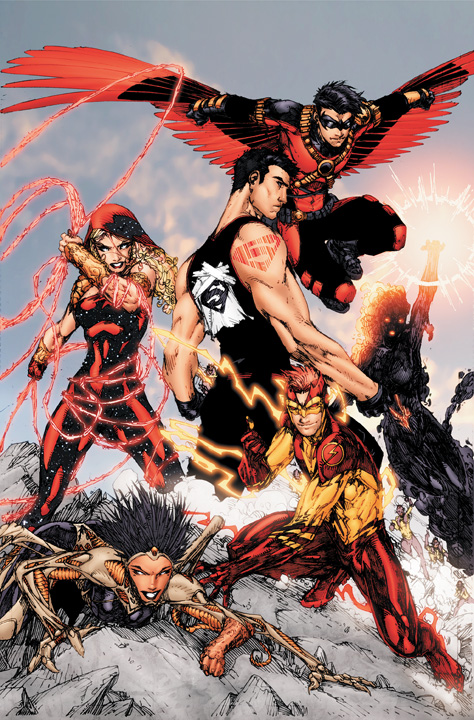
  • At the interview at iO9 commenting on this morning's #1 announcements, Dan Didio and Jim Lee had this to say about the Teen Titans and Tim in particular (emphasis mine):

    Kid Flash, Superboy, and Wonder Girl are part of the Titans roster, but they don't look exactly look like themselves.

    DD: All of these characters have history with the DC Universe that existed before the team is built, but it might be just slightly different. But I think in capturing the voice and the spirit of these characters, I think they're exactly who people think they are.

    JL: There are going to be a lot of surprises.

    DD: I think you're looking at every one of the former Robins to have a real showcase book, and this will be the primary showcase for Tim Drake.

    Every one of the former Robins, Mr. Didio? Even a certain blonde ex-Batgirl? We shall see, but I won't get my hopes up…

  • Titans The Source this morning brings us news of five new titles… and finally, the fate of Tim Drake, though it seems his ties to the world of Batman may be sevrered…

    From the page itself (too much information to try to summarize):

    • Seven heroes from the 31st century have traveled back to the present day. Their mission: Save their future from total annihilation. When the future tech they brought with them fails, they find themselves trapped in a nightmarish world and an ultimate struggle to survive. LEGION LOST #1 will be written by Fabian Nicieza and illustrated by Pete Woods, fresh off an acclaimed run of Action Comics.
    • In the 31st century, the Legion of Superheroes is reeling from the loss of seven of their finest — and trying desperately to keep their youngest recruits alive against a series of terrible new threats. LEGION OF SUPERHEROES #1 will be written by fan-favorite Legion writer Paul Levitz and illustrated by Francis Portela.
    • Tim Drake is forced to step out from behind his keyboard when an international organization seeks to capture or kill super-powered teenagers. As Red Robin, he must team up with the mysterious and belligerent powerhouse thief known as Wonder Girl and a hyperactive speedster calling himself Kid Flash in TEEN TITANS #1, by Scott Lobdell and artists Brett Booth and Norm Rapmund.
    • Virgil Hawkins has been gifted with incredible electrical powers. Adopting the persona of Static, he faces super-powered street gangs, raging hormones, homework, and girls in STATIC SHOCK #1, co-written by John Rozum and Scott McDaniel, with McDaniel also illustrating along with Jonathan Glapion.
    • It’s up to the living avatars of war and peace to root out the hidden forces who look to plunge the country into a deadly civil war in HAWK AND DOVE #1. The exciting new series will be written by Sterling Gates and illustrated by legendary superstar comics artist Rob Liefeld.

    My thoughts? Teen Titans looks and sounds dreadful–sorry, Tim, you deserved better. Love McDaniel's art, so Static Shock is a go, but Liefeld leaves me no reason to get Hawk and Dove. But the Legion titles are definitely buys, Legion for Paul Levitz and Legion Lost for Dawnstar and Wildfire. Nothing to get very excited about here, and the Titans book has me seriously worried–these are superheroes?

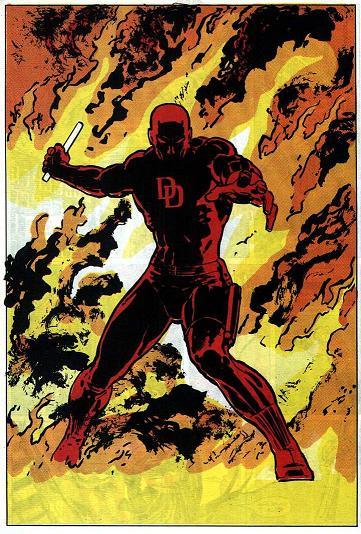
  • Dd_ba Wow, everything's coming up Miller and Mazzuchelli lately (which is fine with me): The Hollywood Reporter is… well… reporting that Fringe writer-producer David Caleb Kane is adapting the "Born Again" storyline for the Daredevil reboot movie. Not familiar with Kane, but if done well this will give the movie some cred with comics fans (just as elements of "Batman: Year One" were used in Batman Begins). And it should provide some great character moments for whomever is selected to play Matt Murdock… can I nominate Ryan Gosling? And maybe his Blue Valentine co-star Michelle Williams for the down-and-out Karen Page?

    (Lindsay Lohan would be too obvious a choice.)

  • Courtesy of Bleeding Cool, here is a trailer for the animated version of Frank Miller and David Mazzuchelli's classic Batman: Year One. I don't much go in for animated superheroics (though The Incredibles made me think all that Pixar should do all superhero films), but this looks tremendous.

  • Demonknights The Source has been updated with complete details of the supernatural #1s announced at Entertainent Weekly earlier this morning (including art teams), and many more. The highlights:

    • Demon Knights #1 by Paul Cornell will feature, as many guessed, the Demon Etrigan (check out the incredible cover to the right)
    • Resurrection Man #1 by Dan Abnett and Andy Lanning with Fernando Dagnino on pencils
    • I, Vampire #1,. written by Josh Fialkov with art by Andrea Sorrentino
    • Voodoo #1 by Ron Marz and Sami Basri

    Not my cup of tea, but I loved Basri's work on Power Girl (the fate of which I assume will be announced with the Superman group, hopefully later this week) and Paul Cornell's medieval book sounds great.

    Wonder where Zatanna is… maybe hiding from the DC hatchet crew somewhere with Tim Drake?

  • Mark D. White

    Just read a very interesting article from The New Republic by Jamie Holmes titled "Why Can't More Poor People Escape Poverty?", detailing new work on the intersection of psychological studies of ego depletion and self-management–the work by Roy Baumeister, Kathleen Vohs, and others that I've cited widely in my own work on willpower–and economists working on development and poverty.

    The basic insight in that deprivation imposes greater cognitive costs on the poor since the relative scarcity of resources leads to higher negative consequences of choice (even in decision-making contexts that seem trivial to the wealthy) and therefore greater decision-making costs (with respect to trade-offs as well as self-control problems), which in turn makes the ascent out of poverty all the more difficult. Some reasonable policy suggestions are offered at the end, which (thankfully) do not veer into Nudge territory, but which mostly involve increasing options for leveraging willpower.

    A very worthwhile read, and a fascinating application of the psychological work on willpower to a pressing economic problem.