Mark D. White

Writer, editor, teacher

  • Mark D. White

    Barry Schwartz (author of The Paradox of Choice: Why More Is Less), Yakov Ben-Haim, and Cliff Dasco have a paper in the latest issue of Journal for the Theory of Social Behaviour (41/2, June 2011) titled "What Makes a Good Decision? Robust Satisficing as a Normative Standard of Rational Decision Making," in which they recommend robust satisficing as a normative standard for decision-making when facing radical uncertainty (in the sense in which Frank Knight used the term):

    In all the research on how heuristics and biases can lead people into bad decisions, the normative standard for comparison has rarely been called into question. However, in this paper, we will argue that many decisions we face cannot be handled by the formal systems that are taken for granted as normatively appropriate. Specifically, the world is a radically uncertain place. This uncertainty makes calculations of expected utility virtually meaningless, even for people who know how to do the calculations. We will illustrate some of the limitations of formal systems designed to maximize utility, and suggest an approach to decision making that handles radical uncertainty—information gaps—more adequately. The arguments below will be normative in intent. They will suggest that “robust satisficing,” not utility maximizing, is often the best decision strategy, not because of the psychological, information processing limitations of human beings (see Simon, 1955, 1956, 1957), but because of the epistemic, information limitations offered by the world in which decisions must be made. (p. 210)

    What is robust satisficing?

    There is a quite reasonable alternative to utility maximization. It is maximizing the robustness to uncertainty of a satisfactory outcome, or robust satisficing. Robust satisficing is particularly apt when probabilities are not known, or are known imprecisely. The maximizer of utility seeks the answer to a single question: which option provides the highest subjective expected utility. The robust satisficer answers two questions: first, what will be a “good enough” or satisfactory outcome; and second, of the options that will produce a good enough outcome, which one will do so under the widest range of possible future states of the world.

  • Mark D. White

    Sociologist Jaye Cee Whitehead (Pacific University) has a wonderful piece in The New York Times today titled "The Wrong Reasons for Same-Sex Marriage," arguing that the recent arguments espousing the economic benefits of same-sex marriage for cash-strapped states and municipalities miss the point:

    Those making these economic arguments probably have the best of intentions. After all, why can’t gays and lesbians have full equality, while also saving the state money and bolstering local economies? Aren’t civil rights narratives consistent with the economic case for same-sex marriage? Shouldn’t supporters use all possible arguments in the hopes that at least one will finally stick?

    And yet supporting marriage on economic grounds dehumanizes same-sex couples by conflating civil rights with economic perks. Americans should be offended when the value of gays and lesbians is reduced to their buying power as consumers or their human and creative capital as workers.

    Why can’t same-sex couples have access to the same rights and protections as their straight neighbors simply because they are citizens? How would we respond if the right to interracial marriage were based on the prospects that these relationships made good business sense or added to the state budget? While economic arguments were certainly advanced during the struggle for African-American civil rights — in the late 1950s, Atlanta’s business-oriented mayor, William B. Hartsfield, promoted his city as being “too busy to hate” — those rationales are not what we think about when we remember that struggle’s highest ideals.

    I made a similar point in my paper "Same-Sex Marriage: The Irrelevance of the Economic Approach to Law," aimed more at academic economic arguments than popular ones, but with the same general thesis: that the argument for same-sex marriage is properly a moral one, based on dignity and equality, not an essentially contingent cost-benefit calculation (particularly one based on current economic conditions).

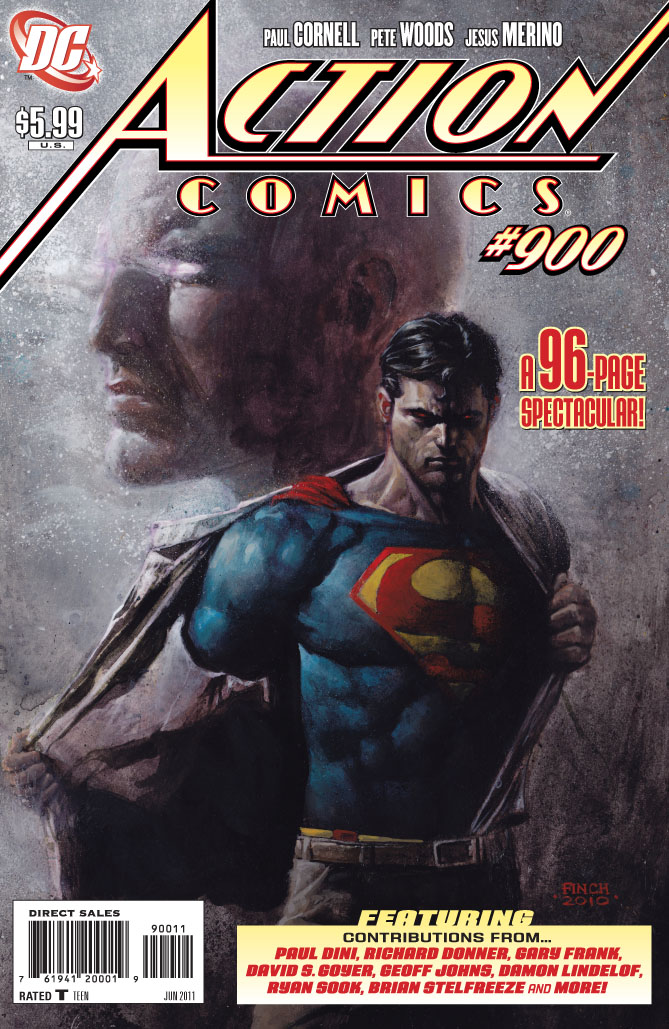
  • Action900 Unfortunately, I saw this discussed all over the interwebs before I had a chance to read the massive Action Comics #900, which (also, even primarily!) contained the final chapter to Paul Cornell and Pete Woods' marvelous "The Black Ring" storyline (featuring several guest artists), which they tied into the "Reign of Doomsday" crossover (with the help of Jesus Merino) that will continue in next issue of Action.

    But as amazing and spectacular as Cornell and Woods' tale was (I can use those terms to describe a DC book, right?), all the media focus is on a 9-page story written by David S. Goyer (and beautifully illustrated by Miguel Sepulveda) in which Superman tells the president's national security adviser that he plans to renounce his U.S. citizenship in front of the U.N. (YouTube would seem a better place to do that–worked for Maxwell Lord in Justice League: Generation Lost #24, right?)

    The widespread media interest in our world is understandable, of course, since Superman has long stood for "truth, justice, and the American way," and the decision is being interpreted as a commentary on current U.S. policy (as was the death of Captain America years ago, and more recently the "unpatriotic" changes to Wonder Woman, both in the comics and on TV). His ties to the United States have been downplayed greatly in the comics for decades, where he is normally portrayed as a "citizen" and protector of Earth. But in the popular imagination, not the minds of the comics-obsessed, Superman is closely associated with the United States, so this action caused an uproar.

    In the story, Supes seems to have (at least) three possible motivations behind this decision, ranging from the more politicial to more philosophical. He makes the political motivation explicit to the NSA: "I'm tired of having my actions construed as instruments of U.S. policy." I think this is very reasonable and prudent, and actually (and ironically) protects the U.S. more than it does Superman. It frees him to intervene in situations around the world, including nations and regions where American intervention is less than welcome–such as the motivating incident in the story–without implicating the U.S. government (which, after all, is what the president in the story–DCPOTUS, if you will–is concerned about).

    Second, as protector of the Earth as a whole, his adoptive world and home of humanity, he doesn't want to be seen as advancing American interests in particular. He hints at this when he says "'Truth, justice, and the American way'–it's not enough anymore. The world's too small. Too connected. … I'm an alien… I can't help but see the bigger picture." As strange as it may be for Supes to say these words outloud, I think most people understand this is how he thinks. After all, even Captain America has defied the U.S. government when he disagreed with specific policy positions; even he will not act solely in U.S. interests when there is a greater principle at stake. I don't think anyone doubted Supes would either, but maybe I'm wrong.

    Finally, and this is the most speculative of the three motivations, Superman may be renouncing the ideals that American stands for (even if its service to them is not always perfect), such as liberty, equality, and democracy. He may be implying as much when he casts doubt on "the American way" (my emphasis) and his invocation of "the big picture." But certainly his actions in the "incident" reflect those ideals, and more generally one has to wonder: if not those ideals, than what? Again, look to Captain America, who has long been able to distinguish between American ideals throughout history and American policy at any point in time; he has disagreed with the latter while never wavering from the former.

    I really doubt Superman is abandoning the ideals of liberty, equality, and democracy–after all, these are hardly uniquely American values–and I interpret his renuncation of U.S. citizenship as a practical, political measure meant to insulate his actions from U.S. policy, freeing up both him and the U.S. to pursue their own goals and interests.

    Was the way it was written a bit inelegant? Probably. Did it shock? Of course. (Was that the goal? Perhaps.) But I think it can be reasonably be understood just as Supes explained it–a eminently prudent measure, which was blown out of proportion (in the real world as well as in the story–very prescient, Mr. Goyer!). We can only wish that political decisions in the real world could be made so well!

  • Mark D. White

    There's a very interesting article in today's Wall Street Journal about the commcerical background of the Middleton family, and how the impending royal nuptials can be seen as belated recognition of the worth of commerce and entrepreneurship:

    Much has been made of the fact that Kate Middleton, Prince William's bride-to-be, is a "commoner." Her mother and father began their careers working as a flight attendant and flight dispatcher for British Airways, respectively. Yet she has known many of the privileges of aristocracy because her parents built a multimillion-dollar business that supported elite educations for her and her siblings.

    Some have wondered if Kate will be a "people's princess," in the mold of Prince William's late mother, Diana. But Kate and her family actually embody a noble, if relatively modern, tradition of their own: a tradition of bettering oneself and one's family, while improving the lot of society. In other words, entrepreneurship.

    For centuries in Britain, commercial activities were looked down upon by many in the aristocracy, whose wealth lay in landownership and who would not deign to dabble in trade. This week's wedding can be seen as the culmination of a long process of elevating the social status of entrepreneurship itself.

    It's curious that Deirdre McCloskey's name didn't show up anywhere in this article, which is an straightforward application of her work defending the honor of commerce and tracing its historical development and importance.

  • Stoicwarriors This week I've been reading Nancy Sherman's book Stoic Warriors: The Ancient Philosophy behind the Military Mind, which not only looks at how Stoicism can apply to the modern military (and how much military codes and standards dervie from Stoic thought), but also provides a nice introduction to Stoicism itself, combatting common (and often) mistaken ideas of it as denying emotion altogether, rather than recommending self-regulation of emotion, allowing it when appropriate and suppressing it when not.

    Chapter 3, "Manners and Morals," contains a defense of military decorum, encompassing all the many elements of it, including dress, movement, and speech. In the following passage, she discusses the importance of the voice:

    …how officers address their troops can be an index of character and excellence. A tone of voice that is stern but not abusive, objective and authoritative yet still compassionate, is a way of commanding (deferential) respect and showing (dignitary) respect. It is a sign that can reveal a leader's good character and sensibilities. (p. 57)

    She then goes to cite from Cicero's classic guidebook On Duties, particular Book I: 133-137 on public speaking–such as "One ought for the most part only to resort to mild criticism, though combined with a certain seriousness so as to show severity while avoiding abusiveness" (137)–and applies it to military command:

    The character and tone of one's voice are part of the example one sets. True, not all are gifted orators like Pericles, who gave a funeral oration for Athenian troops that came to define the species for all of history. But all have an obligation to find ways of commanding with seriousness and resolve, and with a respectfulness that still lets subordinates know who is in authority. (p. 57)

    Cap in dd 233 When I read this chapter in Sherman's book, I thought of how Captain America has been portrayed in comics over the years, especially as regards his voice and the influence and authority it commands. My favorite example of this comes from Daredevil #233 (August 1986), the final issue of Frank Miller and David Mazzucchelli's classic Born Again storyline, in which Ben Urich sees Cap giving orders to Thor, and thinks, "A soldier with a voice that could command a god–and does." The Thunder God's respect for Steve Rogers can been made evident ever since the Avengers thawed him out decades ago, and his demeanor in commanding his "troops" is certainly one factor behind that respect that a god gives a man in this case.

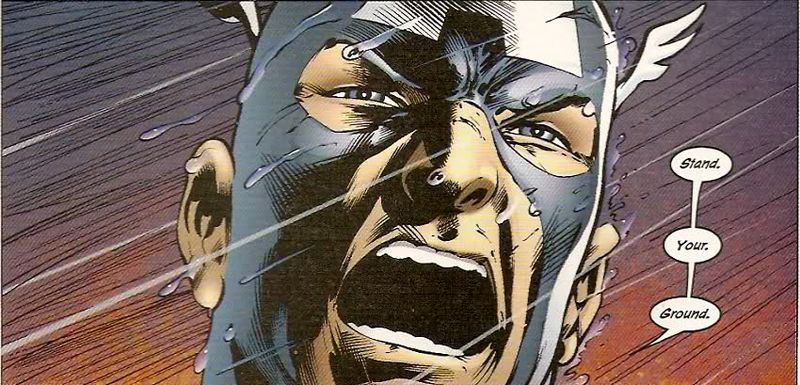
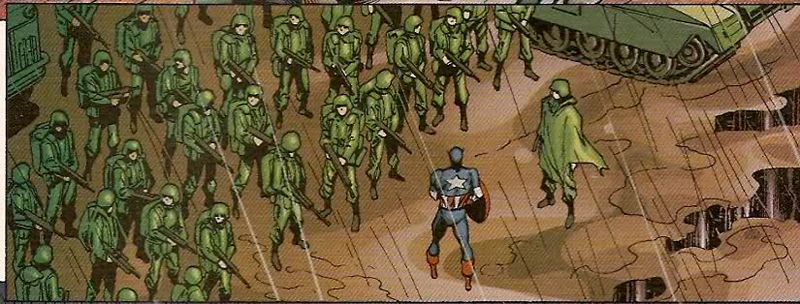
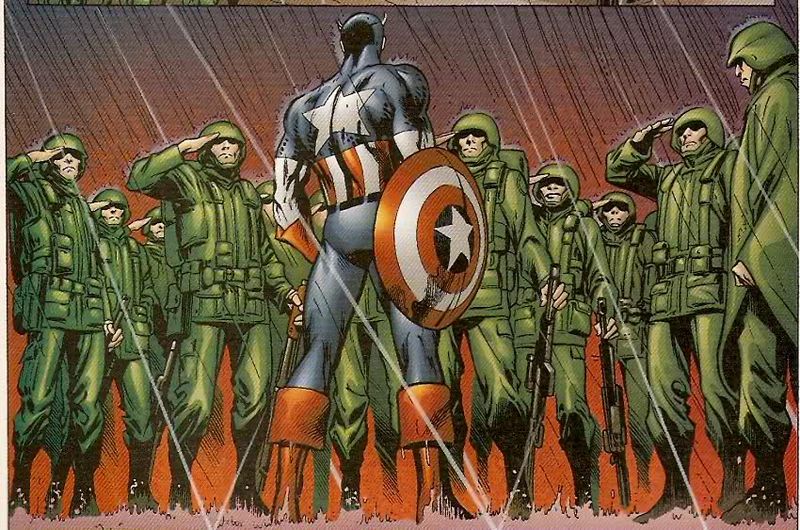
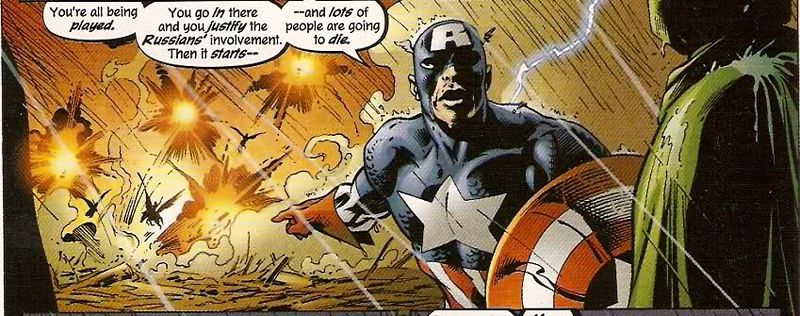
    Another fantastic example of Cap's authority comes from Avengers #63 (March 2003), final chapter of the Standoff storyline that crossed over with Iron Man and Thor. Here we see  Cap trying to keep the American military from escalating a tense situation with the Russians (instigated by Doctor Doom):
    Av63p1 Av63p1p2 Av63p1p3 Av63p2 Av63p3 Av63p4 

    (Scans courtesy of Scans-Daily's post on this issue, which makes a similar point about Cap's authority.)

    Here we see Cap command the U.S. soldiers, his voice stern and firm yet respectful–and also showing respect for the commanding officer at the same time disagreeing with him. But when he gives the order to "stand your ground," we "hear" the voice that commands men and gods alike–and a voice that Cicero and his fellow Stoics would have admired as well.

  • Mark D. White

    Over at Prawfsblawg, Elizabeth Dale, who teaches history and law at the University of Florida, has an extremely thought-provoking post about sabbaticals for full-time professors, wondering if the original purpose–scholarly rejuvenation and renewal–has been replaced by "catching up" with work one wasn't able to complete during the normal academic terms and breaks.

    From the end of her post (after she compares her sabbatical time with her normal working experience):

    If sabbaticals supposed to be a time of rest and rejuvination, I blew this one.  I joke (much to the annoyance of my colleagues who are not on leave) that I am going to need a sabbatical to recover from my sabbatical. But truth be told, apart from reading a lot of mysteries (which I would probably have done if I was working normally) and occasonally meeting people for lunch, I have not exactly been frivoling away my time. Partly that's because you can't exactly afford to frivol when you are on half pay, but partly its because I've been so busy working to catch up I haven't had the time or energy to take a month off to see the sights or smell the daisies. That having been said, I don't want to complain too much–I'm working 7-8 hour days, not 10-12 hour days. That is a break, even if it's hardly time lazing in the sun.

    But that suggests the other side of the problem. If I'm  working that much, and falling behind, during a normal year, then there's either something wrong with me, or something wrong with a normal year.

    I'm inclined to think that there are problems with what are seen as normal academic expectations. We'll need to return to that in a future post (this one is too long as it is).  But my take away for today is that my sense is that even for tenured faculty, the demands of the rest of the time are such that sabbaticals are a time of trying to stay on track or play catch up, rather than a time of R&R, academic renewal and intellectual growth.  Or, to put it another way, distortions in ournormal working conditions are, to significant extent, undermining the original purpose of the sabbatical.

    There is also some interesting discussion brewing in the comments section regarding sabbatical procedures over time and across different universities–well worth a look.

    UPDATE: Professor Dale has a follow-up post here, with additional valuable insights.

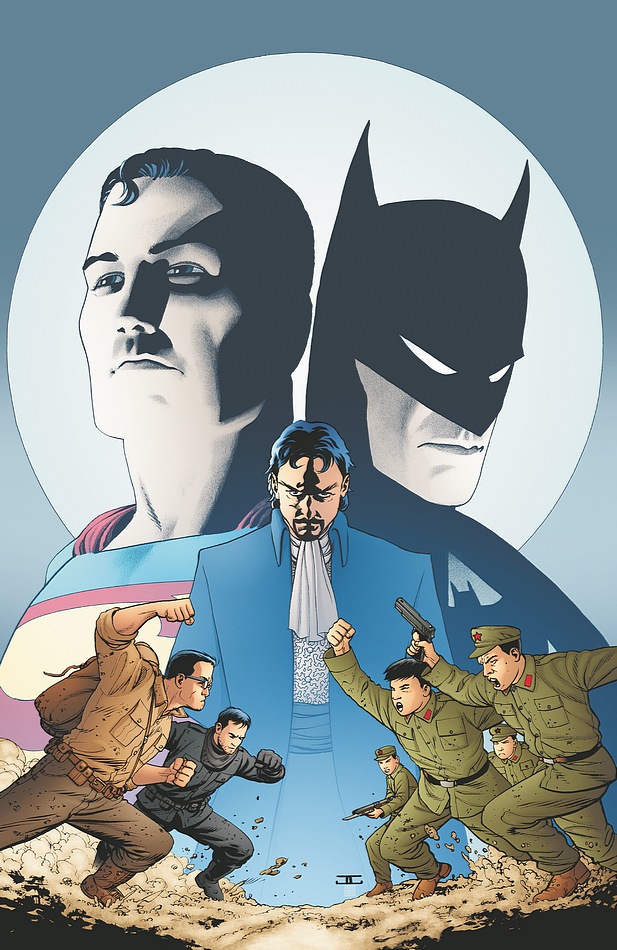
  • Superman_710 Superman #710, written by Chris Roberson with pencils by Eddy Barrows and Travis Foreman, reads like one of the best issues of Superman/Batman (to be honest, I don't know if there's been an issue of that title better than this, even Roberson's issues), right down to the alternating dialogue and the heartfelt discussion between the two at the end. (And check out the incredible John Cassaday cover–love the retro Batman!)

    MILD SPOILERS BELOW THE FOLD…

    (more…)

  • Maybe It’s Just Me, But… (at Psychology Today)

    A mix of ethics and self-help, especially with regard to relationships, plus some discussions of interesting new papers in philosophy and law. I have fortunate to have wonderful, thoughtful readers who challenge me and often suggest topics for future posts. See here for an index of posts at this blog since it started in February 2010.


    Economics and Ethics

    An academic blog launched in September 2009 with three (fairly) like-minded colleagues, at which I discuss new work in economic and ethics, as well as philosophy and law, and also a few newspaper comics. See here for my posts, most of which are announcements of interesting papers and conferences I find online (often at other blogs, such as Larry Solum’s Legal Theory), but some of my favorite substantive posts are:


    The Comics Professor

    Started here in March 2007, then moved to its current location in October 2010, this blog was originally intended to feature short pieces in the style of my chapters for books like Batman and Philosophy, but also developed to feature news and reviews of developing events and storylines in the world of superhero comics.


    The Literary Table

    I started guest-blogging at this general interest blog (with a particular focus on law and literature) in March 2011. (See here for my posts.)

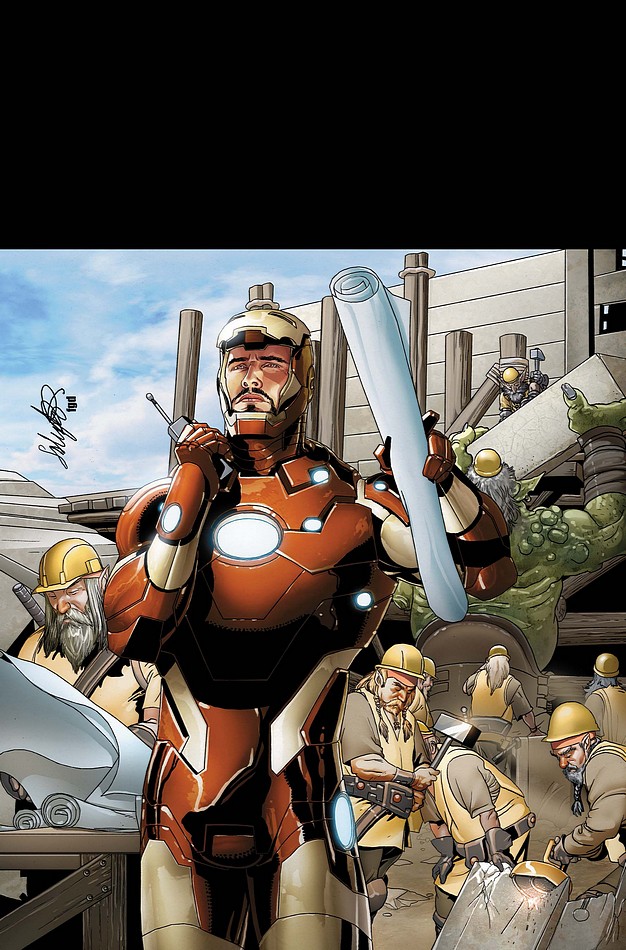
  • IM506 Be honest–who else got a Bob the Builder vibe from the cover of Invincible Iron Man #506, revealed today in Marvel's July 2011 solicitations? (Click thumbnail for a larger version.) Was it just me? Nah, impossible…

  • Newsarama has a feature article on a session at the Comics Arts Conference which took place "within" WonderCon this year. Titled "Life After Trauma: To Be A Superhero Or Supervillain," the session featured my good friend Dr. Robin Rosenberg (editor of The Psychology of Superheroes), as well as Dr. Travis Langely and Andrea Letamendi. From the article:

    So what kind of trauma do superheroes typically experience? War and large-scale events are among the top says Rosenberg, though they also often experience life threatening illnesses. One example she gave was Superman’s regular exposure to the several types of Kryptonite, another was Iron Man’s heart condition. But one of the prime examples was Bruce Wayne witnessing his parents being gunned down.

    “Turns out, intended personal violence is the type of trauma that’s most likely to have a large psychological after effect that leaves a wake,” said Rosenberg. “The other types tend not to lead to PTSD and in fact only a minority of people who experience a trauma develop PTSD.” Rosenberg suggested about 20% of cases lead to the disorder.

    Be sure, too, to check out Dr. Rosenberg blogs, Psychablog and The Superheroes (at Psychology Today).