Mark D. White

Writer, editor, teacher

  • ASM 655 Short and sweet, folks… amidst the wonderfully poignant, mostly silent elegy for the recently departed (I won't spoil things if it you didn't read #654), Dan Slott and Marcos Martin's Amazing Spider-Man #655 portrays Peter in his dreamworld confronting those lost in his battle against evil, and being taunted by the evildors themselves for not "doing what has to be done" to save the innocent: namely, kill.

    As you may know (especially if you've read Chapter 1 in Batman and Philosophy), this is a classic trolley problem situation. The story goes like this: a runaway trolley carrying five passengers is about to crash, and the only way to prevent these deaths is to divert the trolley to another track. You have the power to do this, but there is one innocent person on the other track who will be killed if the trolley is diverted. The dilemma is: do you act to save the five and kill the one, or do you not act, letting the five die while not killing the one. Someone (at least one) is going to die, and you can minimize the death, but only by acting to kill the one rather than doing nothing and letting the five die. Since most superheroes refuse to kill even their most heinous foes, they allow many innocent people to die, which is a perpetual topic of discussion among comics fans, and a person's answer is a sort of Rorschach test for his or her moral values and positions.

    At the end of the issue, Spidey promises that the deaths will end. In the classic trolley problem story, that's not an option. And as much as we'd like to believe it's different in the Marvel Universe, we all know it's not.

  • Det874 Scott Snyder and Francesco Francavilla offer up another fantastic issue of Detective Comics with today's issue 874, continuing the re-introduction of James Gordon Jr. in a tantalizing discussion with his father, while also exploring the aftermath of Dick's exposure to the Dealer's hallucinogenic gas in the previous story arc.

    There are many intriguing elements to this comic, in terms of both writing and art–breathtakingly simple but expressive art from Mr. Francavilla–but I will hold myself to discussing the theme of willpower that Snyder emphasizes throughout the issue, one that psychologists and philosophers have discussed.

    SPOILERS BELOW THE FOLD…

    (more…)

  • Iron man-spidey In a fantastic new interview at Newsarama, The Invincible Iron Man writer Matt Fraction discusses the future of the Iron Man title (including the mammoth #500 issue and the reflective #500.1 issue), previews Tony's role in the upcoming Fear Itself event, and–most interesting to me–compares Iron Man and Spider-Man in terms of their ethics.

    From the interview:

    Nrama: Another interesting thing about #500 was making Spider-Man — and Peter Parker — the co-star of the issue. What led you to that decision, and also, is that the first time we’ve seen Peter Parker and Tony Stark interacting since Tony forgot Peter’s secret identity post-”One More Day”?

    Fraction: I believe so.

    I kind of consider Peter Parker to be the moral center of the Marvel Universe, and I consider Tony to be the most morally flexible, the most morally unhinged hero in the Marvel Universe. So it’s nice from time to time to put Tony and Peter together in a room and look at how they measure up next to one another. See how they compare, see how they work together. It’s a fun relationship.

    Having recently written essays on the ethics of both characters as represented during Civil War–"Did Iron Man Kill Captain America?" in Iron Man and Philosophy and "‘My Name is Peter Parker’: Unmasking the Right and the Good" in the upcoming Spider-Man and Philosophy–Fraction's statement really got me thinking. My immediate reaction was to disagree: to my mind, Captain America, not Spidey, is the undisputed moral center of the Marvel Universe, and Iron Man is by no means "morally unhinged," but rather is just more pragmatic (in terms of consequentialism, not American pragmatism a la Dewey, James, and Peirce) in his moral decision-making.

    Civ war But casting Spider-Man as the moral center begins to make more sense to me if you cast Cap and Iron Man as polar opposites–principles vs. pragmatism, deontology vs. consequentialism–with Peter hovering in the middle, drawn to each side at various times. For instance, during the Civil War, Peter first sided with Tony (based on his consequentialist arguments based on safety and security) until Cap convinced him to cross over (based on deontological arguments based on liberty). But nonetheless, when Aunt May lay dying from a gunshot wound during "One More Day," Peter sought out Tony's help.

    In fact, the topic of my Spider-Man essay is the constant pull that Peter feels between the "right" and the "good," which is one way that philosophers often characterize the contrast between deontology and consequentialism. For instance, when Tony asks him to unmask in Civil War, Peter is torn between his loyalty and gratitude to Tony (representing what he felt was the right thing to do) and keeping his secret identity to protect MJ and May (representing the good that he wants to maximize). His later decision to split from Tony and sign up with Cap was motivated by the same conflict, just recast in terms of his new opinion of what the right and the good were: now he felt that standing against Tony and registration was the right thing to do, even though it endangered the "good" of protecting MJ and May (against the authorities once he was an outlaw). (This also highlights the role of judgment in determining what course of action represents the right or the good in any given situation, which I discussed previously.)

    In both cases, Peter chose the right over the good, indicating that ultimately he sides more with deontology (and Cap) than consequentialism (and Tony), but the fact that he struggles at all makes him unique among the three heroes. So I would agree with Fraction that Spidey is the moral center of the Marvel Universe, not because he is the most grounded, but because he resides in the middle between two proud traditions in moral philosophy: deontology and consequentialism, or the right and the good.

  • Mark D. White

    The New York Times has a great little piece today on Monopoly (the game), Milton Friedman, and monetary economics, which ends with this description of a particular game which took place in a University of Chicago dorm in the late 1970s:

    Monopoly friedman The precise details of our classic game are blurred by the alcohol consumed that night and the years that have passed since then, but this much is recalled. We decided that Monopoly was hostile to a free market because it restricted the number of houses or hotels one could buy. We voted that a player could buy as many hotels as a property could physically bear and rents would be raised proportionally.

    But the bank soon began to run out of money. So we did what any government would do. We began printing more of it, by scribbling $500 on scraps of paper. We printed a lot of money.

    Prices shot up, which we all knew, even in that inebriated state, was the consequence of expanding the money supply. (After all, the great economist [Friedman] told us, “Inflation is always and everywhere a monetary phenomenon.”)

    The inflation became so extreme that we eventually voted to alter the rules again: we’d cut the money supply. Any money we printed that came back to the bank would be taken out of circulation.

    A severe depression kicked in, of course. Prices plummeted and it was a race to liquidate assets. One by one the players quickly went bankrupt, and sometime around 4 that morning the game was over.

  • JSA bk 2JSA bk 1 In a new interview on Newsarama, comics writer (and sometimes artist) Bill Willingham discusses many things, including Fables of course, but also why he left JSA after twelve issues (contained in the trades shown to the left, The Bad Seed and Axis of Evil). In particular, he cites issues with accommodating crossovers and editorial interference, which have bedeviled many a creative writer in the event-crazed status quo of modern comics. (See also: Dwayne McDuffie and JLA.)

    I found this passage particularly interesting:

    And then comes along this crossover in which the whole plot revolves around just about every member of the JSA turning evil for a couple of issues.

    I couldn’t bring myself to do that because, you know, one time something takes control of you and you accidentally turn evil but it’s not your fault? That can be understood. Maybe the second time something takes possession of you and you turn evil, maybe that can be forgiven as well. But by about the third or fourth time that something takes over this person and he becomes evil, you have to ask yourself, like, well, maybe there’s just something wrong with this fellow from the beginning. Maybe he is just evil. Maybe that’s what evil is, is people that are just accessible to being taken over by whatever cosmic hobo happens to be passing through today.

    This is very similar to the Kantian description of weakness of judgment and the will that I first laid out in my chapter in The Thief of Time: Philosophical Essays on Procrastination, and again in my book Kantian Ethics and Economics: Autonomy, Dignity, and Character, coming out in May. 

    In a nutshell, a person's autonomous decision-making–in which she makes choices according to moral principle, with no influence from internal or external pressures–can be corrupted, or made heteronomous, in two different ways. In the first, she makes the right decision, but has trouble carrying through with it because her will is weak; I call this "simple weakness." For example, a person may be dedicated to healthy eating, and for the most part he sticks to his diet, but nonetheless he slips once in a while. In other words, his judgment is sound, but his will is weak; this does not make him a bad or "vicious" person, but simply lacking a bit in "virtue" or strength.

    A person can stay "simply weak" his entire life–and indeed, all of us are a little weak (which is to say, none of us is perfectly strong or resolute, at least not in all areas of our lives). But the worse type of weakness, what Kant calls the "impure will," occurs when judgment itself is corrupted, or when the person lets improper incentives and considerations into her decision-making itself. So the dieter who rationalizes cheating for reason based on the pleasure of tasty but unhealthy food is making the wrong decision, not just failing to carry through with the right one.

    And as Kant wrote, it is the impure will that signals viciousness, since it "involves a conscious choice to be heteronomous, a surrender in the endless fight against inclination, as opposed to simple weakness, which represents merely a temporary loss of control" (Kantian Ethics and Economics, p. 59). It's also more susceptible to corruption, because once a person lets nonmoral considerations into her moral decision-making once, it becomes easier and easier to let it happen again:

    The impure will involves a deliberate submission, a choice to admit the influence of inclination—as evidenced by the fact that "the calm with which one gives oneself up to it permits reflection and allows the mind to form principles upon it"—and is therefore more blameworthy than simple weakness… (ibid., quoting from Kant, The Metaphysics of Morals, p. 408)

    Willingham could have been talking about Kant's version of the impure will when he said that when someone becomes evil once, it might not mean anything, but if he becomes evil again and again, then there's something wrong with him–"maybe he is just evil."
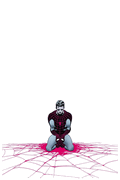
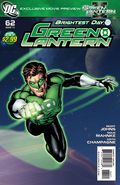
  • Gl62 More about Krona's plan are revealed in this week's Green Lantern #62, as well as in the preview of "War of the Green Lanterns" included in all of this week's DC books.

    Spoilers after the jump…

    (more…)

  • Superman708 For my money–which ain't much, but still–J. Michael Straczynski is an amazing writer. His writing on Amazing Spider-Man was inspiring; his brief run on Fantastic Four was innovative; and his done-in-ones on The Brave and the Bold were stunning. (And don't get me started on Thor…) I hope to write posts on much of his work in the future, but now the book of the moment in Superman (though he's not scripting anymore, of course, since the success of Superman: Earth One, which I have to admit I was less crazy about).

    (Note: I fully realize that Chris Roberson is scripting the current issues of Superman to JMS' plots, and to whatever extent Mr. Roberson is responsible for the broader ideas within the book, I commend him too.)

    UPDATED NOTE: After corresponding with Chris Roberson, I now know that he was actually responsible for most, if not all, of the ideas I discuss in this post. Apologies from Chris for overlooking his contributions before, and kudos to JMS and Chris as an incredible writing team!

    The current "Grounded" arc, in which Superman takes a stroll across America (similar to Green Lantern and Green Arrow's road trip in Denny O'Neil's classic 1970s run), has been controversial, to say the least, especially since Superman was not seen–at least not as Superman, and not on Earth–for a year during the "New Krypton" storyline. And now that he's back, he's… walking. I can walk. I know a lot of people who can walk. Walking's easy. Flying, now that's tough. Now who can fly… hmm… let's see…

    Nonetheless, I like it. "Grounded" is supposed to humanize Superman, bring him in touch with the common folk, and highlight the problems of present-day America (as O'Neil did in the 70s in Green Lantern/Green Arrow). But I like to think it brings him in touch with moral decisions that he normally doesn't have to make, dilemmas we all face everyday. (I discussed some of this previously here.)

    (Spoilers for Superman #708 after the jump…)

    (more…)

  • FF9 Crap.

    DC's May solicits reveal that Freedom Fighters, a title I just sang the praises of, is cancelled as of issue #9:

    FREEDOM FIGHTERS #9
    Written by JIMMY PALMIOTTI and JUSTIN GRAY
    Art and cover by TRAVIS MOORE & WALDEN WONG
    They’ve saved America countless times, but there’s one national crisis the Freedom Fighters are powerless to combat: a troubled economy. The recession hits home as our heroes find themselves among the ranks of the unemployed and facing an uncertain future.
    On sale MAY 4 • 32 pg, FC, $2.99 US,
    FINAL ISSUE • RATED T

    Maybe some of the Freedom Fighters can be phased into the JSA (not long they have enough members already). But Palmiotti and Gray were doing fantastic work (as always), and I hope they have another chance to write the characters soon…

    Also seeing final issues in May are Doom Patrol, R.E.B.E.L.S.JSA All-Stars, and Outsiders. The only one I read regularly (other than FF) was JSA All-Stars, which seemed superfluous from the start, so I'm not particularly upset about those. But Freedom Fighters I will miss.

    (And why is Titans still being published? That deserves a crap all its own…)

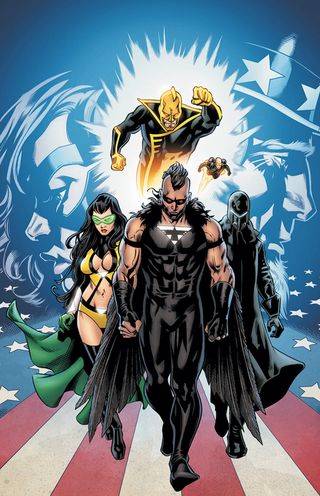
  • FF7 I've always had a soft spot for the Freedom Fighters, stemming from their introduction to the DCU during a 1973 JLA/JSA crossover, then into their short-lived late 70s series, and on into All-Star Squadron and Young All-Stars. It hurt to see most of them wiped out during the first issue of Infinite Crisis, but soon we were given a spanking new version, courtesy of Jimmy Palmiotti and Justin Gray, that was featured in two mini-series before being awarded their own ongoing last year.

    The latest series has been a thrill ride since the first issue (as were the previous two minis), with generous amounts of action, characterization, political intrigue–and grist for the philosopher's mill. A quick survey from the latest issue (#7), released February 2 (POSSIBLE SPOILERS AHEAD):

    • Black Condor discovers that the power-restraining collar around his neck (as well as the rest of the team) is psychosomatic, electronically fooling his brain into thinking his powers have been suppressed rather than actually suppressing them. Once he realizes this, he thinks, "my strength of will is greater than any machine," and easily breaks the restraints and proceeds to save himself and his team. The will, strength of will, and willpower are all contentious issues in philosophy (and psychology); I discuss them in chapter 2 of Green Lantern and Philosophy: No Evil Shall Escape this Book, "Flexing the Mental Muscle: Green Lanterns and the Nature of Willpower," but I could have used the example of Condor as well (if only he wore green).
    • Joan Our heroes save themselves from the underground prison/experimentation center just before it explodes, (presumably) killing all the inmates who were trying to kill them. Phantom Lady and Miss America (she doesn't seem to go by Miss Cosmos anymore) argue about the morality of leaving the inmates/experimentees to die. Stormy makes an argument based on personal integrity and virtue ethics: "We just let those people die! What does that make us?" and "This is about our integrity, setting an example through our actions." Joan makes a more practical argument that they could either stay there and die with the inmates, who were trying to kill them anyway, or escape from them (and the explosion). She argues that they had to save themselves in order to do more good for the country: "Innocent people are dying and will continue to die if we don't do our jobs!" Stormy sees Joan as dismissing the lives of the inmates because they're convicted criminals, but this would have little relevance to the part of Joan's argument that's based on necessity or self-defense. (At the end of their argument, Joan says, "I'm not going to debate ethics with you," but I'll forgive her that because I love her. Did I say that? Oh well… she's awesome. Shut up.)
    • Let's hear it for the bad guy: In his one page (one more than last ish), the Jester tells the captive VPOTUS that "people who aren't willing to die for their ideals aren't deserving of life." I wouldn't go that far, but dedication to the principles that comprise one's character is definitely a plus in my book.
    • In a test of my unconditional love, Joan uses, um, extreme measures to get Doll Man back into the field. Kind of pushing the whole "the ends don't justify the means" thing, but hell, she is awesome, after all.
    • Ff6 And finally, as an example of the necessity of sound judgment in the heat of… well… anyways, Black Condor says to Stormy after she jumps him: "I'm not sure this is a good idea." I'll leave that one alone.

    Be sure to pick up Miss America Freedom Fighters #7 (as well as any back issues you've missed, such as #6 shown to your right, featuring who-know-who, prominently displayed on the cover–I;m just sayin'), and I'll see you next ish…

  • Joe Quesada could have saved a lot of time and effort writing "One Moment in Time," which explained the machinations behind MJ and Peter's split that was orchestrated in "One More Day," if he had just shown what Stan Lee did in three panels in today's Amazing Spider-Man newspaper strip:

    ASM 2011-02-06 

    Good luck, Carlie!