Mark D. White

Writer, editor, teacher

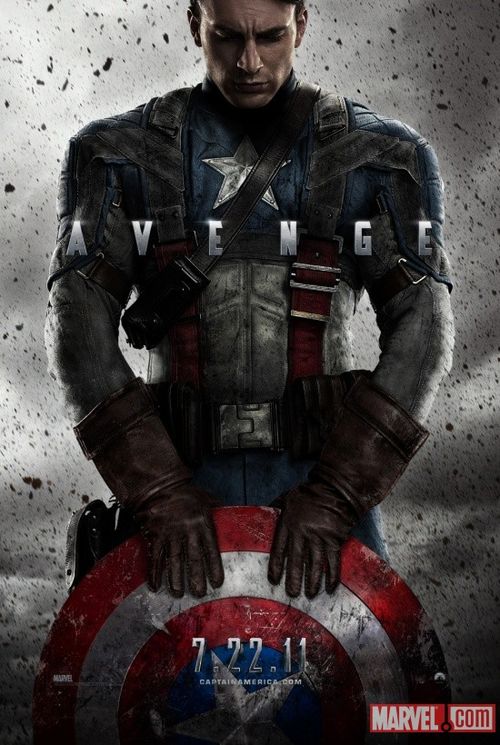
  • In the spirit of Bleeding Cool's "Swipe File," here's the newly released poster for Captain America: The First Avenger:

    Cap poster 

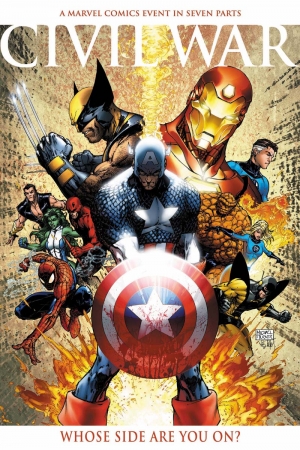
    My first impulse was that it was similar to the famous "Cap's pissin' behind his shield: pose from the wonder Michael Turner (RIP) piece for Civil War:

    Civil war 

    But now I think it resembles more this "death of Captain America" art, with his hands in front of the shield:

    Ocaptain 

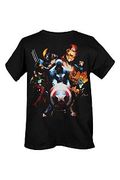
    Cw tee


    Confession: I was actually very excited about the Civil War similarity, because I just happen to have ordered this shirt yesterday.

    (Speaking of Civil War, be sure to check out my chapter titled "Did Iron Man Kill Captain America?" in Iron Man and Philosophy: Facing the Stark Reality, where I discuss the morality of Iron Man's activities during that time, focusing in particular on his various discussions with Cap from books like Iron Man/Captain America: Casualties of War.)

  • GL2 Check out the forums at The Green Lantern Corps, where they've started talking about Green Lantern and Philosophy: No Evil Shall Escape this Book. I recently joined the discussion myself  - hopefully I'll get the chance to share some tidbits with the devout GL fans. (I started with the table of contents to the book.)

    And of course, check back here often for details about the book as the May publication date approaches!

  • Outsiders40 BATO 1 According to a new interview with Dan Didio at Comic Book Resources–or, more precisely, a sneak-peak at the cover of Outsiders #40–Batman (Bruce Wayne, that is) will be returning to the Outsiders, though on what basis is still up in the air.

    This is could be a(nother) perfect forum to showcase the Batman Incorporated concept, of course, especially given how Alfred filled out the team after Batman RIP'ed, picking new members to replicate Bruce's various talents and abilities. Let's hope Bruce makes some further changes now that he's returned–starting with the writer.  😉

    UPDATE (2-14): DC's The Source blog announced Friday that #40 is the last issue. Will we see a relaunched BATO?

  • Mark D. White

    Today, Judge Roger Vinson of Florida reiterated Judge Henry E. Hudson's opinion from last month that the individual mandate provision of the Affordable Care Act is unconstitutional. From The Wall Street Journal:

    In his ruling, Judge Roger Vinson, a Republican appointee, said that the law's requirement to carry insurance or pay a fee "is outside Congress' Commerce Clause power, and it cannot be otherwise authorized by an assertion of power under the Necessary and Proper Clause. It is not constitutional."

    Notably, Vinson went even further than Hudson in one important sense:

    The ruling also said that entire law "must be declared void," because the mandate to carry insurance is "not severable" from the rest of the law.

    For my previous commentary on the individual mandate and health care, see here (on the Hudson decision in particular) and here (on the ACA in general).

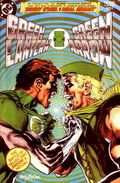
  • Gl-ga In the latest Hot Button feature at Newsarama, Vaneta Rogers discusses social commentary in superhero comics with writers Denny O'Neil (notable in this particular context for his classic run on Green Lantern/Green Arrow), Judd Winick (controversial runs dealing with hate crimes and AIDS in Green Lantern and, uh, Green Arrow), and Greg Rucka (celebrated for redefining The Question and Batwoman as complex, nonstereotypical, and ethnically diverse lesbian characters). The article as a whole is a very good read, but this part stood out in particular:

    Greg Rucka, who recently co-wrote with O'Neil a modern issue of his once-socially-relevant The Question, said the decision to make Green Arrow markedly liberal in O'Neil's comics was one that worked at the time, but he understands why publishers shy away from introducing political motivations to other characters.

    "I think publishers are more frightened of political backlash than they are of issue backlash," Rucka said. "I do think that yeah, if you introduce political stances for your major characters, you have opened up a can of worms there. If you're telling stories in a shared universe about heroism, you don’t want to imply that X hero is only a hero for the Republican party, and is therefore not going to be doing heroic and noble things for everybody else. You never what to establish a risk of status quo that makes them less heroic.

    Let me say first that I feel that defining political orientations for 2nd-tier (or lower) characters is fine, especially when they're set in opposition to each other: Hal and Ollie during O'Neil's run, Ollie and Carter Hall (Hawkman) in more recent comics, Hawk and Dove in their various incarnations, etc. But the thing that scared the bejeebies out of me when the DC Universe Decisions miniseries was announced (and luckily quickly forgotten soon after its release) was that they were going to define political stances for the top tier characters like Superman, Batman, and Wonder Woman–especially Superman.
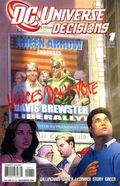
    Decisions Why did this concern me so? Contrary to what Mr. Rucka says, I don't think defining a superhero as liberal or conservative would imply that he or she would help some people and not others in an emergency (though examples do exist, such as Ollie early in O'Neil's run), but making a hero's politics explicit does reduce the appeal of that character to a significant portion of the fanbase.

    Furthermore, it contributes to the perception that our political affiliations define us. If Superhero A is conservative and Superhero B is liberal, many people will take those facts to determine much more about their characters than seems appropriate. There's a lot of room for widely different types of liberals and conservatives in this world (not to mention all the people who reject both labels). And I like to believe that most liberals and conservatives (excluding the ones on the extreme fringe of each group) have more in common than not.

    So even though Mr. O'Neill "defines" Hal as an authoritarian (conservative) and Ollie as a progressive activist (liberal), they were still both heroes who fought evil–just in slightly different ways with slightly different emphases, styles, and tactics. But compared to the villains they confronted (super- or not), they were still heroes first and foremost. Liberal and conservative heroes may fight evil in slightly different ways, which can be interesting to see (as with Hal and Ollie, or Ollie and Carter), but can also be distracting if not handled delicately and sensitively (at which Decisions almost failed, but ultimately didn't, as I remember–whew).
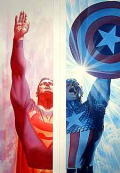
    Supes-cap That said, there are some heroes that should never be defined politically, and instead should represent the best of both (all?) political orientations, values that unite us all (though we disagree on their implementation), such as justice and equality. These heroes can stand as the moral (and political) centers of their respective comics universes, and if the other characters are defined more to the left or right relative to them, then the center will hold them together.

    Superman, of course, is that character in the DCU, though his role as such has not been emphasized very much, though sometimes he functions this way as part of the Trinity, with Batman to his "left" and Wonder Woman to his "right," such as in the build-up to–and, literally, in the first issue of–Infinite Crisis. More clearly, as we all saw after Civil War and through Dark Reign and Siege, Captain America is that character for the Marvel Universe. The two are, as Mr. Rucka said, heroes for us all, but not because they don't exclude anyone from their heroism, but rather because they represent all of us in their characters. Let the other characters orbit Supes and Cap in their own unique ways–some a little to the left, others a little to the right–but I would hope the companies would retain balance overall, and focusing on their centers is, I think, the best way to do this.
  • Mark D. White

    Check out "The Krugman" on Swimming Against the Mainstream, by Christopher Stiffler (obviously a Poe man's economist). An excerpt:

    With inquisitive expression quickly I began to question
    “How do we end this recession and full employment to restore?”
    Not shaken up nor shaven was the economic maven
    Quoth the Krugman, “Spend some more.”

    “More spending can’t be provided," were the words I gently chided
    "With congress ever divided, nothing makes it to the senate’s door”
    “Maybe in a perfect setting, but what you seem to be forgetting
    The whole plan is just begetting of higher deficits galore?
    Borrowing now is easy, paying it back is quite a chore!”
    Quoth the Krugman, “Spend some more.”

  • Shazam1 MILD SPOILER ALERT FOR SHAZAM! #1:

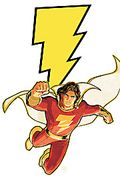
    Today's Shazam! #1 features the wizard Shazam's daughter, Blaze, who wants Freedy Freeman's powers for herself, and so battles Freddy, currently the world's mightiest mortal, Captain Marvel Shazam (thank you Judd Winick) along with the depowered Billy and Mary Batson. As she is about to be defeated, Blaze says to Freddie:

    Our father… the gods… the creator… they all left me in the dark. Do you know what that's like? Of course not. Because their light still shines within you.

    Now imagine an eternity without that light. Without love. Compassion. Or hope.

    That's what hell is, Freddie Freeman.

    Under those circumstances, who's to say you would've turned out any different from me?

    It mat be a familiar riff on "there but for the grace of God go I"–in reverse, of course, and with a different beat–but it is also a topic much discussed by philosophers in the form of moral luck.

    As it is often put, how can you hold a person (or half-wizard/half-demon) responsible for her actions to the extent they were caused by factors beyond her control, such as her genetics and upbringing, which as far as she's concerned are matters of luck. After all, as children we don't choose to whom we are born, where or how we are raised, and so forth. It is very noble to think we can rise above all adversity and develop magnificent characters despite material and emotional deprivation, but is that reasonable–and should a person be held responsible for failing to do this?

    Simply put, how can we hold persons responsible for choices they make, when those choices were to some extent influenced by choices made for them in the past? We don't want to hold persons responsible for things done to them, so how can we hold them responsible for their choices if they are not completely their choices? (You may have noticed that this is similar to the general problem of free will and determinism: how can a person be held responsible for her actions if all worldly phenomena are explained by the laws of physics?)

    There is no simple answer, of course. If you're interested, the most famous modern treatment of moral luck is Bernard Williams' Moral Luck; see also Thomas Nagel's "Moral Luck" in his book Mortal Questions, as well as Daniel Statman's edited book on the topic (creatively titled Moral Luck).

    By the way, Kant wrote memorably of this general theme in his book Religion within the Boundaries of Mere Reason in the context of being proud of one's own morality:

    [People] may … picture themselves as meritorious, feeling themselves guilty of no such offenses as they see others burdened with; nor do they ever inquire whether good luck should not have the credit, or whether by reason of the case of mind which they could discover, if they only would, in their own inmost nature, they would not have practiced similar vices, had not inability, temperament, training, and circumstances of time and place which serve to tempt one (matters which are not imputable), kept them out of the way of those vices. This dishonesty, by which we humbug ourselves and which thwarts the establishing of a true moral disposition in us, extends itself outwardly also to falsehood and deception of others. If this is not to be termed wickedness, it at least deserves the name of worthlessness, and is an element in the radical evil of human nature, which (inasmuch as it puts out of tune the moral capacity to judge what a man is to be taken for, and renders wholly uncertain both internal and external attribution of responsiblity) constitutes the foul taint in our race.  (pp. 33-34)

  • Mark D. White

    Ed Glaeser's Economix/New York Times blog post from yesterday, "The Moral Heart of Economics," argues that a belief in the value of freedom is "at the core of our discipline." While I appreciate that someone of Glaeser's stature and influence is highlighting the role of ethics in economics, I find his claim regarding the universal economic belief in freedom to be weak, simply because he opens the door for so many interpretations of it:

    Economists’ fondness for freedom rarely implies any particular policy program. A fondness for freedom is perfectly compatible with favoring redistribution, which can be seen as increasing one person’s choices at the expense of the choices of another, or with Keynesianism and its emphasis on anticyclical public spending.

    But that is certainly not the meaning of freedom that many classical liberals (or any libertarians, for that matter) would endorse–which is not an argument against it, of course, but merely points out that proposing freedom as a uniting value among economists does not carry much water if the definition of freedom is allowed to vary so widely.

    (HT: Chris Coyne via Peter Boettke at Coordination Problem.)

  • Mark D. White

    Wow. The New York Times reported yesterday that the board of trustees of the City University of New York (CUNY) voted to ban smoking on all 23 of its campuses. The article notes that the ban won't mean much for the urban campuses, since the university cannot ban smoking on the public streets in between college buildings, but on the more traditional campuses–like at the College of Staten Island (CSI), where I teach–it will prohibit smoking in all outdoor areas between the buildings.

    Just considering CSI, this will be huge. By my casual estimates, a significant percentage–I would say at least half–of the students at my school smoke. Preventing them from smoking between classes (and during breaks in classes, official or "otherwise") will definitely have unintended (if not unanticipated) consequences. Most obviously, less students will stay on campus between classes when there are significant gaps in their schedule, implying less attendance at extracurricular events, talks, and so forth.

    Perhaps less obviously, many students will seek sanctuary in their cars to grab a smoke between classes (assuming either that this is allowed, or that it will not be well enforced if the ban extends there). This could also drive (pun intended) more students to travel to school by car rather than bus, stretching parking resources on campus (and countering any environmentally- or safety-minded initiative to cut down on automobile traffic).

  • 52_19 The Wall Street Journal this morning contains a review of Brian Greene's The Hidden Reality: Parallel Universes and the Deep Laws of the Cosmos; the review was written by John Gribbin , author of In Search of the Multiverse: Parallel Worlds, Hidden Dimensions, and the Ultimate Quest for the Frontiers of Reality. Greene's book (and I presume Gribbin's as well) discusses the new scientific evidence and understanding of parallel universes or the multiverse, which can be used to explain why our universe seems so perfectly tailored to life (particularly, us).

    In opposition to intelligent design proponents, who claim that our universe was designed specifically for life, "multiversalists" (seriously) maintain that many–perhaps an infinite number of–parallel universes were created in the intense inflationary period following the Big Bang, and life only arose in those universes with physical constants that supported it, including ours. Or, as Gribbin explains it in his book review:

    There are two possibilities, often expressed in terms of an analogy with a man who buys a suit that is a perfect fit. Either the suit has been specifically tailored for the client—made to measure—or he has visited a large store with an array of suits in all possible sizes, choosing the one right for him off the peg. The best interpretation of the laws of physics as we understand them is that we live in an off-the-peg universe. A vast array of universes exist in the multiverse, many (perhaps most) of them sterile, but since life forms like us can only exist in universes like ours, it is no surprise that we live in such a universe.

    Of course, we know there are 52 parallel universes, and Professor Morrison will explain them soon. I wonder if Messrs Greene and Gribbin will be reading? (And I wonder if either author discusses "hypertime," another interesting conception of parallel worlds.)

    (And this post has made me very nostalgic for 52 – just reviewing the covers for this post brought back memories of the weekly anticipation, as opposed to the weekly dread of Countdown or the weekly meh of Trinity. Sigh…)