Mark D. White

Writer, editor, teacher

  • I just realized I never posted this call for abstracts for what is a long-overdue and much-needed book. My abstract is in, and if you're a philosopher who's also a Wonder Woman fan, you should submit one too. (The deadline is February 1!)


    Call for Abstracts


    Wonder Woman and Philosophy


    Edited by Jacob M. Held

     The Blackwell Philosophy and Popular Culture Series


    To propose ideas for future volumes in the Blackwell series please contact the Series Editor, William Irwin, at williamirwin@kings.edu


    If you have comments or criticisms for the series, please contact the series editor after reading “Fancy Taking a Pop?” and  “Writing for the Reader: A Defense of Philosophy and Popular Culture Books”


    Abstracts and subsequent essays should be philosophically substantial but accessible, written to engage the intelligent lay reader. Contributors of accepted essays will receive an honorarium.


    Possible themes and topics might include, but are not limited to, the following:

    Man’s World vs. Themyscira: Wonder Woman as feminist icon; Is Wonder Woman a feminist; Amazons, nature, domination and ecofeminism; God vs. Goddess of War: War and Peace studies; Does Wonder Woman have to be so sexy? Gender, Empowerment, and DC Comics; Wonder Woman as Archetype? Beauvoir, Butler, and Gender; Kant and the Lasso of Truth; Truth telling and Deception; Are these Gods worth worshipping: Zeus, Ares, Piety and the Nature of Faith, Religious Devotion; Pantheons, Religion, and Reason; WWWWD: Can Wonder Woman be a role model; Which Wonder Woman is the real Wonder Woman: Infinite Earths, Personal Identity, and Possible Worlds; Narrative and Personal Identity, Or That’s not the True Wonder Woman (Golden age, Silver Age, Bronze Age, and the New 52); Origin Stories and Identity;  Could we/Should we create Wonder Women: Amazonians as Transhumanists; The Killing of Maxwell Lord: Killing and Self-Defense; Cat Fights: Cheetah vs. Wonder Woman, Must the villain be female; Eroticism in literature: The Aesthetics of Women in Graphic Novels; Is the Justice League a hostile work environment: Superman, Batman, and Wonder Woman; Gifts from the Gods and Moral Luck; Natural gifts and superiority: Are all of us truly equal;  Wonder Woman and Nietzsche: Ubermädchen?; Does Wonder Woman have an obligation to help: Altruism, Egoism, Wonder Woman Shrugged?; Ethics of Care and Wonder Woman; Propaganda, Art, and Wonder Woman: From WWII to today; Marston’s vision of women and men, and the crafting of a heroine; Can Blind Wonder Woman be in the Justice League? Disability studies and superheroes; Adaptations and Integrity: Lynda Carter is/is not Wonder Woman; Wonder Woman as the Secretary of the Justice League, and Diana Prince the Nurse, Secretary…: Can Wonder Woman Shatter the Glass Ceiling?


    Submission Guidelines:

    1. Submission deadline for abstracts (100-500 words) and CVs: February 1, 2016.

    2. Submission deadline for drafts of accepted papers: June 1, 2016.


    Kindly submit by e-mail (with or without Word attachment) to: jmheld@uca.edu

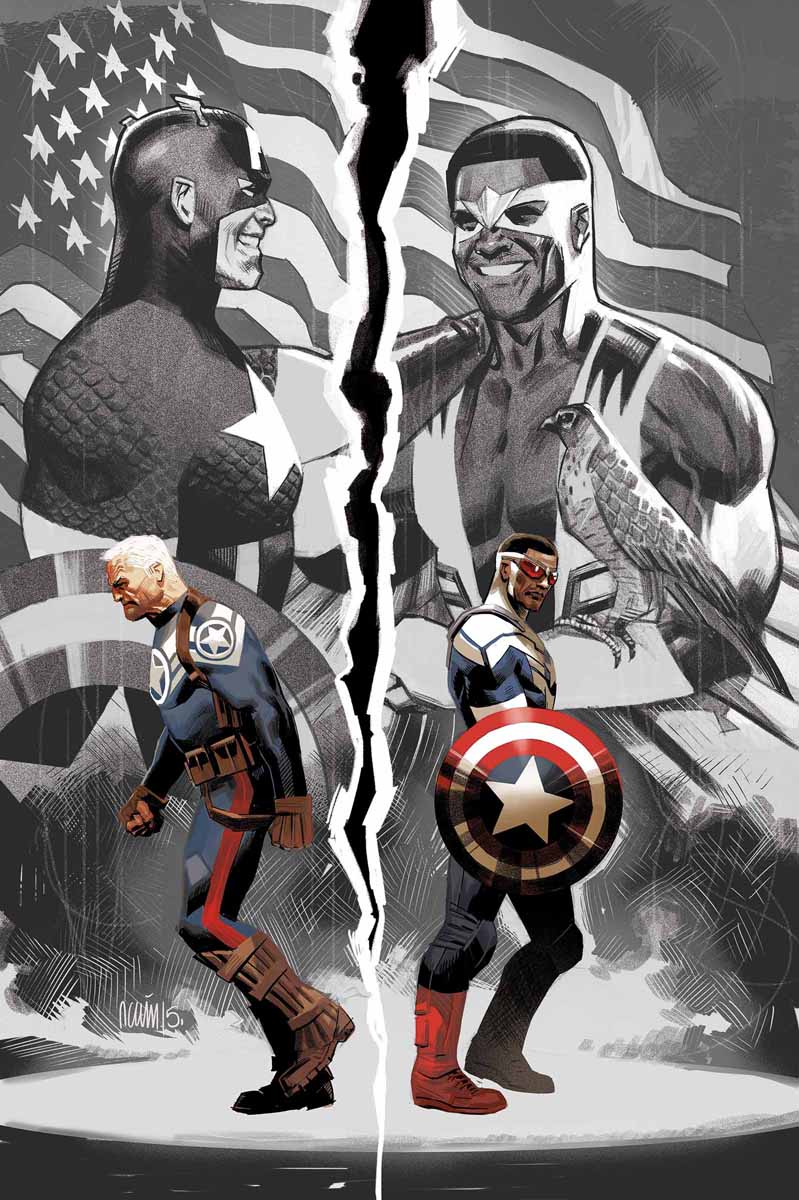
  • Cap 1 2016Like the subject of this post, this old man was nearly off to bed when the news came across the wire that Steve Rogers would once again wield the shield as Captain America following the upcoming "Avengers: Standoff" event. Rogers will star in a new title, Captain America: Steve Rogers, while his successor, Sam Wilson, will continue to serve as Cap and feature in his own title, which launched several months ago. Both titles will be written by Nick Spencer, and Rogers' title will be illustrated by Jesus Saiz, which is encouraging news on both writing and art fronts.

    Naturally, I'm glad to see Classic Cap back in action, and I also like that Sam is continuing in the role—and although I fear it's inevitable, I hope he doesn't become a second-tier Cap and fade from the scene once Steve returns. (More on multiple Caps and other heroes below.) As Spencer says in the news release/interview, he is planning to tell very different stories with each, continuing to address current political controversies with Sam's book and focus on old-fashioned superheroics in Steve's. (I trust this won't be a strict division, and would be disappointed if it were.)

    When asked why this was the right time (in story) for Rogers to come back as Captain America, Spencer answered:

    The country is as divided as it’s ever been, and Steve is one of a kind; he’s a unifying figure, someone we can all look up to, [and] someone we can all put our faith in. It’s no secret the Marvel Universe is about to enter a period of serious conflict with Civil War II looming on the horizon, and as such, it feels like the perfect moment to bring Steve back into fighting shape.

    I always appreciate when creators bring out Rogers' ability to unify people, as I emphasized in The Virtues of Captain America (see also this post at Psychology Today). It will be interesting to see what role Rogers plays in Civil War II, where it seems Iron Man will face off against Captain Marvel, rather than Captain America as he did in the original Civil War. Of course, Cap was anything but a unifying figure in that story, but some time later he did help bring the Marvel heroes together to confront Norman Osborn at the end of his "Dark Reign," restoring the moral center that had been lacking in the Marvel Universe since his "death." (For more on Steve's entire arc during that period, see A Philosopher Reads Marvel Comics' Civil War, on which more here.)

    ~ ~ ~ ~ ~
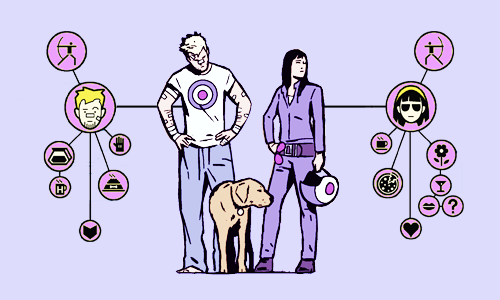
    HawkeyesMore generally, the presence of two Captains America at the same time in the Marvel Universe adds to a growing number of "multiples": two Spider-Men (Peter Parker and Miles Morales), two Hawkeyes (Clint Barton and Kate Bishop), two Human Torches (Jim Hammond and Johnny Storm), and possibly soon two Wasps (Janet van Dyne and the mysterious new character debuting in Marvel's Free Comic Book Day offering), assuming the original sticks around. It is also not unlikely that the Odinson will eventually once again be worthy and serve alongside the current Thor, Jane Foster.

    We in the real world all understand the value of an established name (or "brand"), and we've all heard the difficulties comics companies have creating new characters who catch on. As a result, we get "new" characters with familiar names: Sam as the new Cap, Jane as the new Thor, Kamala Khan as the new Ms. Marvel… only Tony Stark escapes this, perhaps because Tony Stark is as popular, if not more so, than Iron Man himself (thanks to Robert Downey, Jr.). This "recycling" of characters also helps increase diversity and representation, which is difficult to do with more original characters who have trouble catching on with the reading public, and that's a big positive result of the practice.

    All good… until the powers-that-be want to bring the originals back, while retaining the goodwill, publicity, and sales they gained with the new, fresh approaches. So we get two Caps, two Spideys, and so forth.

    The Distinguished Competition has done this at times too, but they handle it in a different way. This was in no small part because there was a longer tradition of legacy characters at DC (at least until the New 52), which usually meant one person adopted the mantle from his or her predecessor rather than operating at the same time, which was more rare: the Flashes Jay Garrick and Barry Allen (or Wally West or Bart Allen), for example, and the thousands of Green Lanterns buzzing around the universe (a handful of them on Earth). And when DC brought a classic version of a hero back, they usually dismissed or diminished the newer version, even after years of building a devoted fanbase—such as when Wally West and Kyle Raynor were shunted to the side when Barry Allen and Hal Jordan were brought back, which upset a great number of readers who had grown up with the younger characters.

    BatmenThe closest DC came to the current Marvel situation, appropriately enough, was during a storyline eerily similar to one at Marvel: Dick Grayson, who won the "Battle for the Cowl" after Bruce Wayne's "death," continued to operate as Gotham City's Batman after Bruce returned and started "Batman Incorporated" to globalize his trademarked brand of crimefighting. (Comics!) Not only did this parallel the situation at the time with Steve Rogers and his former sidekick Bucky Barnes (although they didn't serve as Cap at the same time other than a brief time during the Siege of Asgard, immediately after Rogers came back from the dead), it also closely resembles the current status of the two Spider-Men, with Peter Parker playing global entrepreneur while Miles Morales sticks closer to home.

    There is nothing wrong per se with multiples: it allows various iterations of the general concept of a character, such as Captain America, Spider-Man, and Hawkeye, to play out at the same time, similar to different versions of Superman or Batman in different media. The only difference is that the Marvel multiples operate in the same continuity, the same "earth," even the same city or side-by-side. While this may potentially lead to some confusion among ordinary folk in the Marvel Universe as well as ours, it will be more interesting to see how it plays out in terms of sales, and this is what concerns me.

    The market has supported books with new versions of Cap, Thor, and Ms. Marvel, and it has supported multiple books with one version of a character, like Spider-Man, Superman, and Batman. But will it support multiple books with different versions of the same character, like the two Cap books coming soon? On the bright side, each could capture its own audience, and the fact that both characters are named Captain America will prove trivial. But I can also see the readership wanting to buy just one book with (a) Captain America, not appreciating the different characters and approaches in each, and whichever Cap appeals to them more will get the majority of sales while the other fades and is cancelled. And while the new, fresher, more diverse versions of Cap and Thor have devoted fanbases, I'm guessing the classic versions will get the majority of readers in the end based on mere familiarity if not devotion. (At least readers will have a choice, unlike with Wally West and Kyle Raynor at DC.)

    I wish the very best to the two Captains America and their respective titles; I hope they both find their readership and that they share many of their readers. I know I'll be reading both. But at the same time, I'd rather be reading two books titled Captain America: Sam Wilson and Steve Rogers: Super-Soldier, or The Falcon and Captain America. I have nothing against legacy characters, even I miss seeing my favorite bearer of a particular mantle, but I don't want to see a comics shelf dominated by multiple versions of the same characters. I have to believe that if Marvel and DC put enough creative and marketing effort behind truly new characters, they can break through.

    But maybe that's my foolish idealism. You can blame that on Steve Rogers, one of the people named Captain America.

  • CivilwarUPDATE: See new publication and ordering details—new post coming soon with new cover!

    It's finally here, my long-promised book on Marvel Comics' Civil War storyline and my initial foray into self-publishing with Amazon's Kindle Direct, publishing on February 3 and available now for pre-order: is now being published by Ockham Publishing in print and ebook formats and is available for pre-order on Amazon:

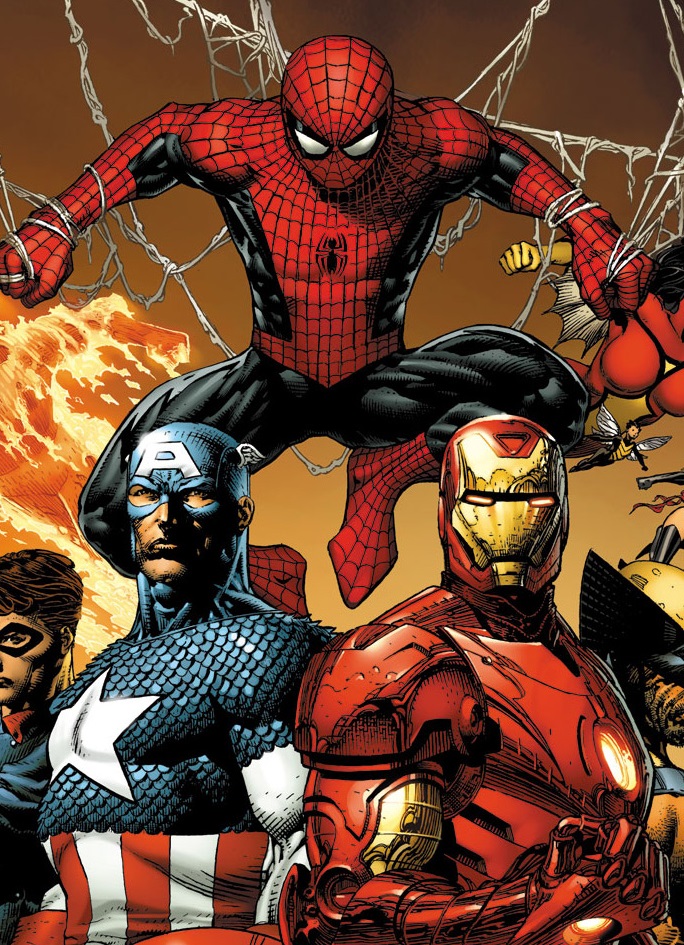
    A Philosopher Reads Marvel Comics' Civil War: Exploring the Moral Judgments of Captain America, Iron Man, and Spider-Man

    From the promotional copy that someone other than me definitely wrote:

    Comic book readers and moviegoers love to see superheroes fight, whether to protect innocent people from supervillains or to save the world from invaders from outer space. But superheroes also fight each other, and if we can look past the energy blasts and earth-shattering punches, we can find serious disagreements over principles and ethics. This was certainly the case when Captain America and Iron Man went head-to-head over liberty and security in Marvel Comics’ epic Civil War storyline, a fictional allegory to post-9/11 America (as well as the basis for the third Captain America film).

    In his latest book, Mark D. White, author of The Virtues of Captain America and editor of Iron Man and Philosophy, carefully leads you through the ethical thinking of the three characters on the front lines of the Civil War:

    Iron Man, who has taken charge of the US government’s efforts to register and train superheroes to enhance safety and security

    Captain America, who leads the resistance against registration in the name of individual liberty and privacy

    Spider-Man, who is torn between his two mentors and has a uniquely personal stake in the battle

    In his characteristically light and humorous tone, White lays out the basic ethical foundations of each hero’s thinking and highlights the moral judgment each must use to put his ethics into action. He also explains how the Civil War affected the three heroes after the battle ended and how the experience continued to test them in very different ways as events in the Marvel Universe continued to unfold. Finally, he uses examples from Civil War to show how conflicting principles such as liberty and security must be balanced in the real world, lest both be lost.

    Written in a style that will be easily accessible to those new to philosophy or superhero comics, A Philosopher Reads Marvel Comics’ Civil War will be a fascinating read for diehard comics fans and philosophy buffs as well.

    Civil war trioAlthough I've wanted to write about Civil War for a long time, and touched on it in The Virtues of Captain America as well as essays for Iron Man and Philosophy and Spider-Man and Philosophy, the late October 2014 announcement of Captain America: Civil War kicked plans for a full-length treatment into gear.

    I originally planned to focus on the larger political issues in the book, but then decided to change the focus to what I really enjoy writing about: the characters themselves. This allowed me to explore the three heroes' different ethical frameworks, the way each used his judgment to put their ethics into action, and how their choices affected them during the Civil War as well as afterwards. Iron Man had the longest arc, which carried him through World War Hulk, the Secret Invasion, Norman Osborn's "Dark Reign," and the Siege of Asgard. Cap's and Spidey's arcs following the Civil War were shorter, for different reasons, but are just as fascinating, with Cap's nicely dovetailing with Iron Man's during the Siege.

    As you might guess from the title—and especially from the banner atop the marvelous cover designed by the incomparable S.L. Johnson, a wonderful collaborator and adviser on this project whose work you can see here—I have a mind to publish more A Philosopher Reads… ebooks on various superhero characters and storylines in the future. (The title was inspired by books like this and is meant to suggest that this is only one philosopher's reading of Civil War, and is in no way definitive, much less comprehensive.) I will continue to publish superhero-related books with traditional publishers when our interests coincide; I'm working on one at the moment and in discussions to do another. But the self-published ebook format allows me the freedom to write on whatever I want, regardless of the availability of "promotional moments" like films or TV series, and at whatever length I choose; A Philosopher Reads Marvel Comics' Civil War is the same length as The Virtues of Captain America, but future ones may be shorter if appropriate. (But my epic treatment of Green Arrow's classic Van Dyke will naturally be a three-volume set.)

    The other person without whom I could never have done this is my intrepid copyeditor Louise Spencely, who also worked on The Virtues of Captain America and Superman and Philosophy. Not only does she find all of my embarrassing typos and unforgivable offenses to grammar, logic, and common sense, she also "gets" my style and voice and helps it come out more clearly. On the top of all this, she was invaluable to helping me format the manuscript for Kindle, not only on technical matters but also finding the most attractive font and layout. (You can learn more about her here.)

    If you liked The Virtues of Captain America or my essays in various books in the Blackwell Philosophy and Pop Culture series, or if you love Civil War and these characters as much as I do, or even if you just like a little philosophy with your superheroes (or vice versa), please check out A Philosopher Reads Marvel Comics' Civil War: Exploring the Moral Judgment of Captain America, Iron Man, and Spider-Man and let me know what you think!

  • BowieWhat a painful thing to write… I've been in tears all morning, but rather than an endless stream of tweets, I'll just pour out my thoughts here.

    I can't remember which Bowie song I first heard. It was probably "Space Oddity," which I loved (who doesn't?), although I likely didn't know who it was. I do distinctly remember seeing the video for "Blue Jean" and thinking how unbelievably cool and suave this man was, and what an incredible yet subtle groove the song had. (Later I would find that same groove in T. Rex, but let's focus here.) I'm sure I saw the videos for "Let's Dance" and "China Girl" on MTV then too. Never Let Me Down was the first Bowie album I bought new when it came out—no one's favorite, I know, but I was so happy to have new Bowie in my hands that I nearly wore it out all the same.

    Older Bowie was difficult to come by when I was a kid, living in a small town and having K-Mart for my main source of music. But one day I found an RCA cassette of The Rise and Fall of Ziggy Stardust and the Spiders from Mars, and as they say, that was that. Still an unsurpassed melding of rock, folk, and soul, filtered through Bowie's distinct Britishness into something unique and ethereal, Ziggy is one of a handful of perfect albums. There were many Bowies, musically as well as visually, and I loved all of them, but this was (essentially) my first and will always be my favorite.

    As I got older (think high school), I found "real" record stores in nearby towns and bought up cassettes of the other early albums when Rykodisc (finally!) reissued them. Hunky Dory become my favorite, with Space Oddity a close favorite. How could he write such complex music, such odd chord changes, that sounded so different from everything else I'd heard, yet sounded so natural and "right"? (Later I would find the same quality in Mingus and Monk, but to do the same thing in rock? Astounding.) And to write such strange, emotional, thought-provoking lyrics, and sing them in THAT VOICE, that voice that could take on as many characters as he could visually. This man—how could he be real?

    But he was real. And he was so many people, whoever he wanted to be at any given time. He created David Bowie anew with every new album, yet it was always the same man. He was nonconformity embodied, rebellion personified, giving a huge f**k you to society's customs and mores—but with class. Always with class.

    To a young weirdo who never fit in, Bowie said to me, "who cares?" He said, "be who you want to be." He was my existentialist teacher years before I knew what existentialism was. He taught me that the only thing that was weird was worrying about being weird. Once you get over that, you're free to recreate yourself as the person you want to be, a process that never stops.

    Until it does.

    Rest in peace, sir.

  • Civil war ii coverThese days, comics companies love to leak big story details to the press, usually the day the comics hit the stands shops, and sometimes even the day before.

    But today, Marvel Comics went several steps farther. In a piece in the New York Daily News written by a reporter "embedded" in an editorial retreat, not only did Marvel reveal that they will kill a major character in the Civil War II storyline coming this spring, but they also pulled the curtain back on the planning behind it, and in doing so, they showed an alarming amount of disregard for fans who are vested in these characters and this universe ("all-new and all-different" as it is)

    The concept behind Civil War II is actually a very good one and seems like a worthy successor to the original Civil War (which I love and have written about quite a bit). As the article reveals:

    “A mysterious new Marvel character comes to the attention of the world, one who has the power to calculate the outcome of future events with a high degree of accuracy,” according to the synopsis. “This predictive power divides the Marvel heroes on how best to capitalize on this aggregated information, with Captain Marvel leading the charge to profile future crimes and attacks before they occur, and Iron Man adopting the position that the punishment cannot come before the crime.”

    That's a fantastic premise and, like the original Civil War, a very timely one. (Most importantly, I could write a lot about it!) It's interesting to ponder how they'll get futurist Tony Stark to reject a technocratic method of crimefighting, but that's what complex characters are for.

    More specifically:

    As the story unfolds this new seer predicts the hero in question will be the cause of a major incident of destruction in three days, requiring the other good guys to make a tough call. The writer just hasn’t figured what or how bad that cataclysm will be.

    The article goes on to describe the process behind deciding which hero will cause the destruction and which will take that hero's life for it. After both Spider-Man and the Human Torch were proposed to be the inciting factor, Marvel editor-in-chief Axel Alonso and Civil War II writer Brian Michael Bendis found the perfect candidate. As the article says:

    After hours of occasionally heated debate, Bendis and Alonso reveal they had a eureka moment during a 10-minute break and came up with the perfect superhero to sacrifice and an even better candidate to murder him. The answer actually gets a loud ovation from the crowd.

    "A loud ovation." I'll just leave that there.

    In terms of the process itself, none of this comes as a surprise to anyone who reads not only modern superhero comics but also the massive amount of news and leaks in the comics press (enough to choke Galactus after a cleanse). But it is unbelievable that Marvel Comics would be so brazen about revealing that this is how they make decisions, and with what glee they agree to kill a major character.

    What sort of message was Marvel hoping to send with this article? "Look how cool we are, no one is safe, we can kill anybody anytime?" This isn't Game of Thrones, where most characters seem to have invented simply to die on another character's sword. If we're to take "major character" literally, then this will be a character that many fans around the world are vested in. That fans cosplay. That kids roleplay with action figures, video games, or such a towel tied around their necks. And that people like me write books about, mainly to inspire other people to read the comics and learn moral lessons from them.

    (If anyone wonders why I write about superheroes themselves and their adventures, rather than the people who create the characters and the stories, as many traditional comics scholars do, this is one reason.)

    Listen, I'm not naive. I've been reading comics a long time, and as I said before I'm glued to the comics news sites. By now I have a pretty good idea how these decisions are made. But to see one of the Big Two comics companies announce in a major newspaper to a wide readership how they make a decision to kill a major character, essentially bragging about how they do it… it's disturbing, to say the least.

    I don't even have that much of a problem with how the decision itself was made, or why. Such a major death will certainly motivate the story, and they seem to have gone to some lengths to find a character whose death would fit the story. (Compare to Dan Didio's plans to kill Nightwing in DC Comics' Infinite Crisis… just because.) I would have liked a less obvious motivation, but these days, it's par for the course. (More on that later.)

    But why would they reveal their thinking months before the storyline even starts? Duh, to get clicks and eyes, of course, but it seems like overkill: too much and too early. More generally, though, why would they let everyone know that they made the decision this way instead of maintaining the fiction that "the story dictates that this was the character who had to die"? The truth often comes out after a storyline is completed, and they make great little tidbits of trivia for diehard fans, like a "making of" featurette on a DVD. At that point, the story has had whatever impact it will have, and behind-the-scenes features are a nice little bonus for the fans without affecting how they read the story the first time. But to give these details out months before the story starts weakens any legitimate emotional weight the story might have had. Maybe it's just me, but I want to enjoy the story as a story before I know how and why it was made the way it was.

    And this doesn't even touch on the question of whether using character deaths as a promotional selling point for comics is in good taste given recent events in the real world. That barn door has been open for a long time, but it would be nice if someone actually tried to close it. There are many brilliant creators in comics today, and don't tell me they can't find another way to motivate a story other than death.

    Representatives of both the Big Two comics companies like to say how superheroes comprise our modern mythology. However, that also makes the Big Two the stewards of that mythology and the characters that ground it, and stewardship implies responsibility. Create characters, change characters, kill characters… they're all fine if done well, but please do so with a little more respect for those who want to revel in the mythology. Let us enjoy the show without telling us ahead of time where the strings are.

  • Another ASSA conference come and gone, this one in San Francisco. Very busy but the most enjoyable ASSA meeting I can remember. Why? Let's see.

    It certainly wasn't due to travel: even though I was on direct flight, flying between Newark to San Francisco is never fun, and I'm sorry, San Francisco, but BART makes the NYC subways look like the pristine subways of Oslo. At least the flight back was marginally better than the one there, as I was lucky—thanks to a very kind United gate attendant—to get on an earlier flight that not only got me home before midnight but also landed me an "economy plus" seat with a little more legroom.

    San fran hotel roomMy hotel (which also hosted the Association for Social Economics sessions) was wonderful, featuring a magnificent snack bar/coffee shop in the lobby with fine coffee (Peet's) and good hot sandwiches—and they opened at 5:30 AM. (That was the best part.) And somehow I was assigned to a corner hotel room with windows on two sides, which allowed amazing light in when the weather gods deemed it appropriate. (I showed the picture at the right to friends from NYC and they said they'd kill for an apartment like that.)

    SATURDAY JANUARY 2

    I flew in a day early (on New Year's Day) so I could adjust to the time difference before the first full day, which began with a lunch meeting with my editors from Palgrave, during which we discussed future books from me as well as for the "Perspectives from Social Economics" series. (I'm very happy to say that three new books were found or planned for the series during this conference.)  In the afternoon I met for coffee with an economist I knew only from Twitter, and in the early evening the conference proper began with the ASE opening plenary, which is always a chance to hear a great speaker—this year, Jan Kregel from the Levy Economics Institute—and reconnect with old friends. After that, I had dinner with another old friend, which was a very nice way to end the first, and least hectic, day of the weekend.

    SUNDAY JANUARY 3

    I spent the morning preparing for my presentation in the 10:15 ASE session on "Great Thinkers on Ethics, Economics, and Financial Markets," where I discussed Kant among longtime friends and colleagues who between them covered Aristotle, Smith, Mill, Keynes, and more. My talk seemed to go over fairly well and the session was very well attended (as were most of the ASE sessions this year, a credit to the program chair and incoming ASE president Giuseppe Fontana). Next I visited the book exhibits, where I caught up with editors from Cambridge, Oxford, and Palgrave (again) to discuss ongoing or potential projects. (My new OUP book, Economics and the Virtues: Building a New Moral Foundation, co-edited with Jennifer A. Baker, just missed being ready for the book display, but it was in the new catalog.)

    HammettOn the way there I happened to see the awning for John's Grill, which reads in very tiny letters at the bottom, "Home of 'The Maltese Falcon'" and "Headquarters of the Dashiell Hammett Society." I stopped in on the way back, and found out that it's where Hammett wrote the book (he worked in the building next door). Amazing.

    I returned to the ASE hotel to catch the end of a standing-room-only session on inequality before the general membership meeting, after which I had drinks with some friends from ASE before heading to the dinner for journal editors hosted by Taylor & Francis, where the ASE contingent mingled with other journals editors and the T&F staff, which is always a fantastic time (and the food was unbelievable).

    MONDAY JANUARY 4

    The last full day of the conference began with the ASE presidential breakfast, which featured a tremendous talk from outgoing president Ellen Mutari, and at which I was honored to present two ASE awards to two longtime friends, Deb Figart and Morris Altman, both of whom were incredibly welcoming and supportive to a particular newbie many years ago. Throughout the rest of the day I alternated between ASE sessions and journal editorial board meetings, after which I joined a few ASE friends for drinks and then dinner at a nearby pub.

    TUESDAY JANUARY 5

    After packing, I met my intrepid Stanford University Press editor for our traditional ASSA breakfast, this time at Brenda's, billed as French soul food, where I indulged in assorted beignets and a sausage-and-Swiss omelet with sausage hash and (of course) sourdough toast. I could not finish it, which is astonishing (given how much I love breakfast) and is my greatest regret from this trip! We talked about book projects and publishing industry scuttlebutt and had a fabulous time as usual.

    Back at the book exhibit I met up with another longtime friend in publishing (an editor I have yet to write for), after which I jumped in a cab and headed back to SFO early in hopes of getting an earlier flight, which as you know I did.

    OVERALL

    RasputinsAt the end of December I was completely exhausted, physically and emotionally, and seriously considered withdrawing from this meeting altogether. As you can guess, I'm glad I didn't. Not only was it a great meeting intellectually and professionally, but it was also a wonderful time socially—and for a classic introvert who dreads walking into the jam-packed hotel on the first day, and for an academic who has never felt like one, it was a surprise that I felt very much in my element throughout the three-and-a-half days. Most of that, no doubt, is due to belonging to a great group like the ASE, full of amazing scholars as well as great people and good friends. (Of course, spending some time in Rasputin Music, one of the last of the "real" independent record stores and one with a dedicated and well-stocked metal section, didn't hurt either!) Let's just hope that, come next December, I remember how much I enjoyed this ASSA when I fret and dither about attending. (Wishful thinking indeed!)

  • 2015 in reviewI started doing end-of-the-year wrap-up last year: as I said then, it's

    a nice exercise to remind me of what I accomplished over this year. (Reminding yourself of accomplishments is often recommended for people who only seem to remember what they didn't do.)

    That certainly still applies, so here we go, summarizing my writing and speaking activities over the year, as well as some other pursuits I enjoyed and personal thoughts regarding the future.

    BOOKS

    I had one book out early this year, the edited collection Law and Social Economics: Essays in Ethical Values for Theory, Practice, and Policy from Palgrave Macmillan, and completed three more that will be out next year: Economics and the Virtues: Building a New Moral Foundation, co-edited with Jennifer A. Baker for Oxford University Press; Social Economics (Critical Concepts in Economics), a four-volume collection of social economics literature co-edited with Wilfred Dolfsma, Deborah Figart, Robert McMaster, and Ellen Mutari for Routledge (I was responsible for editing the volume on philosophy); and a sole-authored (and as-yet-untitled) book on Marvel Comics' Civil War that I will self-publish on Amazon in the spring (after a disagreement with the original publisher that originally contracted it).

    I also worked on the edited book The Insanity Defense: Multidisciplinary Views on Its History, Trends, and Controversies, scheduled to come out late next year from Praeger, and I have a proposal for another edited book that will be presented to the publishers' delegates in January. Finally, I did a lot of background reading for the book on superheroes and philosophy I'll be writing in the spring, and I still have plans for books on individualism, moral judgment, and law-and-economics, one of which I hope to start later next year.

    ARTICLES AND CHAPTERS

    In terms of shorter pieces, I wrote seven new ones (and successfully revised three written last year):

    • An article on externalities (revised and published in Oeconomia)
    • A chapter on nudges in health care (revised and forthcoming in a John Hopkins University Press volume)
    • An article on the ethics of antitrust law (revised and forthcoming in Antitrust Bulletin along with a reply to critics)
    1. My presidential address to the Association for Social Economics (ASE) on judgment (published in Review of Social Economy)
    2. A chapter on the crucial importance of interests in libertarian paternalism (forthcoming in a Springer volume)
    3. A chapter on the basic arguments against nudges (forthcoming in a Palgrave volume)
    4. A chapter on Kant, virtue, and economics (forthcoming in Economics and the Virtues)
    5. An article on Beccaria for a law-and-economics journal (under review)
    6. A chapter on happiness policy for a positive psychology handbook (under review)
    7. An article on merit goods and nudges (under review)

    I also started writing a paper for the Mercatus Center on patient autonomy and a chapter on the ethics and economics of work. Looking ahead to 2016, I've agreed to write three pieces on various aspects of behavioral economics and nudge; other than that, I plan to focus on books (about which more below).

    PRESENTATIONS/LECTURES

    This year it seems I gave a smaller number but wider variety of talks:

    • Two presentations at the ASSA meetings in January: one on inequality at a session of the International Network for Economic Method and my presidential address for the ASE (available on YouTube on the new ASE channel).
    • A similar presentation on inequality for the Young Scholars Initiative at the Institute for New Economic Thinking in February.
    • A presentation on the role of interests in nudges, given at a conference on nudges in Lucerne, Switzerland, in April.
    • A presentation on the ethics and economics of work at a conference in San Diego in May.
    • Finally, a pubic lecture on superheroes and philosophy at York College of Pennsylvania in October (described in an earlier post).

    BLOGGING

    I blogged even less this year than the last: an even dozen posts at Psychology Today and a handful at Economics and Ethics and The Comics Professor, as well as here (on "Why I Edit Books"). Notably, Jennifer Baker and I had a blog post at OUPblog, discussing the movie "The Big Short" in relation to virtue (and our co-edited book), and I was honored to contribute a guest post to the Cultural Gutter about my year reading the Fantastic Four. I always mean to blog more—who doesn't?—but working on books and paper has always seemed more important, and leaves less time for blog posts. (And I'm not totally convinced that's a bad thing.) When I am moved to blog, it's usually about some issue related to work, writing, or life, and seems too self-indulgent; see below on how I'm thinking of dealing with that.

    ON A MORE PERSONAL NOTE

    In 2015 I watched a lot of classic films (mostly from the 30s and 40s) and fell in love with Barbara Stanwyck as well as the films of Frank Capra. (Can you imagine if Capra had directed a Captain America film? Of course, you could argue that he directed several about Steve Rogers.) I also caught up with more shows on Netflix that I missed the first time around, like How I Met Your Mother and One Tree Hill. In terms of music, I enjoyed many fantastic new albums in metal and jazz; reveled in Bing, Louis, and Judy as much as ever; and discovered some second-tier Southern rock bands I had missed, such as the Outlaws and the Marshall Tucker Band (the latter due, of all things, to the prominent placement of "Can't You See" in the One Hill Tree season 6 finale). As always, I would love to write about music, the true center of my life, but I find it very difficult, so I just listen, explore, and listen some more.

    Comics marched on, with the bright lights showing themselves mainly in Marvel Comics' more lighthearted titles, such as Howard the Duck, The Astonishing Ant-Man, Ms. Marvel, and Spider-Woman, and also in a welcome revival of several of the solo Avengers books, such as Captain America: Sam Wilson, The Invincible Iron Man, and The Mighty Thor (although the Avengers books themselves are largely disappointing). On the DC Comics side, the weekly Batman and Robin Eternal was a surprising pleasure, introducing a much-beloved character from the pre-Flashpoint days into the New 52 in a way fairly consistent with earlier characterization. Overall, however, I am growing more disenchanted with newer superhero comics, and spending more time reading and rereading the classics from the 60s, 70s, and 80s, whether for a book project or simply for fun. (Someday I'll try to expand on this at The Comics Professor.)

    LOOKING FORWARD

    In the next year I plan to do just as much writing, but in a different way. As I mentioned above, as far as scholarly writing in concerned I want to focus even more on books than articles and chapters. Looking back on 2015, though, working on the Civil War book was easily the highlight in terms of writing; and following the ordeal with the original publisher, I've enjoyed working with my copyeditor and cover artist to get it ready for self-publication on Amazon's Kindle Direct Program in the spring. After I finish my next superhero-and-philosophy book for Wiley Blackwell, I'm going to consider writing more on comics for self-publication, where I will have more freedom to write on the characters and stories I want to without being concerned with which books a commercial press (with understandable commercial pressures) will be willing to publish. I will always work with traditional publishers to publish some of my superhero work, but having both avenues to travel down will allow to explore book projects focused on characters who might not have the larger exposure in the popular media (as well as those that did but had lousy movies made based on them).

    I also want to move into fiction—or, I should say, back into it. My father regularly asks me when I'll write fiction again, because he was the biggest fan of the stories and short books I wrote in junior high and high school. I've long wanted to write fiction again, albeit much more personal and emotional stories than the science fiction adventure I wrote when I was younger. (Ha, I said "younger.") In particular, the ideas I'm tempted to discuss on my Psychology Today blog these days are too personal, and the resulting blog posts would be so self-indulgent, that I think fiction is the best outlet for them.

    Why haven't I started writing fiction yet? Fear of failure, of course. I know I'm a decent scholarly and popular philosophy writer, but I don't know if I'm a decent fiction writer, so it's easier to keep writing what I've proven to be decent at than take a risk on something that I haven't. Of course, the rational side of me knows that whether I succeed or fail isn't the most important thing; the intrinsic rewards of writing what I want to write, and expressing the ideas and feelings I can't express otherwise, are much more important. As with so many things, however, knowing something and feeling it are two very different things, and continuing to focus on what you know you're decent at is a very comfortable thing to do.

    Nonetheless, in 2016 I hope to move forward with writing fiction, even if it means scaling back on my nonfiction writing—as well as on my addiction to email and Twitter, which may be more difficult! (And don't get me started on making music too… one creative leap of faith at a time, please.) Hopefully, this time next year, I'll be able to write a year-end update more like this one from Jim C. Hines, a fantastic writer (and all-around swell guy) I follow on Twitter, who maintains a pace throughout the entire year that I managed to keep up only for two months while writing the Civil War book. Maybe then, I'll feel comfortable calling myself a writer, but regardless, I think I'll enjoy my time more that way.

    And 44 years into this life, that sounds like a nice thing to do.

  • Cap sam 2I clearly remember seeing the internet headlines on a Wednesday morning several weeks ago when the first issue of Nick Spencer and Daniel Acuña's Captain America: Sam Wilson was published, screaming about "Captain Socialism," which were joined later that day (naturally) by Fox News. The irony, of course, was that the alarm was completely unfounded, that all Sam Wilson said in the comics was that he planned to get more involved in politics than his predecessor Steve Rogers did (with all details given off-panel), and it was the press and the American public in the comic book that overreacted by accusing Sam of being anti-American, socialist, traitorous, etc. Were Spencer and Acuña engaging in a bit of playful trolling based on a too easily predictable real-world media reaction which they actually predicted in the same comic? (I hope so.)

    Beneath the hype and hysteria, though, it remains that Sam Wilson is a different Captain America, forging a new path that diverges in some important ways from the one tread for decades by Steve Rogers. And even more impressive, Spencer and Acuña have achieved this distinction while staying true to Rogers' well-established characterization. (This contrasts with comments made by a previous creative team who, in the process of explaining the difference between Sam and Steve, oversimplified Steve's views to obscure the fact that Sam was going to be little more than a carbon-copy Cap with wings and a bird.)

    Along the way to pointing out Sam and Steve's subtle differences, Spencer and Acuña also toy a bit with the segment of modern comics readership who like to jump to conclusions based on a handful of preview pages and solicitation text and fueled by internet speculation (and, in no small part, the marketing efforts of the comics publishers). Our creative team does so not only with Sam's internal dialogue but also in his exchanges with the dudebros seated on either side of him on an airplane, who take everything they read on Twitter to be the whole story and refuse to listen to Sam's mroe elaborate explanations. As Sam thinks to himself, "it's a complicated, messy story"—and Spencer and Acuña do a masterful job of peeling back the layers to this story (with many more still to be revealed, I'm sure).

    The complicated and messy part I was most pleased to see dealt with the difference in Sam and Steve's moral perspectives, a difference which is nowhere near as simple or stark as the final scene of the first issue (or the cover of the second one) would have us believe.

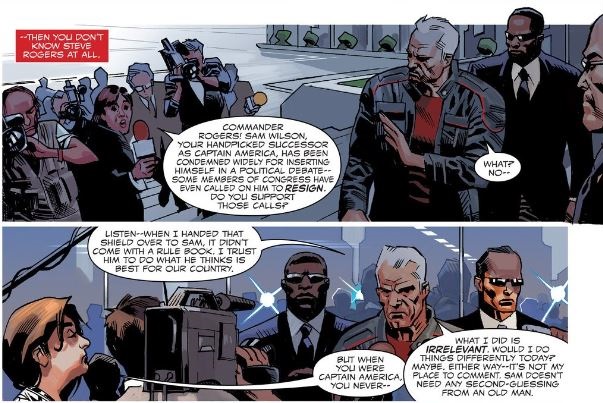
    Two scenes in Captain America: Sam Wilson #2 show this very well:

    1. In these panels, a reporter asks Steve what he thinks about Sam's new political stance:

    Cap-sam 2a

    He simply nails it: Sam is his own Captain America and he can choose how to play that role, whether or not it's how Steve played it in his heyday or how he would play it now. Steve also struggled with the call to political activism in the past, such as when he wanted to support Andrew Bolt's congressional campaign (early in Mark Waid's Heroes Return run). His solution was to remain neutral as Captain America but work for the campaign as Steve Rogers (regardless of whether people knew they were one and the same—recall that he also made a big fuss about surrendering at the end of the Civil War as Steve Rogers, not Cap). Would Sam make that same decision? Perhaps not, but Sam is not Steve, and it was great to see Steve acknowledge that for the press (in the Marvel Universe as well as ours).

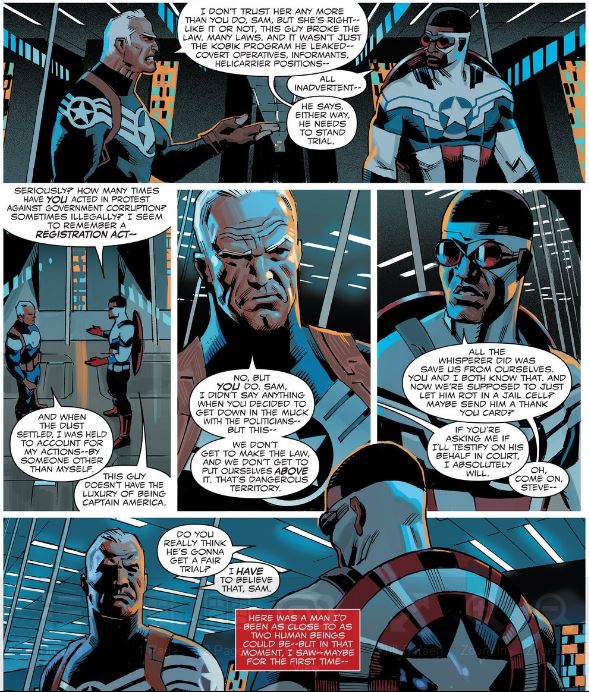
    2. After SHIELD catches a man who released secret files describing a proposal to use Cosmic Cube fragments to make subtle changes to reality, Maria Hill makes clear she relishes the thought of submitting him to military tribunal. While Sam and Steve both oppose this project and personally make sure SHIELD scraps any plans to pursue it, they disagree on what should be done with the whistleblower (let's call him "Snedward Owden"), with Sam much more concerned about Hill's plans than Steve is.

    Cap-sam 2b

    Here we see Steve and Sam differ in terms of their confidence that the whistleblower will receive fair treatment and impartial justice at the hands of SHIELD and/or the military, and also their roles regarding the law (on which more below). Sam describes their essential difference of opinion the following page, an important yet nuanced disagreement that feels natural within the context of the two characters' backgrounds and which could lead to some fascinating character beats in future issues:

    Cap-sam 2c

    I could quibble a bit with Steve's statement above that "we don't get to put ourselves above" the law, especially after admitting his past civil disobedience to Sam (and emphasizing his willingness to be held accountable for it). Perhaps this is a result of Steve's official SHIELD role as chief of civilian oversight, just as his appointment as head of global security following the Siege of Asgard made him more assertive regarding Tony's exclusive use of the Iron Man armor (as seen in the first issue of Avengers Prime). Or maybe he feels it's his responsibility as chief of civilian oversight to monitor the tribunal, requiring a certain degree of faith in a process he'll be involved in. After all, unlike the registration act (and earlier government policies he regarded as unjust), he does not see any problem with military tribunals per se that warrants disobedience—especially if he's on the scene. Even if this does signal a shift in Steve's views, it is not a shocking or abrupt one. (This, of course, assumes that this is the same Steve Rogers we know from the 616 Marvel Universe, and not some New 52-style slight-of-hand where, post-Secret Wars, he's "basically the same character but different—just keep reading!" That remains to be seen.)

    Only two issues into their run, Spencer and Acuña have fulfilled the hopes I had for Sam Wilson as Captain America since his "appointment" was announced. They've begun to give Sam a unique perspective on serving as Captain America that represents an interesting alternative view on the role that offers endless story possibilities, without watering down or stretching the concept of Cap itself beyond recognition. As well as further discussion with Steve, I hope we get to see some of Sam's internal struggles with his new stance, in which he questions how far Captain America can and should go in support of a particular position. This is not to say he shouldn't be more political than Steve was, but I would like to see him acknowledge and confront the fact that it is a different role for Captain America (rather than simply defending it to others).

    Personally, this is the most excited I'm been about the Captain America title since Steve took up the shield after Bucky "died" during Fear Itself. (It's worth mentioning at this point that young James was a different sort of Cap too.) While a part of me longs to see Steve "enyouthened" and back in the star-and-stripes at some point, the rest of me looks forward to a long, insightful, and enjoyable run of Captain America: Sam Wilson from Spencer and Acuña.

    —–

    If you're interested, I discuss judgment and compromise, principle versus politics, and civil disobedience in chapters 5 and 6 of The Virtues of Captain America: Modern-Day Lessons on Character from a World War II Superhero.

  • It's been a bit of an uneasy several months since my last update at the end of July. In the grand scheme of things, everything's fine—no one who I know died, lost their job, or decided to run for president—but for someone like me who tries to maintain a calm and smooth existence, it's been an unsettling time.

    August was a month spent bouncing back from finishing my book on Marvel Comics' Civil War (on which much more later), but I did manage to write one article (on Cesare Beccaria and law-and-economics) and revise another (on externalities). I had larger plans for August which I was lucky to be able to push back; naturally, I underestimated the stress of writing the Civil War book on such a tight schedule, and I'm beginning to see the benefits of taking breaks (which I'm seriously considering next summer).

    As it turned out, September began with an unexpected course to teach, so writing plans for the fall had to be revised as well (beyond what I had managed to reschedule in August). Add to that the normal personnel matters facing department chairs, a minor car accident (no one hurt, everything handled smoothly, but still disruptive), and a surprise root canal (requiring five dental visits), and the fall has not been as productive writing-wise so far as I had hoped.

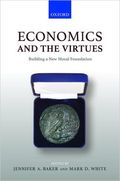
    E&V coverNonetheless, I managed to write and revise a book chapter on happiness policy (thanks to extraordinarily timely feedback from the editors), make further revisions to the article on externalities (which was then accepted), and, with my co-editor Jennifer Baker, correct the proofs and construct an index for Economics and the Virtues: Building a New Moral Foundation, which is due to be published by the end of the year in the UK (to be available at the ASSA and APA Eastern meetings in early January) and two months later in the US.

    I also wrote three new Psychology Today posts in September:

    As for the Civil War book… sigh. To make a long story short, Sterling and I had significant differences of opinion which led to a parting of ways. (Let's just leave it at that.) After lengthy but unsuccessful discussions with several other presses, and with very little time (in publishing terms) before the release of Captain America: Civil War, I have decided to publish the book myself, most likely through Amazon's Kindle Direct. I have already secured the services of an expert copyeditor with whom I have worked before, and am now trying to find an artist I can commission to produce a marvelous (with a small "m") cover. (In the meantime, be sure to check out Kevin Scott's edited book Marvel Comics' Civil War and the Age of Terror: Critical Essays on the Comic Saga, which includes a chapter by me which previews my own book.)

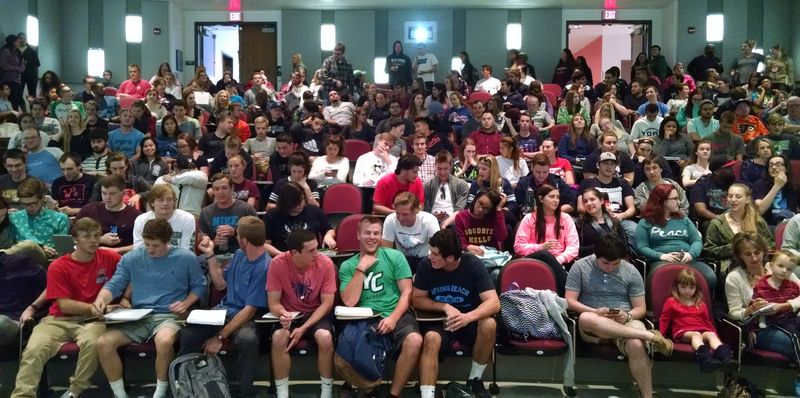
    York displayIn much better news, I was invited by Professor Dianne Creagh at York College of Pennsylvania to deliver their inaugural lecture for the First-Year Experience last Wednesday. (Here's some local press on the event.) It was a tremendously wonderful experience: Creagh and everyone else at York were very welcoming and gracious, and the 200+ students and faculty that filled the lecture hall (standing-room only, as you can see in the picture below) were a great audience as I discussed examples of ethical problems faced by superheroes that also apply to our own lives.

    York room


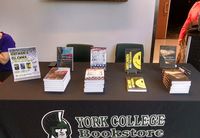
    York signingStudents lined up after the presentation to talk about comics, movies, and philosophy—and also get books signed (some with more than one!) at the table that York's bookstore set up outside the hall (there was also a terrific display of my books in the bookstore itself). The picture to the right was taken before the talk, at which point they were already almost sold out of Watchmen and Philosophy.

    I really can't say enough about how the entire campus came out in support of my visit and how appreciative everyone was. It was easily the most enjoyable "work" experience I can remember having, and several people (including Creagh) suggested I do more talks of this sort, which I am seriously considering.

    Meanwhile, work continues on several articles, book chapters, conference papers, and edited books, as well as preparing to write another book on superheroes and philosophy in the spring. Happily, the semester looks to lighten up in early November, and spring semester is always easier in terms of teaching and administration. (On second thought, maybe I shouldn't say that, ha.)

    Here's to a smoother remainder of the semester and the year for everyone!